











 Secure payments
Standard refund policy
Trade Assurance
Secure payments
Standard refund policy
Trade Assurance
| Product Type | Memory Module |
|---|---|
| Memory Capacity | 128 GB |
| Memory Technology | DDR4 |
| Product Voltage | 1.2 V |
| RAM Speed | 3200 MHz |
| RAM Standard | DDR4-3200/PC4-25600 |
| Error Identifying | ECC |
| Signal Type | Registered |
| Column Access Strobe (CAS) | CL22 |
| Rank | Dual Rank x4 |
| Quantity of Pins | 288-pin |
| RAM Genre | RDIMM |
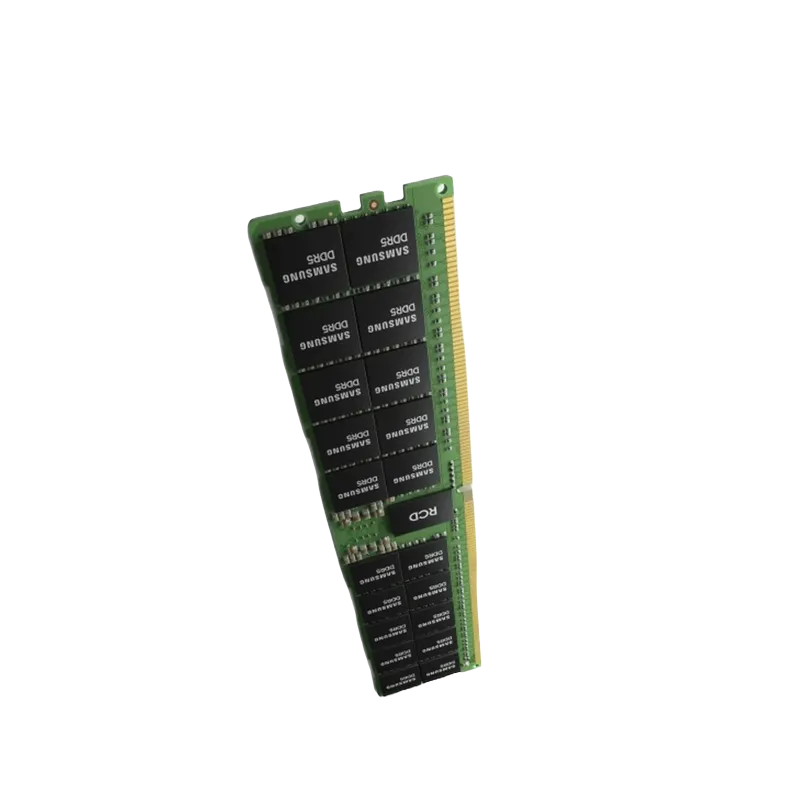
This 128GB DDR4-3200 RDIMM with Registered ECC is purpose-built for enterprise server platforms running virtualization, in-memory databases, and other data-critical workloads that demand uncompromising data integrity. Its dual-rank x4 organization maximizes bank-level parallelism for superior bandwidth under heavy multi-DIMM loads, while the CL22 latency and registered signaling ensure rock-solid stability in dense, high-capacity configurations.
1. ECC protection automatically detects and corrects single-bit memory errors, safeguarding transactional databases and financial records from silent data corruption that could otherwise cascade into costly outages.
2. Registered signal architecture allows the memory controller to drive higher-capacity modules stably across multiple DIMMs per channel, which directly translates to larger memory pools for server virtualization without compromising signal integrity.
3. Dual Rank x4 organization keeps all memory channels fully saturated by leveraging parallel access across ranks, accelerating in-memory analytics and real-time query performance in consolidated cloud environments.
4. High-capacity module density maximizes the memory footprint per server node, enabling dramatically higher virtual machine consolidation ratios and supporting memory-hungry enterprise applications like SAP HANA.
5. DDR4 bandwidth class delivers the sustained throughput required for heavy concurrent workloads, ensuring responsive data delivery to CPUs even during peak traffic in multi-tenant hosting scenarios.
Based on its registered architecture, ECC support, and 288-pin RDIMM form factor, the M386AAG40BM3-CWELY is unmistakably server-grade memory, engineered for mission-critical enterprise environments where downtime is not an option. Its four defining characteristics directly address the real-world pain points of data center operators. The 128 GB capacity and registered signal buffering work in concert to let you pack more virtual machines onto a single host without signal degradation, eliminating memory errors that cause cascading VM failures in dense virtualization clusters. In memory-intensive databases like SAP HANA or large Redis instances, ECC becomes non-negotiable: a single bit flip in financial transaction data can corrupt records silently, but this module catches and corrects those errors in real time, preserving data integrity you can audit with confidence. Meanwhile, the dual-rank x4 organization interleaves memory banks to sustain higher bandwidth under concurrent read/write loads, so your real-time analytics queries return results faster even as user counts spike. That 3200 MT/s speed and CL22 latency deliver the predictable, low-jitter response that transactional databases demand, preventing sluggish performance during peak trading hours. Together, these features transform raw specifications into reliability, density, and speed that keep your services running and your customers satisfied.
General Virtualization
For consolidation of multiple VMs, prioritize total capacity and stability. Populate one 128GB Registered ECC DIMM per memory channel (1DPC) to maintain full 3200 MT/s speed while delivering ample headroom. In a typical dual-socket server with 8 channels per CPU, 8 modules provide 1TB, enabling dense, balanced resource allocation without performance degradation.
In-Memory Database
In-memory databases like SAP HANA demand maximum capacity and uncompromising data integrity. Deploy the 128GB RDIMMs across all memory channels symmetrically—12 or 16 modules yield 1.5–2TB per node—to ensure low latency and identical access patterns between CPUs. ECC protection is essential here, correcting single-bit errors that could otherwise corrupt transactional data.
High-Performance Computing
HPC applications thrive on memory bandwidth. Start with one 128GB module per channel (1DPC) to sustain DDR4-3200 speeds and maximize throughput per core. If capacity-bound, move to 2DPC cautiously, as the memory controller may downclock to 2933 MT/s. Scale identically configured nodes using these high-density RDIMMs to maintain uniform performance and simplify capacity forecasting across the cluster.
Rigorously tested, compatible with Dell PowerEdge R750, HPE ProLiant DL380 Gen10, Lenovo ThinkSystem SR650 V2, and similar servers.
Q: Can I mix this M386AAG40BM3-CWELY with other memory modules of different brands or speeds?
A: Mixing modules is not recommended for server environments. Different brands or speeds may cause instability, reduced ECC effectiveness, or failure to boot. Always populate with identical Samsung 128GB DDR4-3200 RDIMMs for validated reliability.
Q: Is this memory compatible with my Intel Xeon or AMD EPYC server platform?
A: This 128GB DDR4-3200 ECC Registered RDIMM is compatible with Intel Xeon Scalable (2nd/3rd Gen) and AMD EPYC 7002/7003 series platforms that support 288-pin DDR4 RDIMMs at 1.2V. Verify your motherboard's QVL for specific support.
Q: What is the recommended DIMM population order for optimal performance?
A: For dual-processor servers, populate identical DIMMs symmetrically per CPU, filling all channels equally. Start with slots farthest from the CPU and follow your system manual. This Dual Rank x4 RDIMM works best with balanced population across memory channels.
Q: Does this module support overclocking or XMP profiles?
A: No. This is a JEDEC-compliant server DIMM operating at standard DDR4-3200 (PC4-25600) with CL22 latency. ECC Registered memory prioritizes data integrity over overclocking, so XMP profiles are not supported.
Q: What warranty and typical failure rate can I expect?
A: This Samsung module carries a one-year warranty. Enterprise-grade DDR4 RDIMMs feature very low failure rates, typically with an AFR below 0.1% under proper operating conditions, ensuring high reliability for mission-critical workloads.