











 Secure payments
Standard refund policy
Trade Assurance
Secure payments
Standard refund policy
Trade Assurance
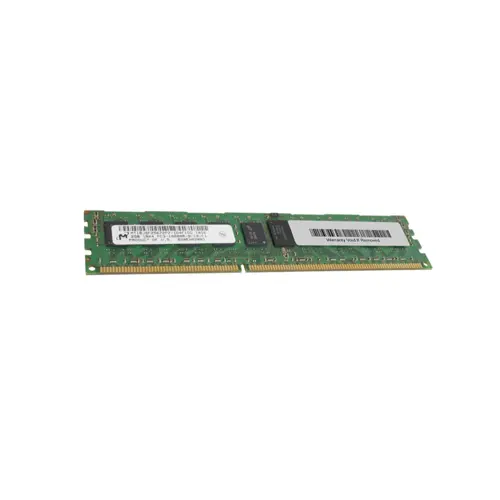
| Model | MT18JSF25672PZ-1G4F1DD |
|---|---|
| Product Type | Memory Module |
| Compliance Standards | RoHS |
| Memory Capacity | 2 GB |
| Memory Technology | DDR3 |
| Product Voltage | 1.5V |
| RAM Speed | 1333MHz |
| RAM Standard | DDR3-1333/PC3-10600 |
| Error Identifying | ECC |
| Signal Type | Registered |
| Column Access Strobe (CAS) | CL9 |
| Rank | Single Rank x4 |
| Quantity of Pins | 240-pin |
| RAM Genre | RDIMM |
This DDR3-1333 RDIMM with ECC is a server-class memory module designed for virtualization hosts and memory-resident database workloads where data integrity is critical. Its registered interface and single-rank x4 configuration reduce bus loading to maintain clean signal integrity across multiple DIMMs, while the integrated ECC engine delivers reliable single-bit error correction for stable, long-term operation.
1. ECC silently corrects single-bit errors in real time, shielding virtualized workloads and critical databases from data corruption that could silently cascade into costly downtime.
2. Registered buffering isolates the memory controller from the DRAM electrical load, allowing servers to populate more DIMMs per channel for higher virtualization density without compromising signal stability.
3. Single Rank x4 organization minimizes bus reflections and power noise, preserving clean signal margins essential for 24/7 rack-server uptime under tightly packed multi-DIMM configurations.
4. 1333 MHz clock speed sustains a steady 10.6 GB/s of bandwidth per channel, preventing memory bottlenecks when a hypervisor concurrently services dozens of active virtual machines.
5. A 2 GB capacity per module efficiently covers dedicated appliance or management-controller roles, keeping power and thermals in check inside dense microserver farms where every watt counts.
The Micron MT18JSF25672PZ-1G4F1DD is a server-class 2 GB DDR3 RDIMM whose four defining characteristics directly resolve critical pain points in the data center. ECC protection automatically corrects single-bit errors, a non-negotiable defense for in-memory databases like Redis where an undetected bit flip would instantly corrupt transactional data or crash the instance. The registered buffer stabilizes command and address signals, making it safe to populate multiple DIMMs per channel in dense VMware or Hyper-V clusters—your virtualization host scales without mysterious signal-related instability. Its single-rank x4 organization keeps electrical loading extremely low, which preserves memory bandwidth as you add VMs and helps avoid the frequency drops that plague dual-rank alternatives under heavy consolidation. Rounding out the design, the CL9 latency at 1333 MHz delivers quick access to hot data, so analytics dashboards and database queries remain snappy even during peak loads. For IT managers, these traits mean less unplanned downtime, sustained throughput in resource-stacked environments, and a reliable way to breathe new life into legacy server platforms.
General Virtualization
Deploy this 2GB registered ECC RDIMM to build a stable, budget-friendly virtualization host. Install one module per memory channel (e.g., three DIMMs for a triple-channel CPU) to enable interleaving and maximize throughput. For moderate VM density, populate all channels with 12 identical sticks to deliver 24GB of seamless, error-correcting memory without overspending.
In-Memory Database
Maximize capacity by filling every DIMM socket on the platform with these 2GB single-rank modules. A fully loaded 18-slot dual-socket server provides 36GB of robust, low-latency ECC memory, keeping entire datasets in RAM. Using identical RDIMMs guarantees symmetric access and eliminates inter-rank timing penalties critical for deterministic database performance.
High Performance Computing (HPC)
Achieve peak memory bandwidth by populating each channel equally—install one DIMM per channel, or two for added capacity. A six-channel compute node with one 2GB RDIMM per channel delivers 12GB of balanced bandwidth for compute-intensive simulations. The integrated ECC safeguards results during long runtimes, preventing silent data corruption in mission-critical HPC jobs.
Rigorously tested for compatibility with Dell PowerEdge R710, HP ProLiant DL380 G7, IBM System x3650 M3, and similar servers.
Q: Can I mix this MT18JSF25672PZ-1G4F1DD with other memory modules of different brands or speeds?
A: Mixing unbuffered and registered modules is not supported. Combining this RDIMM with DIMMs of different speeds or brands may force the memory controller to downgrade to the lowest common speed and can compromise stability; identical modules are strongly recommended.
Q: Is this memory compatible with my server? Which Intel or AMD platforms are supported?
A: This 2GB DDR3-1333 registered ECC module is compatible with servers using Intel 5500/5520/5600 series chipsets or AMD SR56x0/SR55x0 platforms. Verify that your motherboard specifically requires 240-pin RDIMMs with 1.5V signaling.
Q: What is the recommended DIMM population order for optimal performance?
A: Populate identical DIMMs per memory channel, usually starting with the slot furthest from the CPU. For dual-processor boards, balance capacity equally across both sockets. Follow your server's manual to enable single-rank x4 interleaving and maximize bandwidth.
Q: Does this module support overclocking or XMP profiles?
A: No. This is a server-grade registered ECC DIMM built to JEDEC DDR3-1333 specifications. Overclocking and XMP profiles are not supported; stable operation at the rated 1333MHz with CL9 timings and 1.5V is guaranteed for always-on workloads.
Q: What warranty and typical failure rate can I expect?
A: This module is covered by a one-year warranty. With ECC protection and conservative 1.5V operation, the annualized failure rate is extremely low under normal server conditions, typically well below 0.5% when properly cooled.