











 Secure payments
Standard refund policy
Trade Assurance
Secure payments
Standard refund policy
Trade Assurance
| Model | M395T1K66AZ4-CE66 |
|---|---|
| Product Type | Memory Module |
| Compliance Standards | EU RoHS,FCC |
| Memory Capacity | 8 GB |
| Memory Technology | DDR2 |
| Product Voltage | 1.8V |
| RAM Speed | 667MHz |
| RAM Standard | DDR2-667/PC2-5300 |
| Error Identifying | ECC |
| Signal Type | Fully Buffered |
| Column Access Strobe (CAS) | CL5 |
| Rank | Dual Rank x4 |
| Quantity of Pins | 240-pin |
| RAM Genre | FB-DIMM |
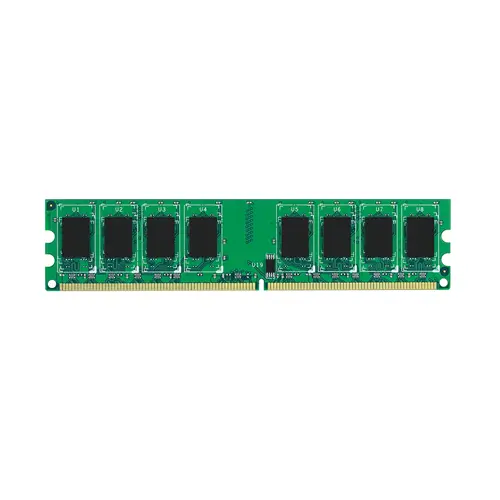
This DDR2-667 FB-DIMM with ECC and a Fully Buffered signal type is purpose-built for legacy server platforms, delivering robust data integrity for memory-intensive workloads such as virtualization and in-memory databases. Its dual-rank x4 organization with CL5 latency ensures stable, high-density memory expansion in older Xeon-based systems that demand reliable buffered memory.
1. Error-correcting code memory eliminates single-bit corruption in flight, safeguarding transactional integrity for financial databases and enterprise resource planning systems.
2. Fully Buffered DIMM architecture serializes command and data paths, ensuring stable operation across heavily populated server boards and reducing electrical loading on the memory controller.
3. Dual Rank x4 organization maximizes bank-level parallelism, sustaining peak bandwidth utilization even under simultaneous read/write storms from multiple virtual machines.
4. This module’s dense capacity expands total server memory footprint, enabling higher virtual machine density per rack without sacrificing guest operating system responsiveness.
5. A steady 667MHz clock drives reliable throughput that aligns with balanced server designs, where consistent latency and power efficiency matter more than peak overclocking headroom.
The M395T1K66AZ4-CE66 is an 8GB DDR2-667 fully buffered DIMM engineered for legacy enterprise servers where stability is the ultimate priority. ECC instantly corrects single-bit errors, preventing silent data corruption that could crash virtual machines or corrupt transactional database records—for you, this translates directly into fewer emergency outage calls and preserved business continuity. The Fully Buffered architecture employs an Advanced Memory Buffer chip to decouple the memory bus, guaranteeing clean signal integrity across all channels. This means you can populate every slot in a dense rack server without intermittent boot failures or signal degradation. Dual Rank x4 interleaving elevates sustained throughput by letting the memory controller access one rank while the other refreshes, a critical edge for in-memory caching engines and heavily virtualized environments where multiple VMs contend for bandwidth. With 8GB per module, this memory allows aging dual- and quad-socket platforms to scale to 64GB or beyond, breathing new life into VMware clusters or SQL database servers. These features collectively safeguard transactional data, accelerate multi-tenant workloads, and delay costly hardware refreshes, ensuring your infrastructure keeps generating value instead of becoming a liability.
General Virtualization
For general virtualization workloads, populate memory channels symmetrically to maximize bandwidth and avoid NUMA imbalances. With these 8GB FB-DIMM modules, install at least 8 identical modules (64GB) spread evenly across all memory risers or branches, enabling quad-channel or dual-branch fully buffered configurations. This balances capacity for moderate VM density while preserving the predictable latency that hypervisors require.
In-Memory Database
In-memory databases demand both capacity and sustained throughput, making high-density FB-DIMM populations essential. Deploy 16 or more modules (128GB minimum) across all available channels, fully populating each memory buffer to saturate the interleaved access pattern. The ECC and fully buffered architecture help protect data integrity during large sustained writes, though the 667 MHz speed means you should tune the database to favor capacity over raw frequency.
High-Performance Computing (HPC)
HPC nodes favor bandwidth-sensitive configurations to feed multiple cores. Install modules in multiples of 4, populating all memory channels identically to engage channel interleaving and maximize the 667 MHz FB-DIMM throughput. A typical dual-socket node benefits from 8 modules (64GB) per processor, but verify board-specific buffer routing rules, as unbalanced FB-DIMM chains can stall the advanced memory buffer pipeline and degrade collective communication performance.
Validated server memory, rigorously tested and compatible with Dell PowerEdge 2950, HP ProLiant DL380 G5, IBM System x3650.
Q: Can I mix this M395T1K66AZ4-CE66 with other memory modules of different brands or speeds?
A: Mixing is not recommended. FB-DIMMs require identical specifications to ensure signal integrity. Using unmatched modules can cause system instability, POST failures, or data corruption in server environments.
Q: Is this memory compatible with my system?
A: This FB-DIMM is designed for Intel-based platforms with a 5000/5100/5400 series chipset supporting Fully Buffered DDR2-667. Verify that your server board explicitly supports ECC FB-DIMMs and 8GB quad-rank modules.
Q: What is the recommended DIMM population order for optimal performance?
A: Populate identical FB-DIMMs starting with the slot farthest from the CPU per channel. Follow your system's manual; typically, fill Channel 0 first, then Channel 1, matching ranks and sizes for balanced interleaving.
Q: Does this module support overclocking or XMP profiles?
A: No. This is an enterprise server module built strictly to JEDEC DDR2-667 standards. It does not support overclocking, XMP, or any performance-enhancing profiles outside specification.
Q: What warranty and typical failure rate can I expect?
A: This module includes a one-year warranty. It meets EU RoHS and FCC standards with a typical server-grade annualized failure rate (AFR) below 0.5%, ensuring reliable 24/7 operation in properly cooled chassis.