











 Secure payments
Standard refund policy
Trade Assurance
Secure payments
Standard refund policy
Trade Assurance
| Product Type | Memory Module |
|---|---|
| Memory Capacity | 64 GB |
| Memory Technology | DDR4 |
| Product Voltage | 1.2V |
| RAM Speed | 2933MHz |
| RAM Standard | DDR4-2933/PC4-23400 |
| Error Identifying | ECC |
| Signal Type | Registered |
| Column Access Strobe (CAS) | CL21 |
| Rank | Quad Rank x4 |
| Quantity of Pins | 288-pin |
| RAM Genre | RDIMM |
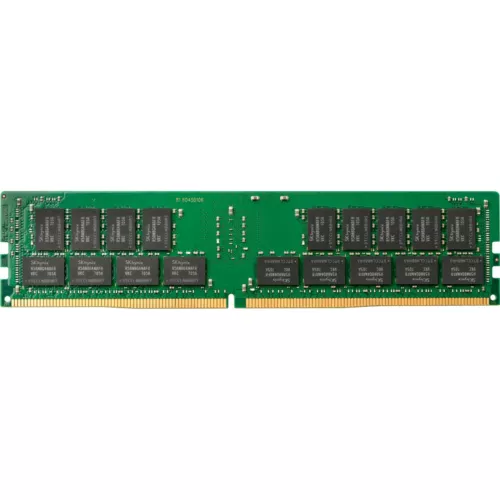
This 64GB DDR4-2933 Registered ECC module (PC4-23400, Quad Rank x4) is engineered for enterprise server environments where data integrity and high capacity are critical, making it ideal for virtualization clusters and in-memory databases. Its quad-rank x4 organization and CL21 latency balance dense memory population with reliable signal integrity on 288-pin RDIMM platforms, while the registered buffer and ECC actively mitigate single-bit errors to maintain system stability under sustained heavy loads.
1. A dense 64GB per module enables hyperscale virtualization and large in-memory database footprints, letting IT consolidate more workloads per physical server without sacrificing performance headroom.
2. ECC error correction actively guards against single-bit corruption and silently flipped cells, preserving transaction integrity in financial systems and 24/7 mission-critical services.
3. Registered signaling offloads electrical loads from the memory controller, making it possible to fill all DIMM slots reliably and scale to terabyte-level memory pools in enterprise-grade deployments.
4. Quad Rank x4 organization saturates the module with enough banks to feed multi-channel server platforms, sustaining steady throughput during hammering access patterns like real-time inference or heavy consolidation.
5. A 2933MT/s transfer rate combined with PC4-23400 class bandwidth shrinks data-fetch latency for heavy database joins and virtualized environments, keeping CPU pipelines fed under concurrent user spikes.
This 64GB DDR4-2933 RDIMM (HMAA8GR7AJR4N-WMTGAA) is purpose-built for mission-critical server environments where data integrity and scalability are non-negotiable. Its ECC technology actively corrects single-bit memory errors, eliminating silent data corruption that can trigger unexplained VM crashes or compromise financial transactions in an in-memory database. The registered (buffered) design reduces the electrical load on the memory controller, allowing you to populate all channels with these high-capacity modules without sacrificing stability—crucial for dense virtualization clusters running dozens of VMs on a single host. Meanwhile, the 64GB capacity per stick enables massive memory footprints for applications like SAP HANA, while the quad-rank x4 organization leverages rank interleaving to boost bandwidth and lower latency under heavy concurrent accesses. In real terms, this means you can consolidate more workloads onto fewer servers, confident that your data remains accurate and your systems stay online during peak loads.
General Virtualization
Deploy this 64GB RDIMM in balanced sets to maximize memory channels. For a dual-socket server, install eight identical modules across both processors to populate all channels, achieving 512GB total for hosting 20–30 moderate VMs. Avoid mixing ranks within a channel to maintain signal integrity and consistent latency.
In-Memory Database
Leverage the high capacity per stick to minimize module count while maximizing density. A single-socket platform with eight of these 64GB RDIMMs yields 512GB, sufficient for in-memory datasets like Redis or SAP HANA sandboxes. The registered ECC design ensures data integrity during cache-heavy operations, and the 2933MT/s speed keeps access latencies low for real-time queries.
High Performance Computing (HPC)
Populate all memory channels symmetrically to feed the CPU with maximum bandwidth. For a dual-socket compute node, install 12 or 16 of these quad-rank modules to reach 768GB–1TB while respecting population guidelines—typically one DIMM per channel when using quad-rank parts to avoid downclocking. The Registered ECC and 2933MHz frequency provide the reliability and throughput required for sustained parallel workloads.
Rigorously tested server RDIMM, compatible with Dell PowerEdge R740, HPE DL380 Gen10, Lenovo ThinkSystem SR650, Supermicro X11 systems.
Q: Can I mix this HMAA8GR7AJR4N-WMTGAA with other memory modules of different brands or speeds?
A: Mixing different brands or speeds of Registered ECC memory is not recommended. It can cause signal integrity issues and system instability. Always use identical modules validated for your server platform.
Q: Is this memory compatible with my system?
A: This 64GB DDR4-2933 Registered ECC RDIMM is compatible with Intel Xeon Scalable and AMD EPYC servers using DDR4. Verify your motherboard's QVL list and chipset support for 2933MT/s and quad-rank modules.
Q: What is the recommended DIMM population order for optimal performance?
A: Follow your server manual; typically populate the first slot in each memory channel (often blue slots) with identical RDIMMs. Balance channels for optimal throughput and avoid mixing quad-rank with other ranks.
Q: Does this module support overclocking or XMP profiles?
A: No, this server RDIMM adheres strictly to JEDEC DDR4-2933 specifications and does not support overclocking or XMP. It runs at the standard speed and timings for reliability in enterprise environments.
Q: What warranty and typical failure rate can I expect?
A: This Hynix module includes a one-year warranty. Its typical annualized failure rate (AFR) is very low, around 0.1%–0.3%, thanks to rigorous manufacturing and ECC error correction.