











 Secure payments
Standard refund policy
Trade Assurance
Secure payments
Standard refund policy
Trade Assurance
| Product Type | Memory Module |
|---|---|
| Compliance Standards | |
| Memory Capacity | 16 GB |
| Memory Technology | DDR4 |
| Product Voltage | 1.2 V |
| RAM Speed | 2133 MHz |
| RAM Standard | DDR4-2133/PC4-17000 |
| Error Identifying | ECC |
| Signal Type | Registered |
| Column Access Strobe (CAS) | CL15 |
| Rank | Dual Rank x4 |
| Quantity of Pins | 288-pin |
| RAM Genre | RDIMM |
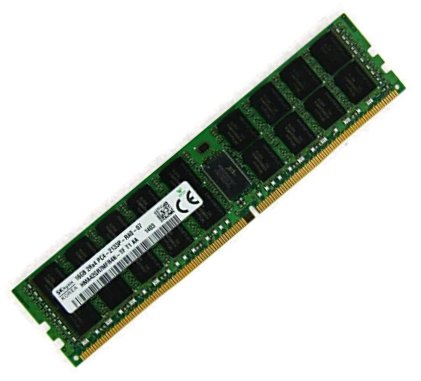
Designed for enterprise servers, this 16GB DDR4-2133 RDIMM with ECC and registered signal architecture ensures data integrity and system stability in memory-intensive workloads such as virtualization and in-memory databases. Its dual-rank x4 organization increases bank-level parallelism for higher throughput, while the CL15 latency delivers responsive access under heavy multi-threaded traffic.
1. 16GB capacity provides the ideal density per channel for virtualization hosts, allowing IT to run more active VMs per server without triggering costly memory ballooning or swapping.
2. ECC error correction continuously detects and corrects single-bit flips, delivering the data integrity required for financial ledgers, scientific computations, and long-running database queries.
3. Registered signal buffering stabilizes command and address lines across fully loaded server boards, ensuring that all twenty-four DIMM slots remain operational under sustained enterprise workloads.
4. Dual Rank x4 architecture interleaves accesses across internal banks to fully saturate the memory channel, sustaining high bandwidth for in-memory analytics and large-scale content serving.
5. 2133 MHz speed with CL15 latency delivers dependable, moderate response times, aligning with the steady throughput demands of scale-out storage nodes and web-tier infrastructure.
The HMA42GR7AFR4N-TF is an enterprise server memory module, immediately identifiable by its Registered DIMM designation and ECC support. In the real world, its four defining characteristics translate directly into hardened reliability and performance for mission-critical infrastructure. Consider a dense virtualization cluster: the ECC engine silently corrects single-bit memory errors caused by background radiation, preventing transient data corruption that could crash dozens of virtual machines without a trace. Meanwhile, the Registered clock buffer stabilizes signal integrity across the memory bus, allowing you to populate all channels with high-capacity DIMMs and confidently scale to terabytes of RAM per host without boot failures or signal reflection issues. Shift to an in-memory database such as Redis or SAP HANA, where latency is revenue. Here the dual-rank x4 organization interleaves memory banks to deliver higher sustained bandwidth, ensuring that enormous datasets served from the 16GB module are accessed with lower contention. This combination of 2133 MHz speed and registered buffering gives you a balanced, power-efficient thermal profile inside dense rack servers, keeping cooling costs down while maintaining deterministic, error-free data processing that your workload uptime demands.
General Virtualization
For dense virtualization hosts, this 16GB DDR4-2133 Registered ECC RDIMM provides the stability essential for hypervisor workloads. Start with a balanced six‑ or eight‑module configuration (96–128 GB) to comfortably support 20–30 moderate VMs. When VM density grows, populate all available DIMM slots up to the platform limit while observing population order for optimal memory bandwidth.
In-Memory Database
In‑memory databases like Redis or SAP HANA demand very large, error‑resilient footprints. Use a full‑channel population of these dual‑rank x4 modules to maximize capacity per channel; a dual‑socket server with 16+ DIMMs easily reaches 256 GB and beyond. Keep speed at 2133 MHz if the platform requires it, but confirm that capacity overrides minor frequency gains for low‑latency data sets.
High-Performance Computing (HPC)
HPC clusters benefit from the predictable performance and ECC protection of registered memory. Configure each node with one DIMM per channel (e.g., 8 modules for 128 GB) to sustain uniform bandwidth and avoid rank‑switching penalties under sustained floating‑point loads. Favor identical Hynix Dual Rank x4 modules across the cluster, ensuring lock‑step operation and simplifying large‑scale troubleshooting and sparing.
Rigorously tested compatibility: Dell PowerEdge R740, HPE ProLiant DL380 Gen10, Lenovo ThinkSystem SR650, and similar servers.
Q: Can I mix this HMA42GR7AFR4N-TF with other memory modules of different brands or speeds?
A: Mixing this RDIMM with different brands or speeds is strongly discouraged in server environments. It can lead to parity errors and system instability. For validated reliability, populate all channels with the same SK Hynix part number.
Q: Is this memory compatible with my Intel Xeon E5 server?
A: This 16GB DDR4-2133 ECC Registered DIMM is compatible with Intel Xeon E5-2600 v3/v4 platforms using C610-series chipsets. Always check your motherboard qualified vendor list (QVL) to confirm specific BIOS support.
Q: What is the recommended DIMM population order for optimal performance?
A: Install identical modules in sets of 4 or 8 per processor, filling the blue slots first (usually slots A1, B1, C1, D1). Refer to your server's service guide to balance memory channels and enable interleaving for maximum bandwidth.
Q: Does this module support overclocking or XMP profiles?
A: No. This enterprise RDIMM adheres to JEDEC DDR4-2133 with CL15 timings at 1.2V. It does not support overclocking or XMP profiles, as server memory prioritizes data integrity and 24/7 operational stability.
Q: What warranty and typical failure rate can I expect?
A: The module carries a 1-year warranty. SK Hynix server memory demonstrates an annualized failure rate (AFR) typically below 0.5%, backed by thorough factory screening and ECC protection during operation.