











 Secure payments
Standard refund policy
Trade Assurance
Secure payments
Standard refund policy
Trade Assurance
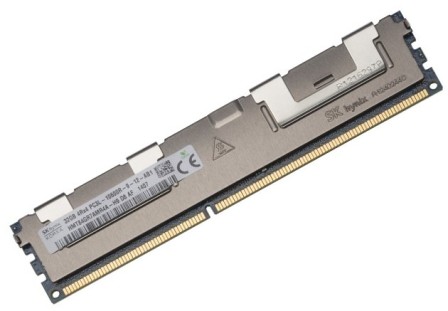
| Product Type | Memory Module |
|---|---|
| Memory Capacity | 32 GB |
| Memory Technology | DDR3 |
| Product Voltage | 1.35 V |
| RAM Speed | 1333 MHz |
| RAM Standard | DDR3-1333/PC3-10600 |
| Error Identifying | ECC |
| Signal Type | Registered |
| Column Access Strobe (CAS) | CL9 |
| Rank | Quad Rank x4 |
| Quantity of Pins | 240-pin |
| RAM Genre | RDIMM |
This RDIMM is purpose-built for legacy enterprise servers and workstations requiring high memory density with data integrity, making it ideal for virtualization hosts and in-memory databases that demand reliable, registered ECC operation. Its 1.35V low-voltage design and quad-rank x4 configuration enable maximum capacity per channel at 1333MHz with CL9 latency, while the registered signal type stabilizes multi-DIMM configurations under sustained load.
1. A 32GB capacity per module maximizes memory footprint in virtualized servers, allowing more VMs and containers to run concurrently without performance degradation.
2. Registered signal buffering preserves electrical integrity across fully populated memory channels, essential for maintaining uptime in large-scale enterprise systems.
3. ECC error correction instantly detects and remedies single-bit faults, protecting critical financial and database operations from silent data corruption.
4. Quad Rank x4 organization enables rank interleaving that elevates command bandwidth, sustaining throughput for in-memory caching and real-time analytics.
5. Operating at 1.35V low voltage curbs power draw and heat dissipation, directly lowering energy costs and improving thermal stability in dense data center racks.
As a server-class Registered DIMM, the HMT84GR7AMR4A-H9 is purpose-built for enterprise environments where downtime is not an option. Its ECC technology continuously detects and corrects single-bit memory errors, a critical defense against silent data corruption in always-on virtualization clusters; a flipped bit in a hypervisor’s memory space can crash dozens of virtual machines, making this protection non-negotiable for business continuity. The registered buffer stabilizes the electrical load across the memory bus, allowing you to populate all 24 DIMM slots in a 2U rack server without signal degradation, which directly translates to confidently scaling your in-memory database instances to 768GB or more. Quad Rank x4 organization pushes bandwidth density further, feeding data-hungry workloads like real-time transaction processing where every nanosecond of latency compounds. Operating at 1.35V, this low-voltage DDR3L module reduces thermal stress and power draw across a server farm; in a 100-node Hadoop cluster, that incremental saving per DIMM becomes a significant reduction in cooling overhead and electricity costs. It is the convergence of integrity, scalability, dense bandwidth, and energy efficiency that keeps your mission-critical services responsive and your total cost of ownership in check.
This is a server‑class memory module: a 32 GB DDR3L‑1333 Registered ECC RDIMM (Quad Rank x4, 1.35 V). Capacity planning for servers must balance channel population, rank loading, and voltage efficiency.
General Virtualization
For general virtualization, capacity usually takes precedence over peak bandwidth. Start by installing one 32 GB RDIMM per memory channel on each CPU — e.g., eight identical modules across two processors — to deliver 256 GB of symmetric, NUMA‑optimised capacity. As guest density grows, add a second DIMM per channel, but expect a speed drop to 1066 MHz due to quad‑rank loading. Always match part numbers and rank configurations across all populated slots.
In‑Memory Database
In‑memory databases demand maximum capacity while accepting moderate speed trade‑offs. Populate every available channel with two quad‑rank 32 GB RDIMMs, yielding 512–768 GB per dual‑socket server (depending on slot count). The 1.35 V low‑voltage design reduces thermal load, which is critical for fully‑populated chassis. Use sparingly heavier ranks only if the workload can tolerate 800 MHz operation; otherwise, limit to one DIMM per channel and scale out by adding nodes.
High‑Performance Computing
HPC workloads require the highest memory bandwidth. Install exactly one 32 GB RDIMM per channel (1DPC) to sustain the full 1333 MHz clock and leverage all memory‑interleaving gains. This configuration avoids the performance penalty of quad‑rank multi‑DIMM setups. If total capacity falls short, choose platforms with more memory channels rather than stacking additional quad‑rank DIMMs per channel, or consider smaller node partitions with faster fabric interconnect.
Compatibility verified: 32GB DDR3-1333 registered ECC server memory, rigorously tested for Dell PowerEdge R720, HP DL380p Gen8, Lenovo RD430.
Q: Can I mix this HMT84GR7AMR4A-H9 with other memory modules of different brands or speeds?
A: Mixing is not recommended for this registered ECC module. Differing ranks, timings, or vendors can cause POST failures and signal integrity issues in server platforms. Uniform population ensures stability.
Q: Is this memory compatible with my server system?
A: It is designed for DDR3-based servers using Intel Xeon E5-2600 v1/v2 or AMD Opteron 6300 series platforms. Verify that your board supports 32GB quad-rank LR/RDIMMs at 1.35V.
Q: What is the recommended DIMM population order for optimal performance?
A: Consult the server motherboard manual for specific slot numbering. Typically, populate identical modules in identical-colored slots per channel to balance interleaving and maximize memory bandwidth.
Q: Does this module support overclocking or XMP profiles?
A: No. As an enterprise registered ECC module, it adheres to JEDEC DDR3-1333 CL9 standards at 1.35V. Overclocking is strictly unsupported and may compromise data integrity in mission-critical environments.
Q: What warranty and typical failure rate can I expect?
A: This Hynix module carries a one-year warranty. Enterprise-grade DRAM exhibits an extremely low annualized failure rate (typically <0.5%) under specified operating conditions with proper cooling.