











 Secure payments
Standard refund policy
Trade Assurance
Secure payments
Standard refund policy
Trade Assurance
| Product Type | Memory Module |
|---|---|
| Memory Capacity | 32 GB |
| Memory Technology | DDR3 |
| Product Voltage | 1.35 V |
| RAM Speed | 1333 MHz |
| RAM Standard | DDR3-1333/PC3-10600 |
| Error Identifying | ECC |
| Signal Type | Registered |
| Column Access Strobe (CAS) | CL9 |
| Rank | Quad Rank x4 |
| Quantity of Pins | 240-pin |
| RAM Genre | RDIMM |
This RDIMM with ECC and a registered signal type is purpose-built for server platforms, delivering the data integrity essential for virtualization, in-memory databases, and mission-critical workloads where silent memory errors are unacceptable. Its quad-rank x4 organization maximizes capacity density per channel while the CAS latency of 9 cycles at DDR3-1333 ensures reliable, deterministic performance under heavy multi-rank loads.
1. Substantial memory capacity enables dense virtualization, allowing more virtual machines per physical host without compromising memory bandwidth or performance isolation.
2. ECC protection silently corrects single-bit errors, safeguarding financial transactions and critical database operations from data corruption and unplanned downtime.
3. Registered signal buffering reduces the electrical load on the memory controller, making it possible to populate all DIMM slots in multi-socket servers reliably at high capacities.
4. Quad Rank x4 organization keeps memory channels fully saturated under heavy consolidation workloads, delivering consistent throughput for virtualized database farms.
5. Low operating voltage cuts power draw and cooling demands, directly reducing energy costs and thermal stress in always-on enterprise server rooms.
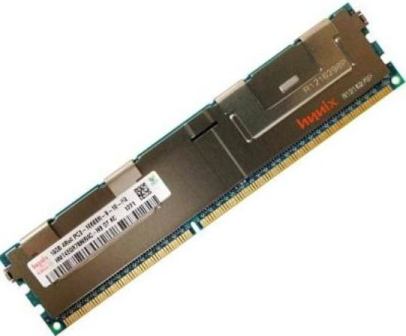
The HMT84GR7MMR4A-H9 is a 32 GB DDR3-1333 Registered DIMM with ECC, built for server-class workloads and operating at a low 1.35 V. In virtualization clusters and in-memory databases, these characteristics are not just technical specifications—they are what keep your business running. ECC detects and corrects single-bit errors caused by background radiation, preventing silent data corruption that could crash a hypervisor hosting dozens of virtual machines or compromise a financial transaction ledger. The registered buffer stabilizes the 32 GB quad-rank module by reducing electrical load on the memory controller, allowing you to fully populate server banks without sacrificing speed or reliability—critical when scaling an in-memory database where hot data must be served in microseconds. The quad-rank x4 design maximizes channel bandwidth utilization, delivering consistent throughput for heavy consolidation workloads. Meanwhile, 1.35 V operation cuts power consumption across racks, reducing cooling and energy costs without performance loss. This module turns raw capacity into assured, mission-critical uptime.
General Virtualization
For dense server virtualization, registered ECC memory is essential to ensure data integrity across multiple VMs. Populate all available channels with identical 32 GB RDIMMs—typically in sets of six or twelve per socket—to maximize capacity while maintaining balanced memory interleaving. This configuration provides the reliability and headroom needed to oversubscribe CPU cores without risking silent data corruption.
In-Memory Database
In-memory databases such as Redis or SAP HANA demand the lowest possible latency and absolute data accuracy, making quad-rank x4 RDIMMs a strong fit for deep capacity per channel. Deploy the modules in a fully balanced configuration across all memory controllers, respecting the platform’s maximum rank limits per channel to avoid speed downgrades. Aim to populate at least eight identical modules per host to sustain high-throughput, low-latency operations while keeping ECC active for real-time error correction.
High-Performance Computing
HPC clusters require every memory channel populated symmetrically to deliver peak bandwidth, and registered DDR3-1333 modules at 1.35 V help balance power consumption across dense nodes. Use complete kits of identical 32 GB DIMMs to fill all channels per CPU, ensuring quad-rank modules are correctly distributed so the memory controller can maintain 1333 MHz speed. This layout yields the large, contiguous memory pools needed for MPI workloads and large-scale simulations while preserving energy efficiency.
Rigorously tested server memory, compatible with Dell PowerEdge R720, R620, HPE ProLiant DL380p Gen8, Lenovo ThinkServer RD630.
Q: Can I mix this HMT84GR7MMR4A-H9 with other memory modules of different brands or speeds?
A: Mixing RDIMMs of different brands or speeds is not recommended. It may cause instability or fail to POST. For guaranteed compatibility, use identical Hynix 32GB DDR3-1333 registered ECC modules with the same rank and CAS latency.
Q: Is this memory compatible with my Intel Xeon E5-2400 series server?
A: Yes, it is compatible with platforms supporting DDR3 Registered ECC memory, such as Intel Xeon E5-2400/2600 series or older AMD Opteron 6300 series. Please verify your server board supports quad-rank RDIMMs at 1333 MHz before purchase.
Q: What is the recommended DIMM population order for optimal performance?
A: Populate identical quad-rank RDIMMs per memory channel, starting with the farthest slot from the CPU. Typically, white slots first then black. Balance capacity across all memory controllers to maintain interleaving and maximize throughput.
Q: Does this module support overclocking or XMP profiles?
A: No. As a registered server memory module, it adheres strictly to JEDEC standards for stability. Overclocking or XMP profiles are not supported; it operates at fixed 1333 MHz with CL9 timings at 1.35 V.
Q: What warranty and typical failure rate can I expect?
A: This Hynix module carries a 1-year warranty. Typical annualized failure rate (AFR) for enterprise-grade registered memory is below 0.5%, ensuring excellent long-term reliability in proper thermal and power environments.