











 Secure payments
Standard refund policy
Trade Assurance
Secure payments
Standard refund policy
Trade Assurance
| Product Type | Memory Module |
|---|---|
| Memory Capacity | 32 GB |
| Memory Technology | DDR4 |
| Product Voltage | 1.2 V |
| RAM Speed | 2666 MHz |
| RAM Standard | DDR4-2666/PC4-21300 |
| Error Identifying | ECC |
| Signal Type | Registered |
| Column Access Strobe (CAS) | CL19 |
| Rank | Dual Rank x4 |
| Quantity of Pins | 288-pin |
| RAM Genre | RDIMM |
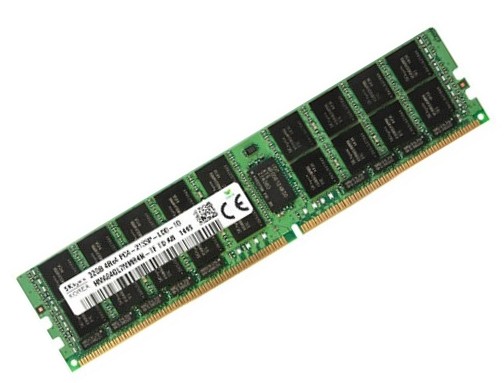
This 32GB DDR4-2666 RDIMM with ECC and registered signaling is engineered for servers and workstations, where it supports memory-intensive virtualization, in-memory databases, and data-integrity-critical workloads. Its dual-rank x4 organization enhances command/address interleaving for higher sustained bandwidth, while full ECC protection and a stable registered interface ensure reliability under load.
1. ECC error correction safeguards data integrity in mission-critical workloads, preventing silent memory corruption that could compromise financial transactions or database accuracy.
2. Registered signal buffering ensures rock-solid signal integrity across high-density memory configurations, enabling seamless scaling to hundreds of gigabytes for large-scale virtualization hosts.
3. 32GB capacity per module maximizes memory density per channel, allowing data centers to provision more virtual machines and in-memory databases without sacrificing physical footprint.
4. Dual Rank x4 organization leverages rank interleaving to hide refresh and access latency, delivering consistent throughput under the sustained random access patterns of multi-tenant cloud environments.
5. 2666 MT/s data rate provides sufficient per-core bandwidth for contemporary multi-core Xeon servers, sustaining heavy analytics and AI inference pipelines without becoming a bottleneck.
When deploying a dense virtualization cluster or an in-memory database like SAP HANA, the HMA84GR7JJR4N-VK RDIMM transforms architectural risks into predictable performance. Its ECC engine silently corrects single-bit memory errors and detects multi-bit corruption before silent data corruption can cascade into a hypervisor crash or a financial calculation anomaly. In a cluster running dozens of virtual machines, that integrity layer means the difference between a transparent live migration and a sudden node failure. The registered signal buffer takes the electrical load off the memory controller, allowing you to fully populate all channels with 32 GB modules without sacrificing stability—critical when your consolidation ratio directly impacts licensing costs. The dual-rank x4 organization drives interleaved bank access, delivering the sustained bandwidth that in-memory databases demand during high-concurrency reads and writes, preventing the transaction queue from stalling under peak OLTP loads. What this means for your data center is measurable: less unplanned downtime from bit flips, denser VM placement without signal compromise, and consistent low-latency throughput for latency-sensitive analytics—all validated at JEDEC standard 2666 MHz with a 1.2 V power envelope that keeps thermal budgets in check across a sea of DIMMs.
Server Memory Configuration Guide
The Hynix 32GB DDR4-2666 RDIMM with ECC and registered signaling is purpose‑built for server environments where data integrity and scalability are paramount.
General Virtualization
A balanced virtualization host should start with at least four modules (128 GB total) to comfortably run 20–30 light to medium VMs. Populate one DIMM per channel across all memory channels to maximize bandwidth while leaving room for expansion.
In-Memory Database
For in‑memory databases like Redis or SAP HANA, density and reliability are critical. Deploy a six‑module configuration (192 GB) in a dual‑socket server, filling three channels per CPU. This provides a large, fully mirrored in‑memory footprint with ECC protection guarding against silent data corruption.
High Performance Computing
HPC workloads demand maximum memory bandwidth. Install eight identical 32GB RDIMMs (256 GB) across all eight memory channels of a single‑socket platform, or evenly distribute across both sockets in a dual‑socket node. Dual‑rank x4 modules deliver the sustained throughput needed for simulation and modeling tasks, and the 2666 MT/s speed keeps latency low under heavy parallel loads.
Proven compatible after stringent testing: Dell PowerEdge R740/R760, HPE ProLiant DL380 Gen10, Lenovo ThinkSystem SR650.
Q: Can I mix this HMA84GR7JJR4N-VK with other memory modules of different brands or speeds?
A: Mixing registered ECC DIMMs is not recommended. Even slight differences in rank, latency, or DRAM vendor can cause instability. Always populate servers with identical, matched modules for guaranteed reliability and performance.
Q: Is this memory compatible with my system?
A: This Hynix DDR4-2666 ECC Registered RDIMM requires a server platform, such as Intel Xeon Scalable or AMD EPYC, with 288-pin slots supporting registered DIMMs. Verify your board's qualified vendor list before purchase.
Q: What is the recommended DIMM population order for optimal performance?
A: Follow your server board’s manual: typically populate identical modules in balanced sets per CPU memory channel. For dual-rank RDIMMs, symmetrical filling across channels ensures maximum memory bandwidth and reduces latency penalties.
Q: Does this module support overclocking or XMP profiles?
A: No. This is a JEDEC-compliant, registered server DIMM operating at a fixed 2666 MHz (PC4-21300). It does not support XMP, overclocking, or manual timing adjustments, prioritizing data integrity and 24/7 stability over speed.
Q: What warranty and typical failure rate can I expect?
A: This module includes a one-year warranty. As an OEM-grade Hynix RDIMM built for enterprise workloads, its annualized failure rate is typically well below 0.5%, ensuring robust reliability under standard operating conditions.