











 Secure payments
Standard refund policy
Trade Assurance
Secure payments
Standard refund policy
Trade Assurance
| Product Type | Memory Module |
|---|---|
| Memory Capacity | 32 GB |
| Memory Technology | DDR4 |
| Product Voltage | 1.2V |
| RAM Speed | 2666MHz |
| RAM Standard | DDR4-2666/PC4-21300 |
| Error Identifying | ECC |
| Signal Type | Unbuffered |
| Column Access Strobe (CAS) | CL19 |
| Rank | Dual Rank x8 |
| Quantity of Pins | 288-pin |
| RAM Genre | UDIMM |
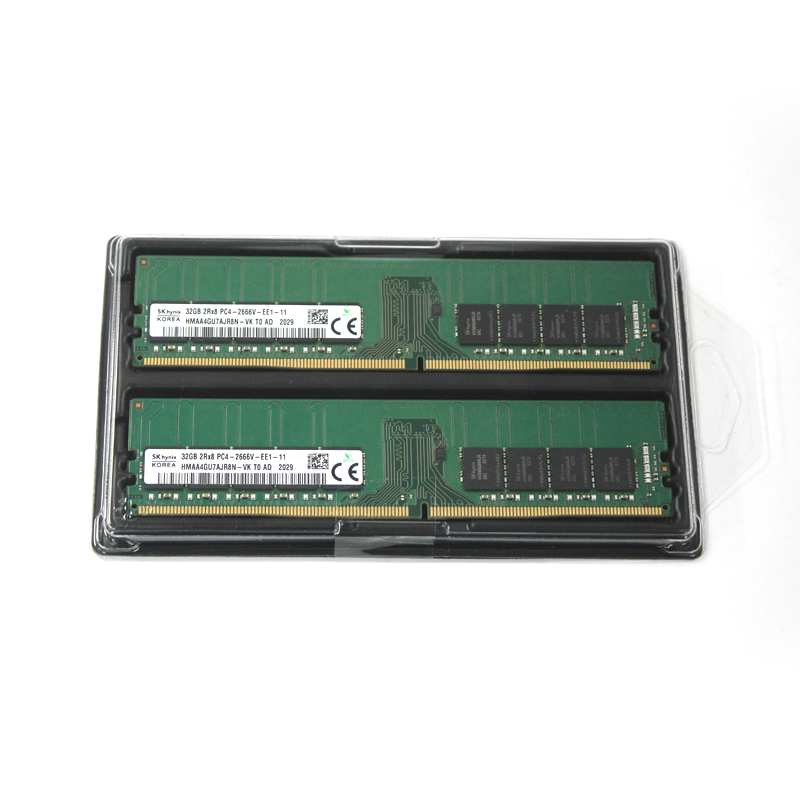
Ideal for entry-level servers and workstations, this 32GB DDR4-2666 UDIMM with ECC ensures data integrity for virtualization and in-memory database workloads. Its dual-rank x8 configuration maximizes memory density per channel while Unbuffered signal type maintains lower latency, making it a reliable choice for platforms that require error correction without the added cost of registered memory.
1. ECC protection silently corrects single-bit errors in real time, safeguarding transactional databases and long-running analytics from data corruption that would otherwise force costly service interruptions.
2. A 32 gigabyte capacity per module allows dense virtualization hosts to pack more guest instances or memory-hungry containers into each node, directly improving total cost of ownership.
3. The 2666 MT/s throughput keeps memory bandwidth aligned with multi-core Xeon processors, preventing bottlenecks when multiple VMs simultaneously stream large in-memory workloads.
4. Dual rank x8 organization enables rank interleaving across the channel, raising effective concurrency and delivering steadier latency under the heavy, random access patterns typical of virtualized infrastructure.
5. Operating at just 1.2 volts, this module trims power consumption per DIMM slot, which compounds into significant energy savings across a full rack while simplifying cooling demands.
As a server and workstation memory module, the HMAA4GU7AJR8N-VK directly addresses the demands of environments where data accuracy, multi‑tasking efficiency, and operating cost are mission‑critical. Consider a virtualized cluster hosting customer‑facing applications and a Redis in‑memory database: a single undetected bit flip in system memory can silently corrupt financial records or crash the hypervisor, leading to unplanned downtime. The onboard ECC instantly corrects single‑bit errors and flags multi‑bit anomalies, preserving transactional integrity and keeping your services online around the clock. While the virtualization layer assigns memory to multiple VMs, the dual‑rank x8 organization interleaves accesses to lift effective bandwidth, preventing the stuttering that occurs when a heavily queried database competes for cycles. This 32 GB capacity, operating at a low 1.2 V, also means you can colocate larger memory‑hungry workloads on a single host without driving up the power and cooling bill inside a dense rack. As an unbuffered ECC DIMM, the module slots natively into cost‑optimized single‑socket AMD Ryzen Pro or Intel Xeon E platforms, ensuring your small business server or engineering workstation obtains enterprise‑class reliability without the premium of registered memory. From safeguarding patient data in a clinic’s imaging archive to accelerating compilation jobs in a development lab, every parameter is tuned to make reliability and responsive performance tangible in the exact moments your operation cannot afford a failure.
General Virtualization
For dense VM hosting, deploy this 32GB ECC UDIMM in pairs across all available channels to maximize memory bandwidth while preserving error correction. A dual-socket platform with 8 to 16 such modules delivers 256–512GB, comfortably supporting 30–50 moderate VMs without overcommitting critical guard capacity.
In-Memory Database
In-memory databases like Redis or SAP HANA demand capacity and reliability. Populate all DIMM slots with identical 32GB UDIMMs to reach 512GB or more per node, leveraging ECC to prevent bit-flip corruption. The 2666MHz speed keeps latency low, while unbuffered design suits single-socket appliances that prioritize deterministic access over sheer density.
High-Performance Computing
HPC clusters benefit from uniform, stable memory configurations. Install six or eight of these dual-rank modules per node for 192–256GB, matching the CPU’s memory channels. ECC ensures result integrity during multi-day simulations, and the 1.2V operation aids thermal control in dense rack environments. Avoid mixing capacities to maintain symmetrical interleaving and peak floating-point throughput.
Rigorously tested ECC UDIMM server memory, compatible with Dell PowerEdge T150, HPE ProLiant ML30 Gen10, Lenovo ThinkSystem ST250, and more.
Q: Can I mix this HMAA4GU7AJR8N-VK with other memory modules of different brands or speeds?
A: Mixing is not recommended. Different brands or speeds may cause instability and force the system to run at the lowest common speed, impacting reliability. Use identical modules for guaranteed compatibility.
Q: Is this memory compatible with my Intel Xeon or AMD EPYC server platform?
A: It is compatible with server boards supporting DDR4 ECC UDIMMs, such as Intel Xeon E-2100/2200 series or AMD AM4 platforms with ECC support. Verify against the manufacturer's QVL list.
Q: What is the recommended DIMM population order for optimal performance with this dual-rank module?
A: Install identical modules in the first slot of each memory channel as specified in your server board manual. For dual-channel configurations, populate slots A1 and B1 first.
Q: Does this module support overclocking or XMP profiles?
A: No. This is a server-grade ECC UDIMM that adheres to JEDEC DDR4-2666 standards. It does not support XMP or overclocking; it runs at its rated native timings.
Q: What warranty and typical failure rate can I expect?
A: It includes a 1-year warranty. Designed with server-grade reliability and strict testing, the module has an extremely low failure rate under standard operating conditions.