











 Secure payments
Standard refund policy
Trade Assurance
Secure payments
Standard refund policy
Trade Assurance
| Product Type | Memory Module |
|---|---|
| Memory Capacity | 32 GB |
| Memory Technology | DDR4 |
| Product Voltage | 1.2 V |
| RAM Speed | 3200 MHz |
| RAM Standard | DDR4-3200/PC4-25600 |
| Error Identifying | ECC |
| Signal Type | Registered |
| Column Access Strobe (CAS) | CL22 |
| Rank | Dual Rank x4 |
| Quantity of Pins | 288-pin |
| RAM Genre | RDIMM |
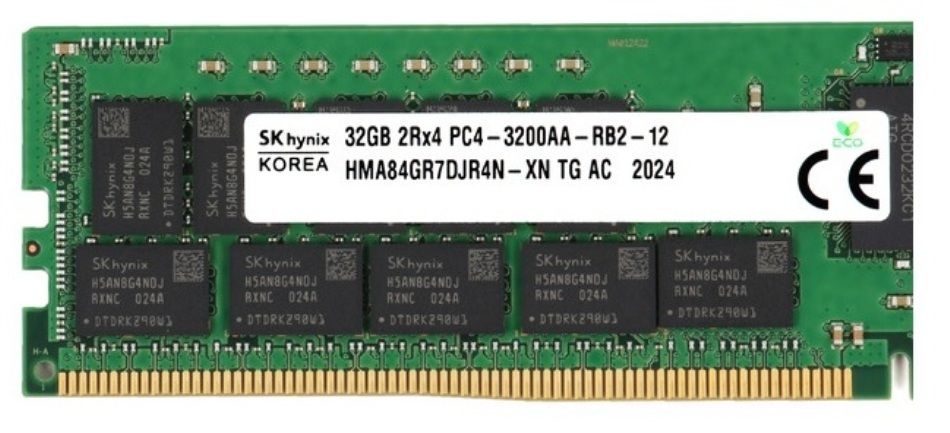
This 32 GB DDR4-3200 Registered ECC RDIMM (PC4-25600, dual-rank x4, CL22) is engineered for server platforms and delivers robust data integrity in virtualized environments and in-memory databases. Its registered signal architecture stabilizes high-capacity memory configurations, while ECC and the dual-rank design provide error correction and improved memory interleaving for sustained throughput under heavy multi-threaded workloads.
1. ECC error detection and correction safeguards data integrity over months of continuous uptime, preventing silent corruption in financial transactions and database records.
2. Registered signal buffering stabilizes electrical loads across fully populated memory channels, ensuring reliable operation when scaling to terabyte-level server platforms.
3. Dual rank x4 organization keeps burst-mode prefetch efficiency high, delivering consistent memory bandwidth for virtualized workloads under heavy consolidation.
4. The 32 GB capacity per module expands the total memory footprint per rack unit, enabling higher virtual machine density without sacrificing performance isolation.
5. DDR4-3200 speed elevates throughput for in-memory analytics and caching tiers, shrinking query response times in latency-sensitive enterprise applications.
In data center environments, the HMA84GR7DJR4N-XN 32GB DDR4-3200 registered DIMM addresses critical pain points that generic desktop memory simply cannot touch. Its ECC technology proactively corrects single-bit errors caused by cosmic radiation or electrical noise—silent data corruption that can crash a virtual machine or miscompute a financial transaction. Coupled with registered logic, the module buffers command and address signals, allowing a single server to populate all memory channels with large, stable configurations; this is essential for dense virtualized clusters where dozens of VMs share physical resources. The dual-rank x4 design boosts bank-level parallelism, delivering continuous bandwidth to memory-hungry databases like SAP HANA or in-memory analytics platforms; under heavy concurrent access, it maintains the low latency and high throughput that real-time decision systems depend on. Operating at 1.2V with 3200MT/s speed, it balances data integrity with power efficiency across scale-out deployments. For a hypervisor host orchestrating 50 virtual machines or a Redis cluster serving millions of queries per second, these four pillars—error correction, registered buffering, dual-rank parallelism, and efficient speed—directly translate to uptime, data fidelity, and predictable responsiveness that your business cannot afford to compromise.
General Virtualization
For a virtualization host, populate a balanced number of identical 32 GB RDIMMs across all memory channels to ensure uniform memory access and maximize bandwidth. A typical dual-socket server with 8 channels per CPU benefits from 8 or 16 such modules, delivering 256 GB or 512 GB of total capacity for a moderate VM density without wasting DIMM slots.
In-Memory Database
In-memory databases demand both large capacity and high reliability, so fully populate all channels with these 32 GB ECC Registered modules while leaving room for growth. A configuration of 16 to 24 modules (512 GB to 768 GB) per socket allows large datasets to reside entirely in RAM, and the dual‑rank design helps sustain throughput under heavy concurrent access.
High Performance Computing (HPC)
HPC workloads are extremely sensitive to memory bandwidth; install exactly one DIMM per channel to achieve maximum speed without throttling. Using 8 or 16 of these 3200 MT/s RDIMMs per node (256 GB or 512 GB) saturates the channel count while keeping command rates low, and the CL22 latency with dual rank x4 organization is well suited for compute‑bound simulations and modeling.
Rigorously tested for server compatibility. Compatible with Dell PowerEdge R750, HPE DL380 Gen10 Plus, Lenovo SR650 V2, and more.
Q: Can I mix this HMA84GR7DJR4N-XN with other memory modules of different brands or speeds?
A: Mixing RDIMM modules of different brands, speeds, or ranks is not recommended. It may cause stability issues, reduced speed, or unbootable server states in demanding enterprise environments.
Q: Is this memory compatible with my system?
A: This RDIMM is compatible with servers using Intel Xeon Scalable (Purley/Whitley) or AMD EPYC platforms. Verify your board supports DDR4-3200 Registered ECC 288-pin modules before ordering.
Q: What is the recommended DIMM population order for optimal performance?
A: Follow your server motherboard's population guide. Typically, populate identical dual-rank modules evenly across memory channels, starting with the first white slot per channel for balanced bandwidth.
Q: Does this module support overclocking or XMP profiles?
A: No. As an enterprise RDIMM, it operates strictly at JEDEC standard DDR4-3200 CL22 with no XMP or overclocking support. Reliability and signal integrity take priority over variable frequencies.
Q: What warranty and typical failure rate can I expect?
A: This Hynix module is covered by a one-year warranty. Enterprise DDR4 RDIMMs exhibit extremely low annualized failure rates, typically within 0.1–0.3%, ensuring long-term mission-critical reliability.