











 Secure payments
Standard refund policy
Trade Assurance
Secure payments
Standard refund policy
Trade Assurance
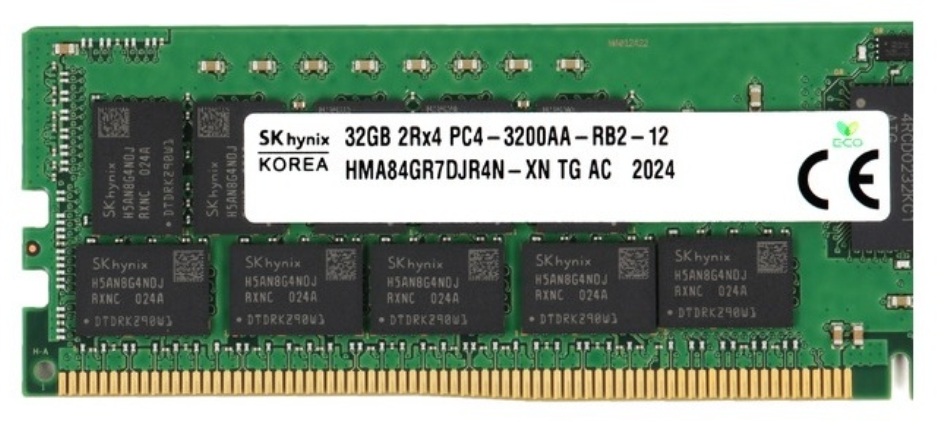
| Product Type | Memory Module |
|---|---|
| Memory Capacity | 32 GB |
| Memory Technology | DDR4 |
| Product Voltage | 1.2V |
| RAM Speed | 3200MHz |
| RAM Standard | DDR4-3200/PC4-25600 |
| Error Identifying | ECC |
| Signal Type | Registered |
| Column Access Strobe (CAS) | CL22 |
| Rank | Dual Rank x4 |
| Quantity of Pins | 288-pin |
| RAM Genre | RDIMM |
This 32GB DDR4-3200 Registered ECC RDIMM, with its dual-rank x4 configuration and CL22 latency, is optimized for server platforms running memory-intensive virtualization and in-memory database workloads. The registered signal topology and integrated ECC enforce robust signal integrity and real-time data correction, ensuring high reliability in dense, mission-critical enterprise deployments.
1. ECC actively detects and corrects single-bit errors in real time, safeguarding financial transaction integrity and preventing silent data corruption in long-running database instances.
2. Registered buffering isolates the memory controller from excessive electrical loading, allowing fully populated server nodes to maintain reliable signal integrity under maximum capacity configurations.
3. 32GB capacity per module maximizes memory density per channel, enabling higher virtual machine consolidation ratios without compromising per-VM performance in private cloud deployments.
4. 3200MT/s throughput supplies 25.6 GB/s peak bandwidth per module, dramatically accelerating in-memory analytics and reducing query latency for high-concurrency SaaS backends.
5. Dual rank x4 organization leverages bank-level parallelism to sustain elevated IOPS under mixed workloads, keeping latency predictable during heavy multi-tenant access spikes.
When you deploy a virtualization cluster or run an in-memory database, every bit of data integrity and every cycle of memory bandwidth directly impacts your bottom line. The HMA84GR7DJR4N-XNT4 32GB DDR4-3200 RDIMM addresses these demands with four critical attributes. The ECC technology silently detects and corrects single-bit errors—a necessity when cosmic-ray-induced bit flips can corrupt financial transactions or database indexes without warning, so you avoid costly downtime and silent data corruption. The registered signal buffer allows you to populate all memory channels without signal degradation, keeping large-scale virtualization hosts stable even when you push 1TB or more of RAM for dense VM consolidation. Its dual-rank x4 organization improves bank-level parallelism, which significantly boosts effective bandwidth under the random, simultaneous access patterns typical of Redis, SAP HANA, or multi-tenant virtualization. Combined with a true 3200MT/s speed, this module delivers consistent high throughput, reducing latency for memory-bound workloads. For you, it means your hypervisor scales securely, your database queries complete faster, and your infrastructure operates with rock-solid reliability, not just on paper, but in the real world where uptime is revenue.
General Virtualization
Equip each processor with six or eight 32 GB DDR4‑3200 RDIMMs (1DPC) for 192–256 GB of balanced capacity. This setup maintains maximum bandwidth for typical VM fleets. When greater memory density is required, add a second matched DIMM per channel, accepting a clock drop to 2933 or 2666 MT/s.
In-Memory Database
Maximize capacity by populating every channel with two 32 GB RDIMMs (2DPC) on a dual‑socket server, reaching 768 GB or more. The dual‑rank x4 design and ECC protection safeguard large in‑memory datasets. Always install modules symmetrically across channels to preserve interleaved performance.
High-Performance Computing
For HPC, install one 32 GB RDIMM per channel per CPU (1DPC). A dual‑socket node with eight modules per socket supplies 256 GB and sustains the full 3200 MT/s speed with CL22 latency, benefiting memory‑bandwidth‑bound simulations. Avoid 2DPC configurations because downclocking directly reduces computational throughput.
Rigorously tested, this server memory is compatible with Dell PowerEdge R750, HPE ProLiant DL380 Gen10, Lenovo SR650 V2, and more.
Q: Can I mix this HMA84GR7DJR4N-XNT4 with other memory modules of different brands or speeds?
A: Mixing modules of different brands, speeds, or ranks is not recommended for registered server memory. To maintain signal integrity and ECC stability, install identical Hynix RDIMMs to avoid training failures and performance degradation.
Q: Is this memory compatible with my system?
A: This 32GB DDR4-3200 ECC RDIMM is compatible with Intel Xeon Scalable (Purley, Whitley) and AMD EPYC (Rome, Milan) platforms using C620, C621, or SP3 chipsets. Verify your board's QVL and ensure BIOS supports registered ECC modules.
Q: What is the recommended DIMM population order for optimal performance?
A: For dual-socket servers, populate identical DIMMs in balanced symmetrical channels across both processors. Adhere to slot numbering from the platform manual, typically filling blue slots first per channel to maximize interleaved memory bandwidth.
Q: Does this module support overclocking or XMP profiles?
A: No. As a JEDEC-compliant DDR4-3200 CL22 registered ECC DIMM, it does not support XMP or overclocking. It is engineered for enterprise reliability under continuous operation, where stability supersedes speed variability.
Q: What warranty and typical failure rate can I expect?
A: This Hynix module includes a one-year warranty. Typical failure rate conforms to enterprise-class specifications (AFR <1%), reflecting rigorous testing and over 2 million hours MTBF for 24/7 data center workloads.