











 Secure payments
Standard refund policy
Trade Assurance
Secure payments
Standard refund policy
Trade Assurance
| Product Type | Memory Module |
|---|---|
| Memory Capacity | 32 GB |
| Memory Technology | DDR4 |
| Product Voltage | 1.2V |
| RAM Speed | 3200MHz |
| RAM Standard | DDR4-3200/PC4-25600 |
| Error Identifying | ECC |
| Signal Type | Unbuffered |
| Column Access Strobe (CAS) | CL22 |
| Rank | Dual Rank x8 |
| Quantity of Pins | 288-pin |
| RAM Genre | UDIMM |
This 32GB DDR4-3200 unbuffered ECC UDIMM is purpose-built for entry-level servers and professional workstations where data integrity is critical. Its dual-rank x8 configuration enhances memory bandwidth through rank interleaving, and the standard 1.2V operating voltage ensures energy-efficient reliability for sustained virtualization or database workloads.
1. ECC protection silently corrects single-bit errors in real time, preserving data integrity for mission-critical small business servers and avoiding costly downtime.
2. Unbuffered signal topology trims access latency compared to registered modules, giving entry-level workstation applications a tangible responsiveness boost.
3. Dual Rank x8 organization maximizes interleaving within a single DIMM, sustaining higher bandwidth under concurrent workloads like multiple VMs or containerized services.
4. Thirty-two gigabyte capacity per stick allows denser memory configurations without populating every slot, leaving room to grow for future database or virtualization expansion.
5. DDR4-3200 transfer rate elevates overall system throughput, ensuring that CPU cores in a departmental server stay fed with data during peak consolidation windows.
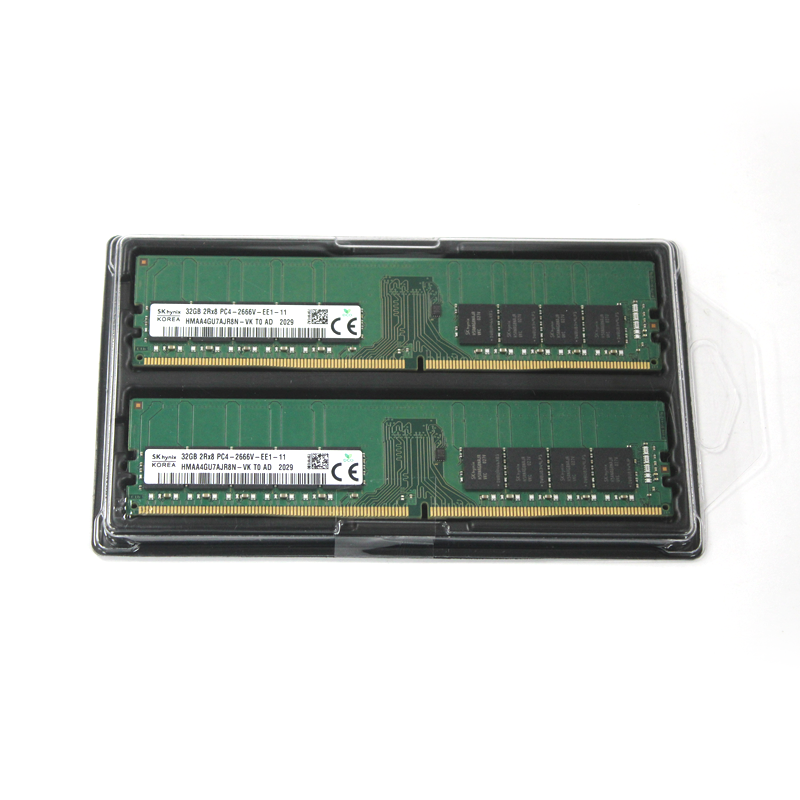
The SK Hynix HMAA4GU7AJR8N-XNT0AD is a 32 GB DDR4 UDIMM with ECC, immediately positioning it as a server-grade memory module designed for workstations and entry-level servers where registered memory is not required but data integrity is non-negotiable. What truly sets this module apart is the convergence of four critical attributes: true ECC error correction, unbuffered architecture, dual-rank x8 organization, and 3200 MHz speed. In a virtualized cluster running multiple VMs, a single-bit memory flip can corrupt hypervisor states or guest data silently; ECC detects and fixes these errors in real time, directly preventing unexplainable application crashes and data loss that erode business trust. The unbuffered design eliminates the extra clock cycle introduced by register chips, yielding lower latency per transaction compared to RDIMMs—a decisive advantage when an in-memory database like Redis processes millions of high-frequency queries, where every nanosecond saved accumulates into tangible response-time improvements. Dual-rank x8 construction means the memory controller can interleave accesses across two internal ranks, sustaining higher effective bandwidth under heavy concurrent loads, such as when a virtualization host saturates its memory bandwidth with simultaneous backup jobs and live migrations. Finally, the DDR4-3200 frequency at a mere 1.2 V delivers this throughput without pushing thermal thresholds inside dense rackmount chassis, ensuring reliable 24/7 operation. For IT managers, this translates into smaller replication lag, faster guest failover, and consistently stable service-level agreements—outcomes that directly safeguard revenue and productivity.
Server Memory Capacity Planning Guide
Based on the specifications — 32GB DDR4-3200 ECC Unbuffered UDIMM (Dual Rank x8, 1.2V) — this module is designed for entry-level servers and workstations requiring data integrity without the cost of registered memory. Below are capacity recommendations for typical server workloads.
General Virtualization
Deploy multiple 32GB modules to achieve at least 128GB across four DIMM slots, which comfortably supports 10–15 lightweight VMs with memory overcommit controlled. Stick to identical dual-rank UDIMMs for symmetric memory population, preserving optimal interleaving and avoiding performance penalties under moderate consolidation ratios.
In-Memory Database
For in-memory datasets (e.g., Redis, Memcached), populate all available channels with 32GB modules to maximize capacity per socket — a 64GB floor is practical for development, while 128–256GB is advisable for production caching. ECC is critical here to prevent silent data corruption, and dual-rank x8 configuration boosts bandwidth to handle heavy read/write streams efficiently.
High-Performance Computing (HPC)
Aim for balanced DIMM-per-channel configuration: install one 32GB DIMM per channel to achieve uniform memory bandwidth across all cores. For compute-bound simulations, 192GB on a 6-channel platform offers both capacity headroom and the sustained throughput of PC4-25600. Select CL22 latency to maintain stability under sustained full-load thermal conditions typical in clustered nodes.
Rigorously tested server memory. Compatible with Dell PowerEdge T350, HPE ProLiant DL20 Gen10, Lenovo ThinkSystem ST250, and similar ECC UDIMM platforms.
Q: Can I mix this HMAA4GU7AJR8N-XNT0AD with other memory modules of different brands or speeds?
A: Mixing different brands or speeds with registered ECC memory is not advised. Mismatched modules may compromise ECC functionality and cause system instability in server environments.
Q: Is this memory compatible with my Intel Xeon E-2300 or AMD EPYC 3000 server platform?
A: This Hynix DDR4-3200 ECC UDIMM is designed for Intel Xeon E/E-2300 and AMD EPYC 3000 platforms that support unbuffered ECC memory. Please check your motherboard's qualified vendor list for confirmation.
Q: What is the recommended DIMM population order for optimal performance?
A: Populate identical DIMMs sequentially per memory channel, starting with the slots farthest from the CPU. For dual-processor servers, balance modules equally across both CPU memory banks as detailed in your motherboard manual.
Q: Does this module support overclocking or XMP profiles?
A: No, this is a JEDEC-compliant server memory module operating at fixed DDR4-3200 CL22. It does not support XMP or overclocking, prioritizing data integrity over adjustable speeds.
Q: What warranty and typical failure rate can I expect?
A: SK hynix provides a 1-year warranty for this module. Due to rigorous factory testing and ECC-grade components, the annualized failure rate is exceptionally low, typically under 0.5%.