











 Secure payments
Standard refund policy
Trade Assurance
Secure payments
Standard refund policy
Trade Assurance
| Product Type | Memory Module |
|---|---|
| Memory Capacity | 64 GB |
| Memory Technology | DDR4 |
| Product Voltage | 1.2 V |
| RAM Speed | 2933 MHz |
| RAM Standard | DDR4-2933/PC4-23400 |
| Error Identifying | ECC |
| Signal Type | Registered |
| Column Access Strobe (CAS) | CL21 |
| Rank | Quad Rank x4 |
| Quantity of Pins | 288-pin |
| RAM Genre | RDIMM |
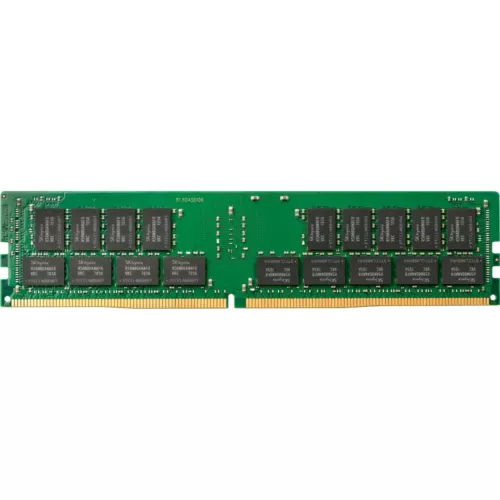
This 64 GB DDR4-2933 Registered ECC memory module is purpose-built for server platforms, excelling in virtualization, in-memory databases, and data-integrity-critical workloads. Its quad-rank x4 architecture combined with registered signal buffering delivers stable, high-density scaling per channel, while integrated ECC and a low 1.2 V operating voltage provide continuous error protection and power efficiency in always-on enterprise deployments.
1. High-capacity 64 GB module dramatically increases VM density per server, allowing IT to consolidate more workloads onto fewer physical hosts without sacrificing performance.
2. End-to-end ECC protection silently corrects single-bit errors and detects multi-bit faults, safeguarding in-memory financial transactions and sensitive databases from silent data corruption.
3. Registered signal buffering stabilizes command/address lines across heavily populated memory channels, ensuring reliable operation when all DIMM slots are filled in large-scale virtualization clusters.
4. Quad Rank x4 organization maximizes capacity per slot for memory-hungry in-memory computing and large-scale analytics, helping delay costly server expansions.
5. 2933 MT/s sustained throughput keeps multiple CPU cores fed with data, reducing memory latency penalties under mixed enterprise workloads and improving response times in virtualized environments.
The HMAA8GR7AJR4N-WM 64GB DDR4-2933 RDIMM is engineered to eliminate memory-related failures in enterprise servers. ECC corrects single-bit errors induced by background radiation, which is critical for VMware virtualization clusters and in-memory databases like SAP HANA—one corrupt bit can crash dozens of VMs or introduce financial discrepancies. Registered buffering ensures stable signal integrity when fully loading multi-socket servers with these dense DIMMs, enabling you to confidently scale to 2TB of RAM per node for higher consolidation ratios. The quad-rank x4 organization maximizes concurrent data access, so Redis or Memcached caches deliver consistent sub-millisecond responses even under extreme query loads. The 2933 MHz speed minimizes bottlenecks for real-time analytics. This translates directly into uncompromised data fidelity, more workloads per server, and relentless uptime.
General Virtualization
Populate all memory channels symmetrically with one 64 GB RDIMM per channel to deliver both high bandwidth and robust capacity. In a typical dual‑socket server with eight channels, this yields 512 GB, comfortably hosting dozens of virtual machines while maintaining the full 2933 MT/s speed. The module’s registered ECC design guarantees data integrity, and spare DIMM slots leave room for seamless expansion as VM density grows.
In-Memory Database
Maximizing capacity is paramount—fill every available DIMM slot with identical 64 GB quad‑rank modules to reach multi‑terabyte footprints so entire databases reside in RAM. Balance population identically across CPU sockets and memory channels to sustain predictable low‑latency access. With on‑chip ECC and registered buffering, these RDIMMs provide the data reliability and signal stability required for 24/7 in‑memory operations.
High-Performance Computing
For bandwidth‑sensitive HPC, install one DIMM per channel (1DPC) using these 64 GB modules to run without frequency penalties at 2933 MHz. When capacity takes precedence, a 2DPC configuration can double total memory per node while accepting a mild clock reduction. A balanced node typically carries 8–16 DIMMs, and always uses identical part numbers across sockets to avoid training inconsistencies and ensure stable parallel computation.
Validated and rigorously tested for Dell PowerEdge R760, R750, HPE ProLiant DL380 Gen10, and Lenovo ThinkSystem SR650.
Q: Can I mix this HMAA8GR7AJR4N-WM with other memory modules of different brands or speeds?
A: Mixing this registered ECC module with different brands or speeds is strongly discouraged. Mismatched timings, ranks, or ECC registry often lead to boot failures, signal integrity issues, or unpredictable server instability. Use identical modules per channel.
Q: Is this memory compatible with my system?
A: This is compatible with servers supporting DDR4-2933 ECC Registered DIMMs, such as Intel Xeon Scalable (Purley/Whitley) or AMD EPYC platforms. For guaranteed compatibility, consult your motherboard’s qualified vendor list (QVL) before purchase.
Q: What is the recommended DIMM population order for optimal performance?
A: Follow your server board’s memory slot numbering precisely. Typically, populate the first slot of each memory channel (often blue or white) first. With quad‑rank DIMMs, balanced per‑channel loading helps maintain 2933 MT/s speed; mixing ranks may reduce frequency.
Q: Does this module support overclocking or XMP profiles?
A: No. This is an enterprise‑grade registered ECC module engineered for 24/7 stability at JEDEC standard timings. It does not support overclocking, XMP profiles, or any non‑standard memory configurations.
Q: What warranty and typical failure rate can I expect?
A: This Hynix memory includes a 1‑year warranty. Enterprise DDR4 RDIMMs typically exhibit an annualized failure rate (AFR) well below 0.5% under specified environmental conditions, ensuring extremely high reliability.