











 Secure payments
Standard refund policy
Trade Assurance
Secure payments
Standard refund policy
Trade Assurance
| Product Type | Memory Module |
|---|---|
| Compliance Standards | RoHS,WEEE |
| Memory Capacity | 64 GB |
| Memory Technology | DDR4 |
| Product Voltage | 1.2 V |
| RAM Speed | 2933 MHz |
| RAM Standard | DDR4-2933/PC4-23400 |
| Error Identifying | ECC |
| Signal Type | Registered |
| Column Access Strobe (CAS) | CL21 |
| Rank | Quad Rank x4 |
| Quantity of Pins | 288-pin |
| RAM Genre | RDIMM |
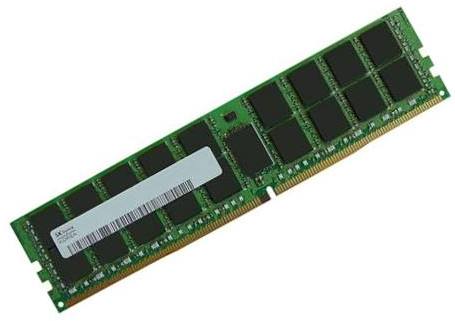
This 64GB DDR4-2933 registered ECC RDIMM, engineered with a quad-rank x4 configuration and CL21 latency, is ideally suited for dense server platforms handling virtualization, in-memory databases, and other mission-critical workloads. Its ECC error correction and registered signaling deliver superior data integrity and robust signal stability even in fully populated memory channels.
1. The 64 GB capacity per module allows dense memory configurations in rack servers, supporting a higher number of virtual machines per physical host without sacrificing performance.
2. Registered signal type stabilizes the command and address buses under heavy loads, which is essential for maintaining data integrity in multi-DIMM enterprise storage and database servers.
3. Error Correcting Code (ECC) detection and correction prevent single-bit memory errors from causing application crashes, delivering the continuous uptime required for mission-critical workloads.
4. The DDR4 memory technology operates at a base voltage of 1.2 V, reducing power consumption across fully populated server nodes and lowering the cooling overhead in data centers.
5. Running at a transfer speed of 2933 MHz, this module increases memory bandwidth to speed up in-memory analytics and high-frequency trading computations where every microsecond counts.
In data centers where every transaction counts, the HMAA8GR7MJR4N-WM 64GB DDR4-2933 RDIMM transforms memory into a reliability engine, not just a resource pool. Its ECC actively corrects single-bit errors, eliminating the silent data corruption that can crash virtual machines or poison financial records in an in-memory database like SAP HANA. Registered signal buffering means the memory controller drives only the register, not all DRAM chips directly, so you can fully populate a server with 16 or more DIMMs per CPU without signal degradation—critical when consolidating dozens of virtual desktops on a single host. The quad-rank x4 organization, combined with 64GB capacity, delivers deeper row-hit efficiency under heavy, random access patterns, directly accelerating hypervisor page-table walks and large Redis datasets. Running at 1.2V, it also shrinks the thermal footprint of a fully loaded rack, reducing cooling costs without sacrificing the 2933 MT/s throughput that keeps latency-sensitive VMs responsive. For your virtualization cluster, this means fewer lockups during live migrations; for your analytics node, it means predictable, error-free results even after weeks of continuous load.
General Virtualization
For dense virtualized environments, populate one 64 GB quad-rank RDIMM per memory channel across both CPU sockets. In a dual-socket server with sixteen DIMM slots, this yields 1 TB of ECC-protected memory, comfortably supporting over 100 moderate VMs. You may leave slots free for expansion or install two DIMMs per channel for even higher density if a slight speed drop is acceptable.
In-Memory Database
To maximize dataset size for applications like SAP HANA or Redis, install one 64 GB RDIMM per channel to sustain the full 2933 MT/s speed. A 24-slot system fitted with these modules reaches 1.5 TB, ideal for large in-memory analytics. The registered ECC design is essential—it prevents silent data corruption and maintains stability under intense, sustained memory loads.
High-Performance Computing (HPC)
HPC workloads demand balanced bandwidth and capacity. Use a one-DIMM-per-channel configuration to keep memory running at the rated 2933 MHz, avoiding frequency downgrades common with multiple quad-rank modules. A dual-socket server with sixteen such DIMMs provides 1 TB of fast, reliable memory, perfect for simulation, modeling, and parallel processing that requires both low latency and high throughput.
Rigorously tested server memory, compatible with Dell PowerEdge R750, HPE ProLiant DL380 Gen10, Lenovo ThinkSystem SR650 V2.
Q: Can I mix this HMAA8GR7MJR4N-WM with other memory modules of different brands or speeds?
A: Mixing brands or speeds is not recommended for server RDIMMs. Mismatched modules may cause POST failures or signal integrity issues. Always install identical, validated DIMMs to ensure reliable ECC operation and platform stability.
Q: Is this memory compatible with my system?
A: This 64GB DDR4-2933 ECC Registered DIMM is compatible with servers based on Intel Xeon Scalable or AMD EPYC platforms that support 288-pin RDIMM. Please verify your motherboard or vendor’s qualified vendor list (QVL) for HMAA8GR7MJR4N-WM.
Q: What is the recommended DIMM population order for optimal performance?
A: Consult your server manual for specific population rules. Typically, populate identical DIMMs per channel, starting with the slots farthest from the CPU (often blue slots). Balance across all memory channels to maximize interleaving and bandwidth.
Q: Does this module support overclocking or XMP profiles?
A: No. This ECC RDIMM is designed for enterprise reliability and strictly adheres to JEDEC DDR4-2933 specifications. It does not support XMP profiles or overclocking, as data integrity is prioritized over frequency scaling.
Q: What warranty and typical failure rate can I expect?
A: This Hynix module carries a 1-year warranty. Enterprise-grade ECC RDIMMs like this offer high reliability with an annualized failure rate (AFR) typically below 0.2% under standard server operating conditions.