











 Secure payments
Standard refund policy
Trade Assurance
Secure payments
Standard refund policy
Trade Assurance
| Product Type | Memory Module |
|---|---|
| Memory Capacity | 64 GB |
| Memory Technology | DDR4 |
| Product Voltage | 1.2V |
| RAM Speed | 2933MHz |
| RAM Standard | DDR4-2933/PC4-23400 |
| Error Identifying | ECC |
| Signal Type | Registered |
| Column Access Strobe (CAS) | CL21 |
| Rank | Quad Rank x4 |
| Quantity of Pins | 288-pin |
| RAM Genre | RDIMM |
This 64GB DDR4-2933 RDIMM with ECC and a Quad Rank x4 organization is purpose-built for enterprise servers running memory-intensive workloads such as virtualization, in-memory databases, and large-scale data analytics. The registered signal type and full ECC ensure robust signal integrity and end-to-end data protection on high-density platforms, while the quad-rank configuration maximizes capacity per channel without sacrificing stability in multi-DIMM deployments.
1. ECC protection silently corrects single-bit memory errors in real time, preserving data accuracy for mission-critical enterprise applications that demand non-stop reliability.
2. Registered signal buffering reduces electrical loading on the memory controller, allowing densely populated server boards to scale up capacity while sustaining rock-solid stability.
3. 64 GB capacity per stick enables high-density virtualization hosts to pack more tenants and memory-hungry workloads into fewer physical nodes, optimizing data center TCO.
4. Quad Rank x4 organization multiplies bank-level parallelism, keeping memory channels saturated to deliver predictable low-latency throughput under heavy consolidation of virtual machines.
5. DDR4-2933 speed supplies the sustained bandwidth necessary for concurrent analytics, high-performance storage caching, and responsive multi-user cloud services.
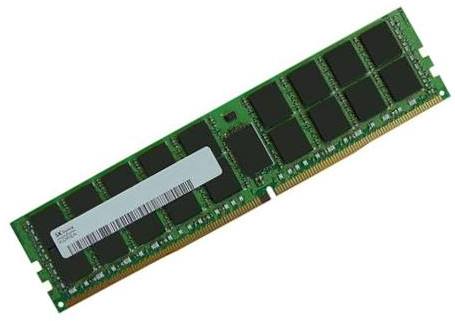
In a data center, silent data corruption is the enemy. The HMAA8GR7MJR4N-WMT8AC is a 64 GB DDR4-2933 Registered DIMM built specifically for enterprise servers where uptime and accuracy are non-negotiable. Its ECC engine actively detects and corrects single-bit memory errors, so a stray cosmic ray won’t flip a bit and corrupt a financial database transaction or a hypervisor’s memory table. That integrity is reinforced by the registered signal buffer, which stabilizes electrical loads when populating all channels on a multi-socket board, letting a virtualized cluster host dozens more VMs without periodic memory-related crashes. The quad-rank x4 organization and massive 64 GB capacity provide deep, interleaved bandwidth that feeds hungry in-memory databases like SAP HANA or real-time analytics platforms, drastically reducing CPU stall cycles during peak query loads. In practice, this module means a VMware farm can densify consolidation ratios safely, while a Redis or Memcached tier can scale its dataset without swapping to slower storage. Every transaction stays consistent, every query finishes predictably, and the server infrastructure delivers the relentless stability that enterprise SLAs demand.
General Virtualization
For general virtualization hosts, deploy this 64 GB RDIMM in multiples of two or four across memory channels to balance capacity and bandwidth. A dual-socket server populated with four modules (256 GB total) comfortably supports moderate VM density, while six or eight modules (384–512 GB) scale for heavier consolidation. Always populate identical DIMMs symmetrically per CPU to maintain NUMA balance and maximize memory interleaving.
In-Memory Database
In-memory databases demand both capacity and data integrity; this ECC Registered 64 GB DIMM is an ideal building block. Start with a minimum of four modules (256 GB) to host sizeable datasets entirely in RAM, and expand to eight or twelve modules for large-scale Redis, SAP HANA, or Memcached clusters. Populate all memory channels identically to sustain high throughput while ECC guards against bit errors during persistent in-memory operations.
High-Performance Computing (HPC)
HPC workloads benefit from high bandwidth and large per-node memory. Install six or eight of these quad-rank 2933 MT/s DIMMs in a dual-socket server to achieve 384–512 GB, ensuring one DIMM per channel for optimal speed. Though quad-rank DIMMs may slightly reduce maximum frequency, the capacity uplift accelerates memory-bound simulations and data-intensive modeling. Pair with balanced interleaving across CPUs to avoid memory bottlenecks in MPI or OpenMP jobs.
Rigorously tested, compatible with Dell PowerEdge R760, HPE ProLiant DL380 Gen10, Lenovo ThinkSystem SR650.
Q: Can I mix this HMAA8GR7MJR4N-WMT8AC with other memory modules of different brands or speeds?
A: Mixing RDIMMs is not recommended. Different brands, speeds, or ranks may cause signal integrity issues and system instability. Use identical Hynix quad-rank modules for guaranteed compatibility in multi-channel server configurations.
Q: Is this memory compatible with my system?
A: This module is designed for servers using Intel Xeon Scalable or AMD EPYC platforms. Verify your motherboard supports DDR4-2933 Registered ECC DIMMs and has available 288-pin slots. Confirm quad-rank loading limits with the server vendor.
Q: What is the recommended DIMM population order for optimal performance?
A: Follow the server board's memory population guide. Typically, populate identical DIMMs in balanced channels—for example, slots A1 and B1 first, then A2 and B2. This ensures symmetric memory interleaving and maximum throughput.
Q: Does this module support overclocking or XMP profiles?
A: No. This is an enterprise RDIMM adhering strictly to JEDEC DDR4-2933 standards. It does not support XMP or user overclocking. Operating outside specified voltage and timings can compromise ECC integrity and system reliability.
Q: What warranty and typical failure rate can I expect?
A: This Hynix module carries a one-year warranty. Enterprise-grade RDIMMs exhibit extremely low annualized failure rates, typically under 0.5%, when operated within specified environmental and electrical conditions.