
 Secure payments
Standard refund policy
Trade Assurance
Secure payments
Standard refund policy
Trade Assurance
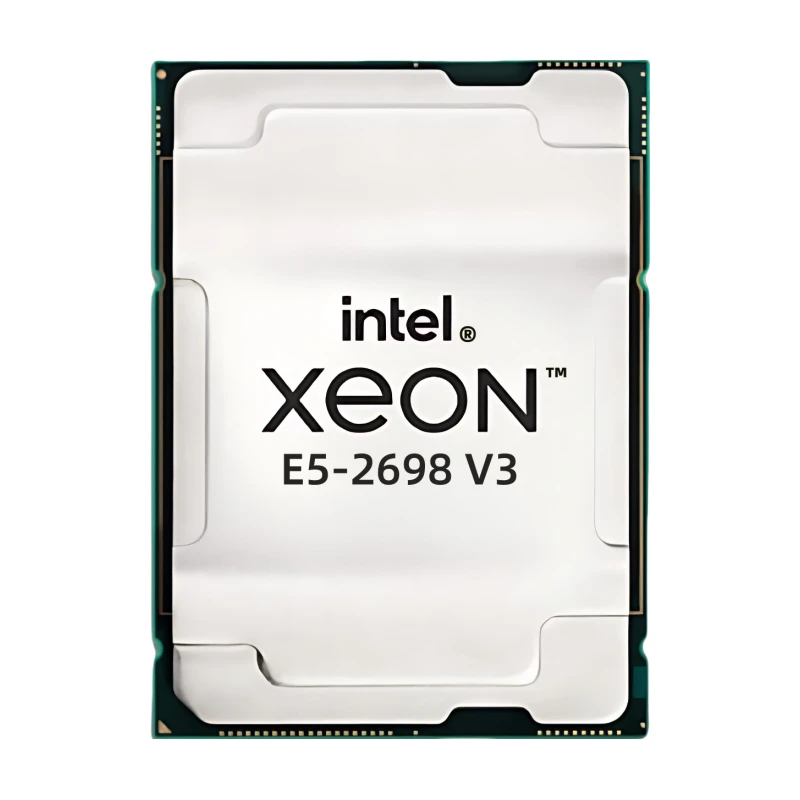
| Model Name | E5-2698 V3 |
|---|---|
| Brand Name | Intel |
| Series | E5 |
| Platform | Server |
| Cores | 16 |
| Threads | 32 |
| TDP | 135 W |
| Base Frequency | 2.3 GHz |
| Max Turbo Frequency | 3.6 GHz |
| Cache L3 | 40 MB |
| Memory Types | DDR4 1600/1866/2133 |
| Max Memory Size | 768 GB |
| ECC Memory Supported | Yes |
| Sockets Supported | FCLGA2011 |
| Max CPU Configuration | 2 |
Engineer's Note: The Intel Xeon E5-2698 v3 pairs 16 cores / 32 threads with a 2.3 GHz base clock that boosts to 3.6 GHz on demand, making it a drop-in candidate for budget virtualization clusters and dev/test environments. The 135 W thermal envelope keeps it inside standard server cooling budgets. Positioned as a proven Haswell/Broadwell-era Xeon that still powers thousands of production clusters worldwide, it is built for sustained multi-user workloads.
1. 2.3 GHz base / 3.6 GHz turbo: the frequency governor drops light threads onto boosted cores, so single-threaded paths (license checks, stored procedures, log processing) finish fast while background jobs keep the remaining cores saturated. The result is responsive interactive performance without sacrificing aggregate throughput.
2. Value in the refurbished market: as a previous-generation part it delivers proven reliability at a fraction of launch pricing, which is why it remains the default choice for dev/test farms, lab clusters, and secondary nodes where cost per core matters more than peak performance.
3. 135 W TDP: the thermal envelope is sized for sustained all-core loads in multi-socket chassis, so the processor holds its rated clocks through long batch windows instead of throttling halfway through. It also keeps per-socket cooling and power costs predictable when you scale out — datacenter capacity planning runs on numbers like these.
4. 16 cores / 32 threads: hardware multi-threading lets each physical core run two instruction streams, so concurrent workloads — budget virtualization clusters and dev/test environments — share the die without context-switch overhead. When you size licenses or plan VM placement, thread count is the number the scheduler actually sees.
5. Memory platform on the Intel Xeon E5-2698 v3: support for DDR4 1600/1866/2133, up to 768 GB of RAM. This is the headroom in-memory databases and dense VM farms need — capacity for growth, bandwidth for the data streams in between.
If your roadmap includes budget virtualization clusters and dev/test environments, the Intel Xeon E5-2698 v3 turns architectural decisions into predictable outcomes. Its 16-core layout sizes the node for expected concurrency, the 3.6 GHz turbo headroom keeps interactive paths responsive, and 768 GB of addressable memory gives the platform room to grow. Every unit passes functional testing before shipment, and our bulk-pricing desk keeps multi-socket refresh projects inside budget.
Q: Is the Intel Xeon E5-2698 v3 compatible with my server?
A: The Intel Xeon E5-2698 v3 uses the platform-standard socket. Verify your board's supported processor list before purchase. Our team can confirm compatibility if you share your server model.
Q: Do you offer bulk pricing for fleet upgrades?
A: Yes. Multi-socket refresh projects and fleet orders get consolidated pricing — request a quote through the form on this page with your target quantity, and our team responds with an offer typically within one business day.
Q: Will 135 W TDP fit my server's cooling budget?
A: 135 W is within the standard envelope for its socket generation, so existing chassis cooling handles it under sustained all-core load. Confirm your server's supported TDP range if you are upgrading from a lower-tier part.
Q: Is it new or refurbished? What warranty applies?
A: We offer both new and tested refurbished units — the condition is shown on each listing. All processors include a one-year warranty and pass functional testing (boot, memory controller, all cores) before dispatch.
Q: What memory does it require?
A: The platform supports DDR4 1600/1866/2133. Use ECC registered memory (RDIMM/LRDIMM) — desktop UDIMMs are not compatible with Xeon sockets. Faster modules will downclock to the processor's rated speed.