











 Secure payments
Standard refund policy
Trade Assurance
Secure payments
Standard refund policy
Trade Assurance
| Product Type | Memory Module |
|---|---|
| Memory Capacity | 64 GB |
| Memory Technology | DDR5 |
| RAM Speed | 6400 MHz |
| RAM Standard | DDR5-6400/PC5-51200 |
| Error Identifying | ECC |
| Signal Type | Registered |
| Column Access Strobe (CAS) | CL52 |
| Rank | Dual Rank x4 |
| Quantity of Pins | 288-pin |
| RAM Genre | RDIMM |
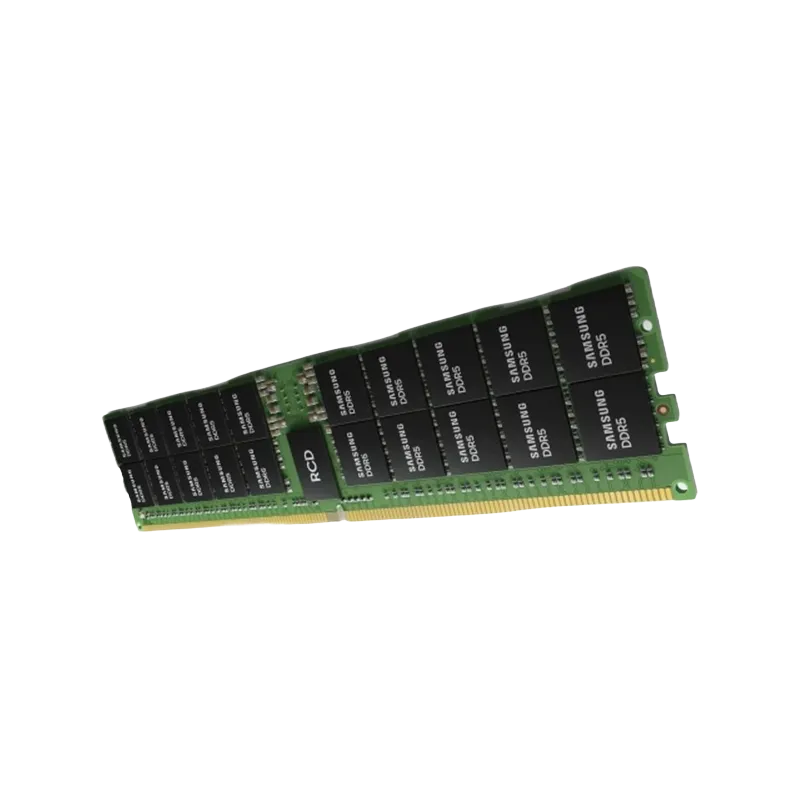
Designed specifically for enterprise servers, this 64GB DDR5-6400 Registered DIMM with ECC delivers the data integrity and reliability essential for virtualization, in-memory databases, and mission-critical workloads. Its Dual Rank x4 organization and Registered signal type maximize memory bandwidth and channel stability in dense multi-DIMM configurations, ensuring consistent performance under heavy load.
1. A 64GB capacity per module allows a single server to host significantly more virtual machines or in-memory databases, maximizing consolidation ratios and reducing total cost of ownership in dense data center deployments.
2. DDR5-6400 bandwidth doubles the peak throughput over previous generations, ensuring real-time analytics and AI inference workloads receive data with minimal latency across populated memory channels.
3. ECC protection actively detects and corrects single-bit memory errors, preserving the integrity of financial transactions and long-running scientific computations where silent data corruption is unacceptable.
4. Registered signal architecture decouples the DRAM load from the memory controller, enabling fully-populated RDIMM configurations without sacrificing signal integrity—vital for large-scale, always-on server environments.
5. Dual Rank x4 organization interleaves access across multiple internal banks, keeping channel utilization high even under heavy multi-core processing, which directly translates to smoother performance for containerized microservices scaling across CPU cores.
Based on its specifications, the M321R8GA0EB2-CCPWF is unmistakably a server-class DDR5 Registered DIMM, purpose-built for mission-critical enterprise environments. Its 64GB capacity directly tackles the memory starvation plaguing dense virtualization clusters; when a single hypervisor runs dozens of VMs, each demanding dedicated RAM, this high-density module allows far more workloads to be consolidated on one node, slashing licensing and power costs. The ECC technology is non-negotiable for financial transaction databases or scientific computing, where even a single cosmic-ray-induced bit flip can silently corrupt results or trigger costly system halts—here it catches and corrects errors in real time, preserving data integrity round the clock. Registered buffering stabilizes the heavy electrical loads of fully populated servers, ensuring reliable signal integrity when all 24 DIMM slots are loaded in a database server. Meanwhile, DDR5-6400 speed combined with a dual-rank x4 organization delivers immense parallel throughput, dramatically accelerating in-memory analytics platforms like SAP HANA, where every nanosecond of increased bandwidth translates directly into faster business insights.
General Virtualization
For a dual-socket server with 16 or more DIMM slots, populate at least eight of these 64GB RDIMMs per CPU to achieve 512GB–1TB total capacity, which comfortably supports 50+ moderate VMs. Enable balanced or interleaved memory configuration in BIOS to maximize bandwidth and minimize NUMA latencies, and always install identically ranked dual-rank DIMMs in each memory channel for stability under multi-tenant workloads.
In-Memory Database
Deploy six or eight 64GB modules per socket with one DIMM per channel (1DPC) to preserve the 6400MT/s speed and avoid clock-down, yielding 384GB–512GB of low-latency capacity per node. Scale to 1TB with additional modules if the platform supports 2DPC at the same speed, ensuring the entire dataset fits in RAM for real-time analytics on Redis or SAP HANA.
High-Performance Computing
Fully populate all eight or twelve memory channels per socket with one of these 64GB RDIMMs per channel to maximize bandwidth and double the raw throughput over half-populated configurations. Configure the memory in symmetrical quad-channel groups and leverage ECC and registered signal integrity, critical for sustained parallel simulations and large-scale MPI jobs running over many nodes without data corruption.
Rigorously tested for seamless compatibility with Dell PowerEdge R760, HPE ProLiant DL380 Gen11, Lenovo ThinkSystem SR650 V3.
Q: Can I mix this M321R8GA0EB2-CCPWF with other memory modules of different brands or speeds?
A: Mixing different brands or speeds is not recommended for server environments. It may cause instability or compatibility issues. For guaranteed reliability, use identical M321R8GA0EB2-CCPWF modules across all populated channels.
Q: Is this memory compatible with my system?
A: This 64GB DDR5-6400 RDIMM is designed for Intel Xeon Scalable and AMD EPYC platforms supporting registered ECC memory. Please verify your server motherboard’s QVL for exact compatibility with this part number.
Q: What is the recommended DIMM population order for optimal performance?
A: Populate DIMMs in sets of eight for balanced multi-channel performance. Typically, fill the farthest slot from the CPU in each channel first. Always consult your server’s service guide for the specific layout to maximize interleaving.
Q: Does this module support overclocking or XMP profiles?
A: No. As an enterprise-class Registered ECC module, it operates exclusively at JEDEC standard specifications (DDR5-6400 CL52). XMP and overclocking are not supported to ensure data integrity and long-term stability.
Q: What warranty and typical failure rate can I expect?
A: This module includes a one-year warranty. The typical annualized failure rate (AFR) is exceptionally low, achieved through rigorous screening, ECC, and registered design, meeting strict enterprise reliability standards.