











 Secure payments
Standard refund policy
Trade Assurance
Secure payments
Standard refund policy
Trade Assurance
| Model | M393A1G43DB0-CPB0Q |
|---|---|
| Product Type | Memory Module |
| Compliance Standards | CE,WEEE,RoHS |
| Memory Capacity | 8 GB |
| Memory Technology | DDR4 |
| Product Voltage | 1.2V |
| RAM Speed | 2133MHz |
| RAM Standard | DDR4-2133/PC4-17000 |
| Error Identifying | ECC |
| Signal Type | Registered |
| Column Access Strobe (CAS) | CL15 |
| Rank | Dual Rank x8 |
| Quantity of Pins | 288-pin |
| RAM Genre | RDIMM |
This DDR4-2133 registered ECC RDIMM is engineered for server platforms running memory-intensive workloads such as virtualization and in-memory databases, where data integrity is non-negotiable. Its dual-rank x8 organization boosts bandwidth through bank interleaving, and the registered signaling with CL15 latency ensures stable, low-latency operation while hardware ECC corrects errors to maintain 24/7 reliability.
1. ECC memory actively detects and corrects single-bit errors, safeguarding transactional data integrity in financial and database servers where even a silent corruption is unacceptable.
2. Registered signal buffering decouples the memory controller from the DRAM load, allowing fully populated server boards with high capacity while maintaining rock‑solid signal stability under 24/7 operation.
3. Dual Rank x8 organization enables rank interleaving that raises effective bandwidth, letting a hypervisor serve multiple virtual machines with reduced access contention.
4. An 8 GB capacity provides a balanced memory footprint for entry‑level application servers or scaling‑out microservice nodes without wasting power on overprovisioned resources.
5. DDR4‑2133 speed delivers a reliable 17 GB/s throughput per channel, well suited for running lightweight databases and business logic in power‑constrained rack environments.
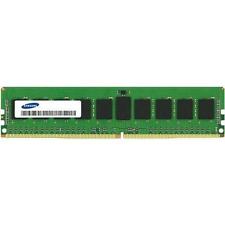
The Samsung M393A1G43DB0-CPB0Q is an 8GB DDR4-2133 registered ECC RDIMM engineered for server platforms where data integrity, capacity scalability, and consistent performance are non‑negotiable. Its four defining characteristics translate directly into real‑world reliability for demanding data‑center workloads.
First, ECC error correction continuously detects and corrects single‑bit memory errors, a critical defense against silent data corruption. In a virtualized cluster hosting dozens of VMs, a single uncorrected bit flip can crash a hypervisor or silently alter financial transaction records — ECC ensures your virtualization stack remains stable and trustworthy. Second, the registered buffer isolates the memory controller from the electrical load of multiple ranks, enabling you to populate all DIMM slots without signal degradation. This means you can scale to 512GB or more per node with confidence, essential for dense consolidation in VMware or Hyper‑V farms. Third, the dual‑rank x8 organization leverages rank interleaving: the memory controller can issue commands to one rank while the other completes a previous access, boosting effective bandwidth by up to 10–15%. For an in‑memory database like SAP HANA or a Redis cache that must serve millions of key‑lookups per second, that extra throughput directly reduces query latency. Finally, the 1.2V operating voltage lowers thermal output and power draw compared to earlier generations — in a rack of 40 nodes, the cumulative energy savings and reduced cooling load measurably cut your total cost of ownership, all while preserving the rugged stability your enterprise applications demand.
General Virtualization
For a hypervisor host running multiple VMs, populate all memory channels evenly with identical 8GB RDIMMs to maximize bandwidth. A common configuration is 8 or 12 modules (64–96GB), allowing per-VM allocation while leaving headroom for ballooning and failover.
In-Memory Database
In-memory databases demand large capacity and low latency, so install at least 16 of these dual-rank DIMMs (128GB) across all channels, fully populating a dual-socket server. Use the maximum supported speed and disable NUMA interleaving where beneficial to keep data local to the processor.
High-Performance Computing (HPC)
For memory-bandwidth-bound HPC workloads, aim for a balanced configuration of one DIMM per channel to avoid rank-stalling, typically 8 or 16 modules per node. Leverage the ECC and registered signaling to maintain data integrity under sustained parallel processing; consider populating only half the slots if per-core capacity requirements are modest, preserving all-channel throughput.
Rigorously tested server memory. Compatible with Dell PowerEdge R760, HPE ProLiant DL380 Gen11, and Lenovo ThinkSystem SR650.
Q: Can I mix this M393A1G43DB0-CPB0Q with other memory modules of different brands or speeds?
A: Mixing is not advised for server environments. Mismatched speeds, ranks, or vendors can cause instability and unexpected POST failures. Always use identical, validated modules to ensure full RDIMM interoperability and data integrity.
Q: Is this memory compatible with my server platform, such as Intel Xeon or AMD EPYC?
A: This DDR4-2133 ECC Registered DIMM targets Intel Xeon E5-2600 v3/v4 and select single-socket platforms using C612/C232 chipsets. AMD Ryzen/Threadripper is not supported. Verify your motherboard’s RDIMM Qualified Vendor List.
Q: What is the recommended DIMM population order for optimal performance with this module?
A: Populate identical DIMMs per channel, filling blue slots first on Intel dual-socket boards, then black. Balance across memory channels evenly to maximize interleaving and avoid throttling. Consult your server’s manual for population sequence.
Q: Does this module support overclocking or XMP profiles?
A: No, this server-grade RDIMM does not support overclocking or XMP. It runs at fixed JEDEC DDR4-2133 CL15 timings to guarantee 24/7 stability, ECC protection, and compliance with OEM platform electrical and thermal tolerances.
Q: What warranty and typical failure rate can I expect with this module?
A: This module includes a 1-year warranty. In controlled data-center environments, the typical annualized failure rate (AFR) is well below 0.5%, reflecting the reliability of Samsung’s server-grade RDIMM design and stringent testing.