











 Secure payments
Standard refund policy
Trade Assurance
Secure payments
Standard refund policy
Trade Assurance
| Model | M393B2G70EB0-CMAQ3 |
|---|---|
| Product Type | Memory Module |
| Compliance Standards | CE,WEEE,RoHS |
| Memory Capacity | 16 GB |
| Memory Technology | DDR3 |
| Product Voltage | 1.5V |
| RAM Speed | 1866MHz |
| RAM Standard | DDR3-1866/PC3-14900 |
| Error Identifying | ECC |
| Signal Type | Registered |
| Column Access Strobe (CAS) | CL13 |
| Rank | Dual Rank x4 |
| Quantity of Pins | 240-pin |
| RAM Genre | RDIMM |
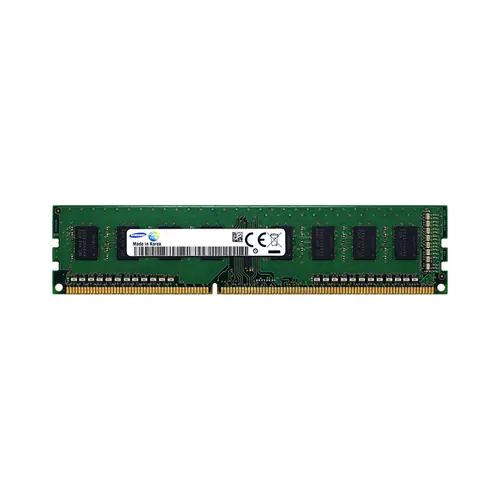
This DDR3-1866 Registered ECC RDIMM, leveraging a Dual Rank x4 organization and CL13 latency, is purpose-built for legacy server platforms that demand uncompromising data integrity and memory density in virtualized environments. Its registered signal type ensures stable command-address management under heavy loads, making it ideal for memory-intensive workloads like in-memory databases and large-scale virtualization.
1. Registered signal Type stabilizes high-density memory configurations, ensuring reliable 24/7 operation under heavy multi-tenant data center loads.
2. ECC error Identifying corrects single-bit errors in real time, preventing silent data corruption in transactional databases and financial workloads.
3. Dual Rank x4 architecture interleaves memory accesses to fully saturate the channel, maximizing bandwidth efficiency for dense virtual machine consolidation.
4. 1866MHz ram Speed delivers the elevated throughput needed to keep pace with multi-core server CPUs, reducing latency spikes during simultaneous data streaming.
5. 16GB memory Capacity provides the headroom to run more containers and VMs per node, directly driving higher workload density in virtualized environments.
The Samsung M393B2G70EB0-CMAQ3 is a 16GB DDR3 Registered ECC memory module engineered specifically for enterprise servers and data‑critical platforms, where downtime is not an option. Its four defining characteristics directly address the real‑world demands of virtualized clusters and in‑memory databases.
First, ECC error correction continuously detects and corrects single‑bit memory errors—silent data corruption that, in a financial trading database or a customer ledger, could cascade into costly discrepancies. Without ECC, a flipped bit in a Redis or SAP HANA dataset might go unnoticed until it distorts a critical business report. Second, the Registered (RDIMM) architecture buffers command and address signals, allowing you to populate all memory channels with high‑density 16GB DIMMs without signal degradation. For a VMware ESXi host running 30 or more virtual machines, this means stable, massive memory pools that prevent random guest crashes during peak consolidation. Third, the Dual‑rank x4 organization leverages internal bank interleaving to deliver faster row‑cycling and higher sustained bandwidth; when your in‑memory analytics engine scans terabytes of data, this parallelism cuts query latency noticeably. Finally, the DDR3‑1866 speed and CAS 13 timing provide a sweet spot of throughput and responsiveness, ensuring that even in a mixed‑workload environment—from database indexing to live user sessions—your memory subsystem never becomes the bottleneck. Every transaction, every query, and every virtualized application runs with the integrity, density, and speed that make enterprise reliability more than a specification—it is your operational baseline.
General Virtualization
For dense VM consolidation, populate at least six 16GB RDIMMs per socket in balanced channel configurations to achieve 96–128 GB of ECC-protected capacity. Leverage Registered DDR3-1866’s higher per-channel scalability while avoiding small UDIMM limits, and leave two slots free for future scale-out to 256 GB when workload density increases.
In-Memory Database
Maximize capacity and rank interleaving by installing a full population of 16 GB dual-rank x4 RDIMMs — 12 modules per dual-socket node deliver 192 GB with outstanding throughput. Keep all channels populated identically to sustain low latency under heavy OLTP access, and favor 1.5V registered ECC modules to protect in-flight data integrity.
High-Performance Computing
Configure triple-channel or quad-channel uniformity with 16 GB RDIMMs to supply 2–4 GB per core for memory‑bandwidth‑bound simulations. Aim for 6–8 modules per socket to balance rank count and 1866 MT/s speed; avoid mixing ranks within a channel. The 1.5V registered design ensures signal stability across large‑node deployments running MPI workloads.
Rigorously tested server memory, compatible with Dell PowerEdge R720, HP ProLiant DL380p Gen8, and more.
Q: Can I mix this M393B2G70EB0-CMAQ3 with other memory modules of different brands or speeds?
A: Mixing modules is not recommended for server environments. It can lead to instability and forced lower speeds. For reliable operation, use identical Samsung RDIMMs with the same part number, rank, and timings.
Q: Is this memory compatible with my system?
A: This DDR3-1866 Registered ECC RDIMM is designed for dual-processor servers using Intel Xeon E5-2600 v2 or AMD Opteron 6300 series platforms. Verify your board supports 16GB Dual Rank x4 1.5V modules.
Q: What is the recommended DIMM population order for optimal performance?
A: Populate identical DIMMs per channel, starting with the slot farthest from the CPU. Match across memory channels to enable interleaving. Consult your server board manual for specific balanced configuration diagrams.
Q: Does this module support overclocking or XMP profiles?
A: No. This is a JEDEC-compliant server memory module and does not support XMP or overclocking. It operates at a fixed 1866MHz speed to ensure data integrity and 24/7 platform stability.
Q: What warranty and typical failure rate can I expect?
A: This module includes a 1-year warranty. Samsung server DRAM exhibits an extremely low annualized failure rate, typically under 0.1%, backed by rigorous testing for 24/7 enterprise workloads.