











 Secure payments
Standard refund policy
Trade Assurance
Secure payments
Standard refund policy
Trade Assurance
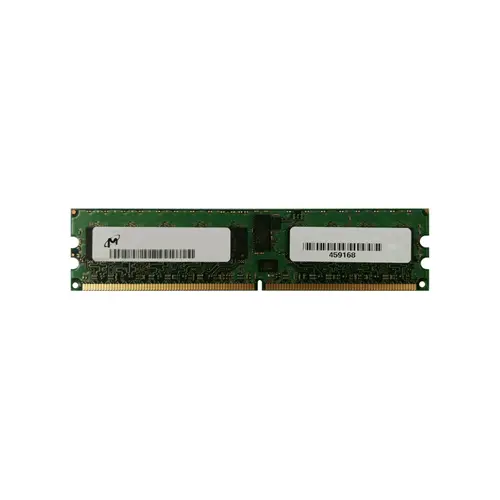
| Model | MT18HTF25672PDZ-667H1 |
|---|---|
| Product Type | Memory Module |
| Compliance Standards | RoHS |
| Memory Capacity | 2 GB |
| Memory Technology | DDR2 |
| Product Voltage | 1.8V |
| RAM Speed | 667MHz |
| RAM Standard | DDR2-667/PC2-5300 |
| Error Identifying | ECC |
| Signal Type | Registered |
| Column Access Strobe (CAS) | CL5 |
| Rank | Dual Rank x8 |
| Quantity of Pins | 240-pin |
| RAM Genre | RDIMM |
This 2GB DDR2-667 Registered ECC RDIMM is engineered for legacy server platforms handling memory-intensive workloads like virtualization and lightweight databases, where data integrity and system stability are non-negotiable. Its dual-rank x8 organization maximizes bank-level parallelism for improved bandwidth efficiency, while the registered signal architecture and ECC error correction maintain clean command/address paths and protect against single-bit data corruption under sustained load.
1. ECC error correction safeguards financial databases against silent data corruption, ensuring data accuracy during non-stop transactional processing.
2. Registered clock buffering stabilizes the command and address lines, allowing fully populated memory channels to run reliably in dense virtualization hosts.
3. Dual Rank x8 organization maximizes interleaving efficiency, boosting bandwidth for multiple VMs competing for shared memory resources.
4. 2GB module capacity supplies sufficient memory footprint for lightweight container hosts or dedicated security appliances, balancing cost and operational density.
5. 667MHz clock speed delivers a 5.3 GB/s peak data rate, eliminating I/O bottlenecks in high-traffic web serving and caching tiers.
As a DDR2‑667 Registered ECC module, the MT18HTF25672PDZ-667H1 is engineered specifically for servers where uptime and data accuracy are non‑negotiable. In a virtualized cluster, a silent memory error can corrupt the hypervisor, causing downtime for all guest VMs. The onboard ECC actively detects and corrects single‑bit flips, protecting your virtual infrastructure from erratic crashes. Meanwhile, the Registered buffer strengthens signal integrity across densely populated memory channels, letting you populate all DIMM slots without sacrificing stability—critical when a single host runs eight or more memory‑hungry VMs. For performance‑sensitive in‑memory databases like Redis or SAP HANA, the dual‑rank x8 organization leverages bank interleaving to serve concurrent requests with far lower latency. Combined with its 667MHz clock delivering 5.3 GB/s of sustainable bandwidth, this module keeps transactional throughput high under real‑time loads. Every cycle translates directly into business reliability: fewer VM failures, faster query responses, and a server that stays resilient where it matters most.
General Virtualization
This 2GB DDR2-667 Registered ECC module is suited for entry-level virtualized environments running lightweight hypervisors. Deploy four to eight modules per server to build a 8–16 GB memory pool, enabling a handful of low-resource virtual machines. Always install in matched pairs or groups to maintain balanced interleaving and reliable ECC error correction.
In-Memory Database
For small-scale in-memory databases or caching layers, populate all available DIMM slots to maximize capacity on legacy platforms. A fully loaded server with 16–32 GB of registered memory allows datasets to reside primarily in RAM, reducing disk latency. Strictly adhere to dual-rank population rules and ensure identical modules are used to guarantee data integrity under constant write loads.
High-Performance Computing
In HPC clusters with older nodes, these modules can sustain memory bandwidth-sensitive parallel workloads when installed in multiples. Configure eight modules per dual-socket node for a 16 GB total, optimizing for dual-channel interleaving and minimizing NUMA penalties. Match capacity across all cluster nodes to preserve workload symmetry and prevent performance variability in MPI-based tasks.
Rigorously tested server memory. Compatible with Dell PowerEdge R805, HP ProLiant DL385 G2, IBM System x3455, Supermicro X7DBR.
Q: Can I mix this MT18HTF25672PDZ-667H1 with other memory modules of different brands or speeds?
A: Mixing is not recommended for server environments. Mismatched brands, speeds, or ranks can cause instability and defeat the purpose of ECC registration. For guaranteed reliability, use identical part numbers in all channels.
Q: Is this memory compatible with my system?
A: This DDR2-667 Registered ECC RDIMM is compatible with server platforms using Intel 5000/5400 series or AMD Opteron chipsets supporting 240-pin DDR2 ECC Registered memory. Always verify your server's Qualified Vendor List (QVL).
Q: What is the recommended DIMM population order for optimal performance?
A: For multi-channel server boards, populate identical DIMMs per channel starting with the farthest slot from the CPU. Follow the motherboard manual's memory configuration matrix to balance interleaving and maximize memory bandwidth.
Q: Does this module support overclocking or XMP profiles?
A: No. This is a JEDEC-compliant server-grade RDIMM operating at fixed 667MHz with CL5 timings. It does not support overclocking, XMP profiles, or any form of dynamic performance tuning beyond standard specifications.
Q: What warranty and typical failure rate can I expect?
A: This module carries a 1-year warranty. As an enterprise-grade RDIMM, it delivers a very low annualized failure rate (AFR) under nominal conditions when used within specified voltage and thermal limits in validated server systems.