











 Secure payments
Standard refund policy
Trade Assurance
Secure payments
Standard refund policy
Trade Assurance
| Product Type | Memory Module |
|---|---|
| Compliance Standards | RoHS |
| Memory Capacity | 8 GB |
| Memory Technology | DDR3 |
| Product Voltage | 1.5V |
| RAM Speed | 1600MHz |
| RAM Standard | DDR3-1600/PC3-12800 |
| Error Identifying | ECC |
| Signal Type | Registered |
| Column Access Strobe (CAS) | CL11 |
| Rank | Single Rank x4 |
| Quantity of Pins | 240-pin |
| RAM Genre | RDIMM |
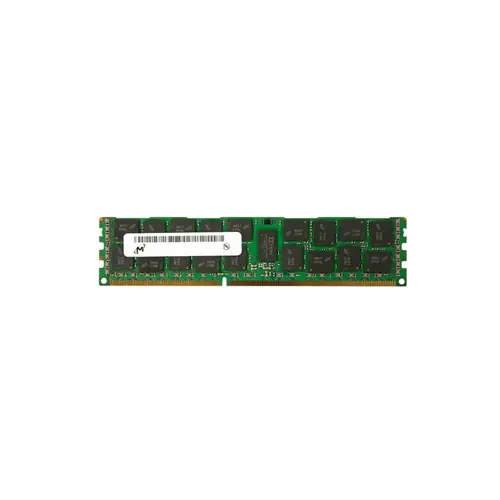
Designed for server platforms, this 8 GB DDR3-1600 Registered DIMM with ECC ensures data integrity in virtualized environments and in-memory databases. Its single-rank x4 configuration reduces electrical loading on the memory bus, enabling stable operation in high-density deployments where reliability is critical.
1. ECC protection actively corrects single-bit errors and detects multi-bit corruption, shielding financial and database transactions from silent data loss in 24/7 operation.
2. Registered signal buffering reduces electrical load on the memory controller, enabling a server to populate all DIMM slots for maximum RAM scalability without compromising stability.
3. Single Rank x4 configuration leverages four-bit-wide DRAM chips to strengthen ECC granularity, isolating chip failures into smaller data chunks and maintaining overall system integrity.
4. Eight gigabytes per module provides dense building blocks for virtualization hosts, allowing more concurrent virtual machines per physical server within constrained slot counts.
5. 1600 MHz transfer rate delivers high memory bandwidth essential for parallel processing in big-data analytics and content delivery, keeping data pipelines saturated under multicore CPU loads.
For your enterprise server infrastructure, the Micron MT18JSF1G72PZ-1G6E1HE 8GB DDR3-1600 RDIMM is far more than a simple capacity upgrade—it is an architectural safeguard. Designed expressly for registered server platforms, this module’s ECC technology actively corrects single-bit memory errors in real time. In a dense virtualization cluster hosting dozens of VMs, a cosmic ray-induced bit flip in ordinary memory can silently corrupt a guest operating system or a transactional database record. ECC eliminates that risk at the hardware level, preserving data integrity across your entire virtualized estate absolutely non-negotiable for financial services or healthcare workloads. The registered signal buffer is equally critical. By re-driving address and command signals, it allows your server to populate all channels with multiple modules without electrical loading instability, enabling smooth scaling to 128 GB or more. Scenario two: an in-memory database like Redis or SAP HANA. Here, the single-rank x4 organization provides consistent, predictable bandwidth under the heaviest query loads, while the registered design ensures zero signal droop when all banks are hammered concurrently—meaning your lowest-latency transactions never stall, even during peak trading or analytics windows. This is stability engineered for always-on business.
General Virtualization
For moderate consolidation of virtual machines, start with four of these 8 GB RDIMMs (32 GB total), populating identical modules across all memory channels to ensure balanced interleaving and maximum throughput. Scale to eight modules (64 GB) or sixteen modules (128 GB) as VM density grows, always matching DIMM rank and speed to avoid performance penalties and maintain ECC reliability.
In-Memory Database
In-memory databases benefit from large, low-latency capacity; use at least sixteen 8 GB modules (128 GB) to keep entire datasets resident. Fill all available DIMM slots with identical single‑rank x4 RDIMMs to maximize capacity while preserving the error‑correcting protection that registered ECC memory provides for mission‑critical data integrity.
High-Performance Computing (HPC)
HPC workloads are often memory‑bandwidth‑sensitive, so populate one or two DIMMs per channel to fully utilize the memory controller’s width. A common building block is eight 8 GB modules (64 GB) installed symmetrically across channels, delivering 1600 MT/s with CL11 latency. Avoid mixing different ranks or capacities within a channel to prevent sub‑optimal interleaving and maintain peak floating‑point throughput.
Tested and compatible with Dell R720, HP DL380p G8, Lenovo x3650 M4 servers.
Q: Can I mix this MT18JSF1G72PZ-1G6E1HE with other memory modules of different brands or speeds?
A: Mixing RDIMMs is not recommended. Different brands, speeds, or ranks often cause instability. For validated performance and ECC reliability, populate all channels with identical Micron 8GB DDR3-1600 RDIMMs.
Q: Is this memory compatible with my Intel or AMD server platform?
A: This 240-pin DDR3-1600 Registered ECC module targets Intel Xeon E5-2600 v1/v2 and select AMD Opteron platforms using C600 or A890 chipsets. Confirm your server board explicitly supports 1.5V 8GB Single Rank x4 RDIMMs.
Q: What is the recommended DIMM population order for optimal performance?
A: Populate one DIMM per channel starting from the slot farthest from the CPU. Follow your server manual for balanced configurations. Identical Single Rank x4 modules across channels ensure maximum memory bandwidth and interleaving.
Q: Does this module support overclocking or XMP profiles?
A: No. This is a JEDEC-compliant Registered ECC server module running at DDR3-1600 CL11. Overclocking and XMP are not supported, as enterprise memory prioritizes data integrity and 24/7 stability over peak frequency.
Q: What warranty and typical failure rate can I expect?
A: This Micron RDIMM includes a 1-year warranty. Enterprise Registered ECC memory exhibits very low annualized failure rates (generally under 0.5%) due to rigorous screening, JEDEC compliance, and RDIMM signal integrity improvements.