











 Secure payments
Standard refund policy
Trade Assurance
Secure payments
Standard refund policy
Trade Assurance
| Product Type | Memory Module |
|---|---|
| Compliance Standards | RoHS |
| Memory Capacity | 8 GB |
| Memory Technology | DDR3 |
| Product Voltage | 1.5V |
| RAM Speed | 1866MHz |
| RAM Standard | DDR3-1866/PC3-14900 |
| Error Identifying | ECC |
| Signal Type | Registered |
| Column Access Strobe (CAS) | CL13 |
| Rank | Single Rank x4 |
| Quantity of Pins | 240-pin |
| RAM Genre | RDIMM |
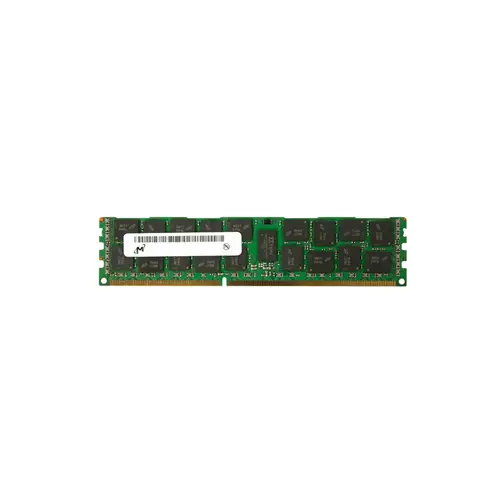
This 8GB DDR3-1866 RDIMM leverages ECC and registered signal buffering to deliver uncompromised data integrity and stability for server platforms running virtualization or in-memory database workloads. Its single-rank x4 configuration reduces electrical loading on the memory controller, while the CL13 low latency accelerates data access in latency-sensitive enterprise applications.
1. Registered signal type buffers the command and address lines, enabling large memory populations with minimal electrical load for rock-solid stability in dense server racks.
2. ECC error correction actively detects and corrects single-bit memory faults, preventing silent data corruption in mission-critical virtualization and database workloads.
3. 8 GB capacity per module provides a balanced building block for virtualization hosts, allowing fine-grained memory allocation to multiple VMs without oversubscription waste.
4. 1866 MHz speed delivers high memory bandwidth, reducing latency in simultaneous data-streaming operations such as in-memory analytics and large-scale caching.
5. Single Rank x4 organization offers a lean electrical profile that maximizes signal integrity and clock-frequency headroom in fully populated multi-DIMM server channels.
Based on the RDIMM form factor, ECC error correction, and Registered signal type defined under RAM Genre, the MT18JSF1G72PZ-1G9E1HG is unequivocally a server-grade memory module. This 8GB DDR3-1866 RDIMM is engineered for reliability, not just speed, and its specifications translate directly into uptime and performance for critical enterprise workloads.
The ECC technology is the first line of defense against bit-flip errors caused by cosmic radiation, silently correcting single-bit faults that would otherwise corrupt transactional databases or crash a hypervisor during extended uptime. In a dense virtualization cluster running dozens of VMs, a single uncorrected memory error can cascade into service outages; this module eliminates that risk. The Registered signal buffer is equally vital: it stabilizes the electrical load on the memory controller when populating all 24 DIMM slots across a dual-socket server. This allows your VMware farm or in-memory database like Redis to scale to massive capacities without signal degradation or boot failures. Meanwhile, the single-rank x4 organization at 1866MHz provides balanced bandwidth and low latency for rapid data access—critical when hundreds of virtual machines compete for a finite memory bus, or when an SAP HANA instance needs to traverse large datasets in real time. Combined, these features ensure that your server infrastructure stays predictable, consistent, and resilient under 24/7 operation, directly protecting your revenue stream from memory-induced downtime.
Memory Type Identification: This is server-class memory, specifically an 8 GB DDR3-1866 Registered ECC RDIMM. It is designed for rack and tower servers requiring data integrity and large memory capacities.
General Virtualization
For a typical dual-socket server with triple-channel architecture, populate all memory channels symmetrically to maximize bandwidth. Install at least six modules (48 GB total) to support a moderate number of virtual machines, but scaling to 12 modules (96 GB) is recommended for dense consolidation. Always use identical RDIMMs per channel to avoid speed degradation and ensure ECC protection across all VMs.
In-Memory Database
In-memory databases demand low latency and high capacity above all else. Use the maximum supported DIMMs per channel while respecting rank limitations. For a 2-socket server with 12 DIMM slots, install twelve of these 8 GB RDIMMs for a total of 96 GB. This single-rank x4 configuration helps maintain 1866 MHz operation even with multiple DIMMs per channel, which is critical for real-time analytics.
High-Performance Computing (HPC)
HPC workloads are sensitive to memory bandwidth. Populate one DIMM per channel to achieve peak throughput and avoid frequency drops. In a six-channel platform, six 8 GB modules yield 48 GB with full 1866 MHz speed; for capacity-bound simulations, deploy twelve modules (96 GB) but verify that the platform can sustain the rated speed at 2 DIMMs per channel. ECC ensures result accuracy during extended computation runs.
Rigorously tested for Dell PowerEdge R720, R620, HPE ProLiant DL380p Gen8 servers.
Q: Can I mix this MT18JSF1G72PZ-1G9E1HG with other memory modules of different brands or speeds?
A: Mixing is not recommended. To ensure stability, all DIMMs must match type (DDR3 Registered ECC), speed, rank, and ideally brand. Mismatched modules may cause system incompatibility or signal issues.
Q: Is this memory compatible with my system?
A: This RDIMM is designed for servers with Intel Xeon E5-2600 v1/v2 or AMD Opteron 6300 platforms supporting DDR3-1866. Confirm compatibility via your motherboard’s QVL list.
Q: What is the recommended DIMM population order for optimal performance?
A: Populate identical DIMMs per channel starting from the farthest slot from CPU. Balance across CPUs in dual-processor systems. Refer to the server manual for specific population rules to avoid performance loss.
Q: Does this module support overclocking or XMP profiles?
A: No. This is a server Registered ECC module operating at JEDEC standard DDR3-1866 CL13. It does not support overclocking or XMP, prioritizing stability and data integrity.
Q: What warranty and typical failure rate can I expect?
A: This module includes a 1-year warranty. Enterprise RDIMMs exhibit a very low annualized failure rate (typically <0.5%), ensuring high reliability for mission-critical workloads.