











 Secure payments
Standard refund policy
Trade Assurance
Secure payments
Standard refund policy
Trade Assurance
| Product Type | Memory Module |
|---|---|
| Compliance Standards | RoHS |
| Memory Capacity | 4 GB |
| Memory Technology | DDR3 |
| Product Voltage | 1.5V |
| RAM Speed | 1866MHz |
| RAM Standard | DDR3-1866/PC3-14900 |
| Error Identifying | ECC |
| Signal Type | Registered |
| Column Access Strobe (CAS) | CL13 |
| Rank | Dual Rank x8 |
| Quantity of Pins | 240-pin |
| RAM Genre | RDIMM |
Designed for server platforms, this 4GB DDR3-1866 Registered DIMM with ECC ensures data integrity in mission-critical environments such as virtualization and in-memory databases. Its dual-rank x8 organization and CL13 latency provide a balanced combination of signal stability and responsive access, making it ideal for legacy enterprise systems that require reliable, high-speed memory.
1. ECC memory detects and corrects single-bit errors in real time, safeguarding transactional data integrity in mission-critical server environments.
2. Registered signal buffering reduces electrical load on the memory controller, enabling stable operation with high-capacity DIMMs in dense rack servers.
3. RDIMM architecture ensures reliable command/address signal integrity, a must-have for scalable multi-socket platforms running enterprise databases.
4. The DDR3-1866 frequency elevates memory bandwidth, accelerating in-memory analytics and large-scale virtualization workloads under heavy concurrency.
5. Dual Rank x8 organization interleaves memory accesses across two internal rank groups, boosting throughput efficiency for heavily multi-threaded server applications.
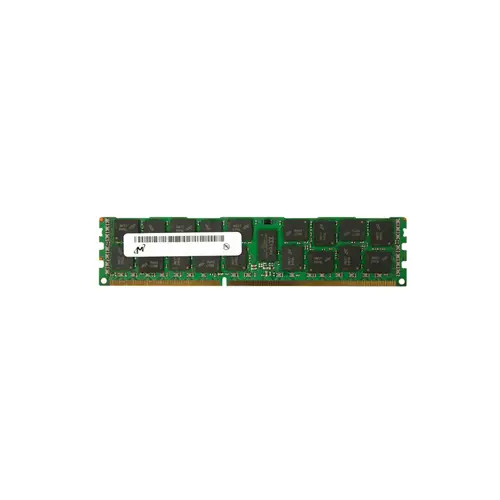
The Micron MT18JSF51272PDZ-1G9K1 is a 4GB DDR3-1866 Registered DIMM with ECC, purpose-built for server environments where uptime and data accuracy are non-negotiable. Its ECC engine silently corrects single-bit memory errors, defending against cosmic-ray-induced bit flips that could corrupt financial transaction logs or silently destabilize virtual machines in a dense VMware cluster. The registered clock driver buffers command and address signals, dramatically reducing electrical loading on the memory controller; this stability lets you populate all 24 DIMM slots in a dual-socket platform without signal degradation, essential for scaling memory capacity in large virtualization hosts. Dual-rank x8 organization enables rank interleaving, which overlaps read and write operations across ranks to sustain high bandwidth, directly accelerating in-memory databases like Redis or SAP HANA where microsecond latency matters. Meanwhile, the 1866MHz clock speed with CL13 latency ensures that critical queries execute swiftly, minimizing response times under heavy concurrent loads. For IT managers, these four characteristics combine to deliver rock-solid reliability, predictable performance, and investment protection in always-on enterprise workloads.
General Virtualization
For DDR3-era servers, this 4 GB RDIMM is best deployed in high-density module counts to overcome the modest per-DIMM capacity. Aim for at least 12–16 identical modules across all memory channels to maximize interleaving and bandwidth. Populate in balanced configurations (e.g., 6×4 GB or 8×4 GB per socket) to support a healthy number of light to medium virtual machines without excessive swapping.
In-Memory Database
In-memory databases demand both capacity and resilience, making ECC Registered memory non-negotiable. While 4 GB sticks are small by modern standards, you can build a reliable 64–128 GB pool using 16–32 modules in a multi-socket platform. Ensure all ranks are populated identically to maintain uniform latency and avoid NUMA penalties, keeping the working set fully resident in RAM for real-time analytics.
High-Performance Computing (HPC)
HPC workloads benefit from the predictable timing and signal integrity of registered DIMMs at 1866 MHz. A fully populated 16-slot or 24-slot server (e.g., dual-socket) using these dual-rank x8 modules delivers strong memory bandwidth aggregation for parallel MPI tasks. Balance modules per channel (one or two DIMMs per channel) to sustain the rated speed, and leverage ECC to protect long-running simulation integrity.
Rigorously tested server memory, validated for Dell PowerEdge R720, HP ProLiant DL380p Gen8, Lenovo System x3650 M4.
Q: Can I mix this MT18JSF51272PDZ-1G9K1 with other memory modules of different brands or speeds?
A: Mixing RDIMMs is strongly discouraged. Registered ECC modules must match in speed, rank, and timings to ensure signal integrity. Mixed configurations often cause POST failures or system instability on server platforms.
Q: Is this memory compatible with my system? It will be used in an Intel-based server platform.
A: This DDR3-1866 Registered ECC module requires a server board with an Intel C602 or similar chipset supporting dual-rank x8 RDIMMs. Verify your board's QVL list and ensure 1.5V ECC support.
Q: What is the recommended DIMM population order for optimal performance?
A: Populate corresponding slots per channel following your server board's memory configuration guide. Typically, install identical modules in blue slots first, balancing across memory channels for optimal interleaving.
Q: Does this module support overclocking or XMP profiles?
A: No. This is a JEDEC-compliant server RDIMM running at fixed 1866MHz with CL13 timings. It does not support XMP or user overclocking, prioritizing stability and data integrity for mission-critical workloads.
Q: What warranty and typical failure rate can I expect?
A: This module includes a 1-year warranty. Enterprise-grade RDIMMs exhibit very low annualized failure rates, typically below 0.5%, thanks to rigorous screening and ECC protection against single-bit errors.