











 Secure payments
Standard refund policy
Trade Assurance
Secure payments
Standard refund policy
Trade Assurance
| Product Type | Memory Module |
|---|---|
| Compliance Standards | RoHS |
| Memory Capacity | 4 GB |
| Memory Technology | DDR3 |
| Product Voltage | 1.5V |
| RAM Speed | 1600MHz |
| RAM Standard | DDR3-1600/PC3-12800 |
| Error Identifying | ECC |
| Signal Type | Registered |
| Column Access Strobe (CAS) | CL11 |
| Rank | Single Rank x4 |
| Quantity of Pins | 240-pin |
| RAM Genre | RDIMM |
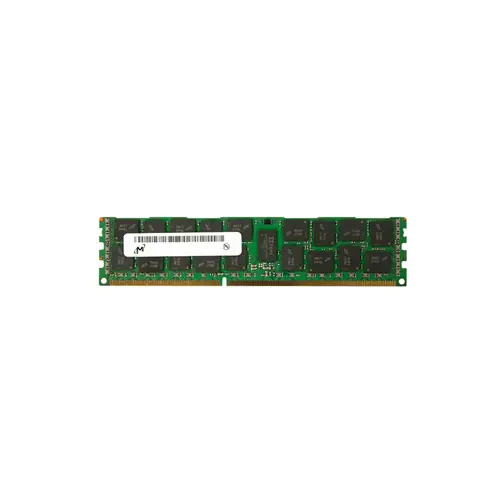
This Micron 4GB DDR3-1600 Registered ECC RDIMM is purpose-built for entry-level server and small-scale virtualization environments where data integrity and system uptime are critical. The combination of Error Correcting Code (ECC) and a Registered signal type ensures signal stability and single-bit error correction across multiple DIMMs, while the single-rank x4 organization helps reduce electrical loading and improve memory controller efficiency in dense server configurations.
1. ECC memory actively corrects single-bit errors and detects multi-bit failures, safeguarding data integrity for virtualization hosts and financial transaction logs.
2. Registered buffering re-drives address and command signals across fully populated channels, enabling stable memory expansion in high-density rack servers.
3. Single rank construction with narrow-interface DRAMs enhances granular error correction and reduces bus loading for cleaner signal quality.
4. Operating at mainstream DDR3 throughput, the module supplies consistent bandwidth for entry-level enterprise workloads while ensuring proven platform compatibility.
5. CAS eleven latency delivers predictable read timing, helping to keep server response uniform under sustained query processing.
The Micron MT18JSF51272PZ-1G6K1 is a server-grade Registered DIMM engineered for mission-critical enterprise environments, where unplanned downtime and silent data corruption are simply unacceptable. Its integrated ECC relentlessly detects and corrects single-bit errors—a vital safeguard when you run in-memory databases like Redis or SAP HANA, where a cosmic ray-induced bit flip could otherwise cascade into a financial misreport or a corrupted transaction log. The registered buffer dramatically reduces the electrical load on the memory controller, allowing your virtualization cluster to populate all channels without signal degradation; this means you can confidently scale up to dozens of virtual machines on a single host, even under heavy consolidation workloads, without mysterious reboots or memory training failures at boot. Paired with a single-rank x4 organization and 1600MHz speed, this module strikes a deliberate balance between low latency and sustained bandwidth, optimizing interleaving across channels for predictable high throughput during simultaneous VM snapshots or massive database query floods. Together, these attributes deliver what any IT manager craves: deterministic stability and ironclad data integrity, so your services stay up and your results stay accurate, even at three in the morning when no one is watching.
This DDR3-1600 registered ECC RDIMM (4GB, 1.5V, single-rank x4) is server-class memory. Its ECC and registered signaling are designed for 24/7 reliability in multi-socket servers. For capacity planning with this module, consider the following workload profiles.
General Virtualization
Populate all memory channels symmetrically to maximize bandwidth and support as many VMs as possible. A dual‑socket server commonly uses 12 to 16 of these 4GB RDIMMs (48–64GB total) to balance moderate VM density with cost. Ensure identical modules per channel for consistent performance.
In-Memory Database
Low latency and high capacity are critical. While a single 4GB module is small, populate every available DIMM slot — for example, 24 modules across a dual‑socket board to reach 96GB. The single-rank x4 organization helps maintain signal integrity at high slot count, enabling stable operation for real‑time analytics and caching workloads.
High Performance Computing (HPC)
Maximize memory bandwidth per core by filling all memory channels equally. A typical HPC node deploys 16 or 24 of these 1600MHz modules (64–96GB) to avoid bottlenecks in bandwidth‑sensitive simulations. The CL11 latency and registered design provide sufficient throughput for sustained floating‑point and data‑intensive parallel jobs.
Rigorously tested and compatible with Dell PowerEdge R720, R620, HP DL380p Gen8, and Lenovo ThinkServer RD630.
Q: Can I mix this MT18JSF51272PZ-1G6K1 with other memory modules of different brands or speeds?
A: Mixing Registered ECC modules of different brands or speeds is strongly discouraged. Mismatched ranks, timings, or voltage may cause server instability, POST failures, or data corruption. Always install identical modules for guaranteed reliability.
Q: Is this memory compatible with my Intel Xeon or AMD server platform?
A: This DDR3-1600 Registered ECC RDIMM is designed for Intel Xeon E5-2600 v1/v2 and AMD Opteron 6300 series platforms with C600/C602 chipsets. Confirm your board supports 1.5V, 240-pin, ECC Registered modules.
Q: What is the recommended DIMM population order for optimal performance?
A: Populate identical DIMMs per channel, starting from the farthest slot from each CPU. Balance capacity equally across all memory channels, and follow the server board’s specific slot numbering to achieve maximum throughput and RAS features.
Q: Does this module support overclocking or XMP profiles?
A: No. This is a JEDEC-compliant server RDIMM built for data integrity and 24/7 stability. It does not support overclocking, XMP profiles, or other enthusiast timings, as those features compromise error correction and reliable operation.
Q: What warranty and typical failure rate can I expect?
A: This Micron module carries a 1-year warranty. Enterprise-class Registered ECC memory typically delivers an annualized failure rate below 0.5% when kept within specified voltage and temperature thresholds, ensuring long-term operational dependability.