











 Secure payments
Standard refund policy
Trade Assurance
Secure payments
Standard refund policy
Trade Assurance
| Product Type | Memory Module |
|---|---|
| Memory Capacity | 16 GB |
| Memory Technology | DDR3 |
| Product Voltage | 1.35V |
| RAM Speed | 1600MHz |
| RAM Standard | DDR3-1600/PC3-12800 |
| Error Identifying | ECC |
| Signal Type | Registered |
| Column Access Strobe (CAS) | CL11 |
| Rank | Dual Rank x4 |
| Quantity of Pins | 240-pin |
| RAM Genre | RDIMM |
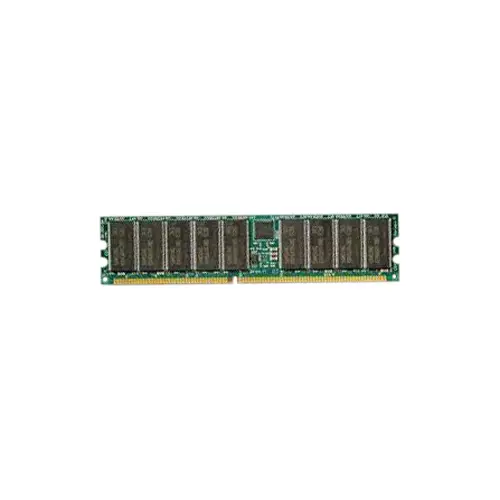
This RDIMM is engineered for server platforms demanding high data integrity, where its registered signal buffering and ECC ensure reliable operation under heavy, sustained loads typical of virtualization and in-memory database workloads. The dual-rank x4 organization, paired with a 1.35V low-voltage design, delivers enhanced memory bandwidth and reduced power consumption without sacrificing stability in multi-DIMM configurations.
1. Sixteen gigabyte capacity per module enables high-density memory configurations, allowing hypervisors to pack more virtual machines per physical server without sacrificing response times.
2. ECC protection corrects single-bit errors in real time, shielding transactional databases and mission-critical workloads from silent data corruption.
3. Registered signal type stabilizes the command and address bus, so the memory controller can reliably drive three DIMMs per channel and sustain large-capacity deployments.
4. Dual rank x4 organization interleaves memory accesses across internal banks, keeping server-class processors fed with maximum throughput during heavy consolidation peaks.
5. Low-voltage operation at 1.35 volts curbs power draw at the DIMM level, which compounds into meaningful savings on electricity and cooling in a fully populated data center rack.
The Micron MT36KSF2G72PZ-1G6P1MG is a 16GB DDR3-1600 Registered DIMM purpose-built for servers, and four of its design features directly translate into reliable, high-stakes performance. ECC error correction silently detects and repairs single-bit data corruption in real time—protecting your virtualized workloads and transactional databases from the random bit flips that cause application crashes or silent data loss. The registered buffer preserves signal integrity as you populate all memory channels, so you can scale a VMware cluster to its maximum capacity without stability fears, maintaining smooth live migration even under heavy memory pressure. Its dual-rank x4 organization exploits bank-level parallelism, dramatically reducing latency when dozens of virtual machines or an in-memory cache like Redis simultaneously issue read-modify-write commands. Operating at just 1.35V, this module draws less power than standard DDR3, slashing thermal buildup and electricity costs across dense server racks. In your virtualized server farm, these characteristics mean uninterrupted uptime and consistent guest responsiveness. In an OLTP database engine, they guarantee deterministic commit latency and data accuracy even at peak concurrency.
General Virtualization
For dense virtualization hosts, populate all memory channels symmetrically to maximize bandwidth and reduce NUMA latency. Using multiple 16 GB RDIMMs, aim for a balanced configuration such as 128 GB (8×16 GB) or 256 GB (16×16 GB) across two processors, allowing ample headroom for dozens of VMs. The low 1.35 V operation and ECC protection ensure stability and power efficiency in always‑on environments.
In-Memory Database
Capacity and reliability are paramount for in‑memory databases, making registered ECC memory a hard requirement. Deploy these 16 GB dual‑rank DIMMs at maximum supported population—often 256 GB to 512 GB per server—to keep entire datasets in RAM, and configure memory mirroring or sparing if the platform supports it to guard against uncorrectable errors. Dual‑rank x4 organization provides a good balance of capacity and signal integrity under heavy sustained load.
High-Performance Computing
HPC clusters benefit from the bandwidth consistency of registered DDR3‑1600 when all channels per CPU are populated identically. Install six or eight 16 GB RDIMMs per node to supply 96 GB or 128 GB, which satisfies the memory‑per‑core demands of most MPI and threaded simulation workloads. The 1.35 V low‑voltage design helps reduce thermal load in dense rack deployments, contributing to overall cluster energy savings without sacrificing ECC reliability.
Rigorously tested server memory. Proven compatible with Dell R720/R620, HP DL380p Gen8, Lenovo RD530, and more.
Q: Can I mix this MT36KSF2G72PZ-1G6P1MG with other memory modules of different brands or speeds?
A: Mixing modules of different brands or speeds is not recommended. For server reliability, use identical modules with the same part number, rank, and timings to avoid signal integrity issues and potential data corruption.
Q: Is this memory compatible with my system?
A: This DDR3-1600 Registered ECC RDIMM is compatible with Intel Xeon E5-2600 v1/v2 and AMD Opteron 6300 series platforms. Verify your server's QVL supports 1.35V low-voltage RDIMMs and dual-rank x4 configuration.
Q: What is the recommended DIMM population order for optimal performance?
A: Populate identical DIMMs in balanced pairs per memory channel, following your server board's slot numbering (often slot 1 and slot 3 first per channel) to maintain interleaving and maximize bandwidth while preserving ECC functionality.
Q: Does this module support overclocking or XMP profiles?
A: No. As an enterprise-grade RDIMM, it operates at JEDEC standard DDR3-1600 CL11 timings only. It does not support overclocking or XMP, ensuring 24/7 data integrity and operational stability.
Q: What warranty and typical failure rate can I expect?
A: It comes with a 1-year warranty. Under normal server operating conditions, the typical annualized failure rate is below 0.5%, backed by rigorous manufacturing and testing standards for mission-critical deployments.