











 Secure payments
Standard refund policy
Trade Assurance
Secure payments
Standard refund policy
Trade Assurance
| Product Type | Memory Module |
|---|---|
| Memory Capacity | 8 GB |
| Memory Technology | DDR3 |
| Product Voltage | 1.35V |
| RAM Speed | 1333MHz |
| RAM Standard | DDR3-1333/PC3-10600 |
| Error Identifying | ECC |
| Signal Type | Registered |
| Column Access Strobe (CAS) | CL9 |
| Rank | Dual Rank x4 |
| Quantity of Pins | 240-pin |
| RAM Genre | RDIMM |
This DDR3-1333 RDIMM, with its 1.35V low-power operation and registered ECC design, ensures robust data integrity and signal stability for always-on server platforms. Its dual-rank x4 configuration enhances interleaving efficiency, making it an ideal choice for memory-intensive virtualization workloads and in-memory databases where consistent low latency (CL9) is critical.
1. Registered buffering guarantees signal stability across fully loaded memory channels, a must-have for large-scale server deployments demanding uninterrupted operations.
2. ECC correction defends in-memory data integrity, preventing silent bit-flip corruption in mission-critical database and analytics workloads.
3. Low-voltage operation curtails datacenter energy draw and waste heat, driving down total cost of ownership per server node.
4. Dual Rank organization keeps data streaming efficiently by overlapping bank accesses, sustaining high throughput for virtualized server farms.
5. Generous module capacity allows dense memory configurations, supporting many virtual machines or containers without immediate scale-out expense.
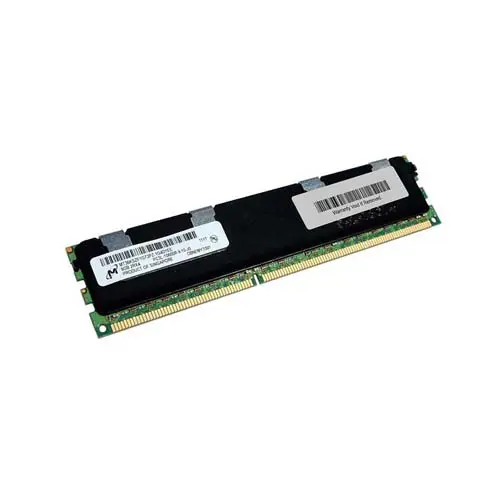
Designed for demanding server environments, the Micron MT36KSZF1G72PZ-1G4D1EE is an 8GB DDR3-1333 RDIMM that directly addresses the critical pain points of enterprise IT. The combination of ECC and Registered signal buffering forms the backbone of data integrity and system stability. In a dense virtualization cluster running multiple VMs per host, ECC actively corrects single-bit memory errors caused by background radiation, preventing silent data corruption that could crash a database transaction or an entire virtual machine. The registered buffer isolates the memory controller from electrical loading, enabling you to populate all 24 DIMM slots on a dual-socket server without sacrificing signal quality or facing unexpected reboots under full load.
Beyond reliability, the module’s Dual Rank x4 organization and 1.35V low-voltage operation deliver measurable performance and operational gains. In an in-memory database like Redis or a heavy SQL analytics workload, dual rank interleaving boosts effective bandwidth by overlapping access cycles, reducing the latency spikes that hurt query response times when multiple users hit the same tables. Meanwhile, operating at 1.35V instead of the standard 1.5V cuts power consumption per DIMM by nearly 20%, which directly lowers electricity costs and thermal stress inside densely packed chassis. Less heat means slower fan speeds and a longer hardware lifespan, turning what appears to be a simple 8GB stick into a strategic asset for cost-efficient, always-on data centers where every millisecond of latency and every watt of overhead counts.
General Virtualization
For light to moderate virtualization hosts, populate at least six of these 8GB RDIMMs (48GB total) across triple-channel memory controllers. Distribute modules evenly per CPU socket to maximize memory bandwidth and leave headroom for additional VMs. Avoid single-channel configurations as they severely limit guest performance.
In-Memory Database
In-memory workloads demand capacity and low latency. Deploy twelve or more modules for 96GB+, populating all channels per processor (e.g., three DIMMs per channel in a typical Nehalem/Westmere-based server). The registered ECC nature ensures data integrity, but confirm that CAS 9 and 1333MHz speed align with the CPU’s maximum supported frequency to prevent downclocking under full load.
High-Performance Computing (HPC)
Balance capacity and memory bandwidth by installing an equal number of DIMMs per channel, typically two per channel (2DPC) using dual-rank x4 modules. Starting with 96–128GB across nodes allows large working sets while dual-rank x4 organization yields optimal command/address scheduling. Scale out by adding identical kits to maintain uniform rank population and avoid performance cliffs in parallel MPI jobs.
Rigorously tested server memory, compatible with Dell PowerEdge R720, HP DL380p Gen8, IBM x3650 M4.
Q: Can I mix this MT36KSZF1G72PZ-1G4D1EE with other memory modules of different brands or speeds?
A: Mixing different brands or speeds is not recommended. For optimal stability in a server environment, use identical RDIMMs with the same part number, rank, and timing.
Q: Is this memory compatible with my system?
A: This DDR3L-1333 RDIMM works with select Intel Xeon E5-2400/E5-2600 v1/v2 and AMD Opteron 4300/6300 platforms. Verify your motherboard's QVL for full compatibility.
Q: What is the recommended DIMM population order for optimal performance?
A: Populate identical DIMMs per channel, starting with the farthest slot from the CPU. For dual-rank x4 modules, install in groups of three if triple-channel configuration is supported.
Q: Does this module support overclocking or XMP profiles?
A: No. This is a server-grade registered ECC module; it operates strictly at JEDEC-standard 1333MHz with CL9 timings and does not support XMP or overclocking.
Q: What warranty and typical failure rate can I expect?
A: It includes a 1-year warranty. Failure rate is extremely low (AFR <0.5% under normal conditions) as this premium Micron module is built for 24/7 enterprise reliability.