











 Secure payments
Standard refund policy
Trade Assurance
Secure payments
Standard refund policy
Trade Assurance
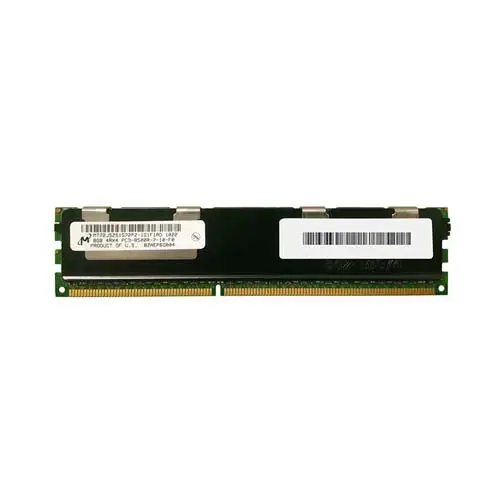
| Product Type | Memory Module |
|---|---|
| Memory Capacity | 8 GB |
| Memory Technology | DDR3 |
| Product Voltage | 1.5V |
| RAM Speed | 1066MHz |
| RAM Standard | DDR3-1066/PC3-8500 |
| Error Identifying | ECC |
| Signal Type | Registered |
| Column Access Strobe (CAS) | CL7 |
| Rank | Quad Rank x4 |
| Quantity of Pins | 240-pin |
| RAM Genre | RDIMM |
This DDR3-1066 registered ECC module (RDIMM) with a quad-rank x4 organization and CL7 latency is purpose-built for legacy server platforms requiring high memory density and data integrity, making it well-suited for virtualization hosts and in-memory database applications where registered signaling ensures stable operation across multiple DIMMs. The combination of Error Correcting Code (ECC) and registered signal buffering minimizes the risk of silent data corruption while allowing reliable population of all memory channels under sustained 1.5 V operation.
1. ECC error correction safeguards transactional data integrity, preventing silent memory corruption in always-on enterprise databases.
2. Registered signal buffering stabilizes high-capacity memory buses, essential for populating all channels without compromising server uptime.
3. Quad Rank x4 organization boosts channel interleaving and memory density per slot, directly increasing virtual machine consolidation ratios.
4. A moderate capacity footprint suits dense scale-out nodes where balanced resource allocation matters more than raw gigabytes.
5. Conservative DDR3-1066 clocking delivers predictable latency and thermal reliability, aligning with legacy server platforms that prioritize consistency over peak speed.
The Micron MT72JSZS1G72PZ-1G1F1AD 8GB DDR3-1066 Registered DIMM is engineered specifically for enterprise server environments, where stability and data fidelity are non‑negotiable. Its ECC capability silently detects and corrects single‑bit errors caused by background radiation or component aging, preventing silent data corruption that could crash an entire virtualized cluster or distort financial records inside an in‑memory database. The registered buffer decouples the memory controller from signal degradation when every channel is fully populated, allowing a single host to reliably support dozens of virtual machines without random reboots or data loss. The quad‑rank ×4 organization further leverages rank interleaving to hide refresh gaps and increase effective bandwidth, keeping latencies low for real‑time analytics platforms like SAP HANA that demand instant response even under heavy concurrent access. A tight CAS latency of just 7 cycles at 1066MHz sharpens that responsiveness, ensuring that ERP transactions and customer‑facing dashboards remain fluid during peak loads. For IT operators, these are not abstract parameters — they mean fewer outages, higher VM density, and snappier database performance that directly safeguards business continuity.
General Virtualization
For virtualization, install a minimum of two identical RDIMMs to enable dual‑channel operation and provide at least 16 GB for guest VMs. ECC memory ensures stability under constant load. Increase to 4 modules for 32 GB when hosting more VMs or memory‑intensive services.
In-Memory Database
To serve in‑memory databases, populate every DIMM slot (e.g., 12 or 24 sockets) to reach 96–192 GB, allowing entire datasets to reside in RAM. Quad‑rank RDIMMs require strict rank‑per‑channel planning; use identical modules and follow the server’s guidelines to avoid frequency penalties. Registered ECC safeguards transactional data integrity.
High-Performance Computing (HPC)
For HPC, install DIMMs in balanced sets across all memory channels to maximize bandwidth—typically 8 or 16 identical RDIMMs. The quad‑rank design improves rank interleaving, partially offsetting the 1066 MT/s data rate. If possible, overprovision capacity to avoid swap; however, consider newer platforms for compute‑bound workloads.
Proven reliable on Dell PowerEdge R710, R610, HP DL380 G7, IBM x3650 M3, and more after rigorous testing.
Q: Can I mix this MT72JSZS1G72PZ-1G1F1AD with other memory modules of different brands or speeds?
A: We strongly discourage mixing registered ECC modules of different brands or speeds. Mismatched timings or ranks may cause POST failures or silent data corruption in server environments. Always use identical modules for guaranteed stability.
Q: Is this memory compatible with my server? (Intel/AMD platforms)
A: This 8GB DDR3-1066 RDIMM is designed for Intel Xeon 5500/5600 series or AMD Opteron 6100 platforms with 240-pin slots. Please confirm your motherboard supports registered ECC memory and quad-rank DIMMs before purchase.
Q: What is the recommended DIMM population order for optimal performance?
A: Always follow your server’s specific population guide. Typically, install quad-rank RDIMMs starting with slots farthest from the CPU, balancing channels to maintain proper memory interleaving and thermal clearance.
Q: Does this module support overclocking or XMP profiles?
A: No. This server-grade DDR3-1066 RDIMM operates at JEDEC standard 1066MHz CL7 for 1.5V. It intentionally lacks overclocking or XMP support to deliver 24/7 error-free reliability under enterprise workloads.
Q: What warranty and typical failure rate can I expect?
A: This Micron module includes a 1-year warranty. Enterprise DDR3 RDIMMs exhibit very low annualized failure rates, typically under 0.5% when kept within rated voltage, temperature, and workload specifications.