











 Secure payments
Standard refund policy
Trade Assurance
Secure payments
Standard refund policy
Trade Assurance
| Product Type | Memory Module |
|---|---|
| Compliance Standards | RoHS |
| Memory Capacity | 1 GB |
| Memory Technology | DDR3 |
| RAM Speed | 1066MHz |
| RAM Standard | DDR3-1066/PC3-8500 |
| Error Identifying | Non-ECC |
| Signal Type | Unbuffered |
| Column Access Strobe (CAS) | CL7 |
| Rank | Single Rank x8 |
| Quantity of Pins | 240-pin |
| RAM Genre | UDIMM |
This unbuffered, non-ECC DDR3-1066 UDIMM with a CAS latency of 7 and single-rank x8 organization delivers low-latency responsiveness, making it an affordable upgrade for basic desktop productivity, web browsing, and light content creation. Its 240-pin unbuffered design ensures straightforward compatibility with consumer desktop platforms, while the tight CL7 timing enhances data access efficiency in everyday workloads.
1. Unbuffered UDIMM design eliminates unnecessary signal regeneration, maximizing compatibility with consumer desktop motherboards and ensuring a straightforward plug-and-play upgrade for home users.
2. Non-ECC architecture prioritizes raw speed and lower memory access overhead, delivering the fluid responsiveness that competitive gamers and live streamers demand.
3. DDR3 technology provides the foundational bandwidth headroom needed to keep multiple browser tabs, office applications, and media playback running concurrently without stuttering.
4. Low CAS latency directly shrinks the delay between a data request and its delivery, giving content creators a perceptibly snappier preview experience when scrubbing through timelines.
5. Single Rank x8 organization reduces the electrical load on the memory channel, improving signal integrity for higher achievable overclocking margins and rock-solid stability during extended desktop sessions.
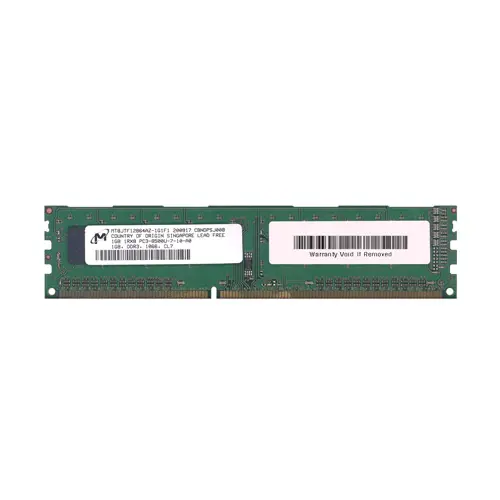
When you are still relying on a trusty older desktop platform, the MT8JTF12864AZ-1G1F1 module shows why specific technical attributes translate directly into tangible everyday performance. This 1 GB DDR3-1066 UDIMM is fully unbuffered and non-ECC, a combination that strips away any signal buffering latency. With a tight CAS latency of just 7 cycles, the stick reacts almost instantly to memory controller commands, which in real terms means every click in a classic game or legacy productivity suite registers without the micro-stutter that plagues slower-clocked, higher-latency replacement parts. Gamers restoring a vintage LAN rig will immediately notice smoother frame delivery in CPU-limited titles, while home theater PC users enjoy seamless HD video playback where audio sync remains perfectly stable. The single-rank x8 organization and 240-pin design maximize electrical compatibility with older Intel and AMD chipsets that can be fussy about high-density modules, eliminating no-boot scenarios during a quick upgrade. Because the module fully conforms to RoHS standards, it also means you are extending the life of aging hardware in an environmentally responsible way, avoiding hazardous materials while giving a reliable second wind to the system that still handles your daily browsing, media streaming, and light office work without a complete overhaul.
Gaming Build
For dual-channel gaming rigs, this 1GB DDR3-1066 UDIMM is outdated and insufficient. Modern titles demand at least 16GB total; a matched pair of 8GB sticks is the baseline. Using this module would severely bottleneck performance, so we recommend replacing it with a 2x8GB or 2x16GB kit running at higher speeds.
Content Creation
Content creation workloads like video editing and 3D rendering require large capacities—typically 64GB or more. A single 1GB stick is entirely obsolete. The ideal configuration is a four-module, quad-channel setup using 16GB or 32GB DIMMs, filling all slots for maximum bandwidth and capacity. This legacy module cannot support modern creative software.
General Productivity
For office multitasking and web-based work, 8GB is the cost-effective sweet spot. This 1GB module can function as a basic replacement in very old systems, but we strongly advise a dual-channel kit of 2x4GB or 2x8GB DDR3 1600MHz modules instead. Single-channel 1GB configurations will cause noticeable slowdowns even with light multitasking, making any upgrade to a matched pair a substantial usability improvement.
This rigorously tested desktop DDR3 UDIMM fits Dell OptiPlex 790, HP 8200 Elite, Lenovo M81.
Q: Can I mix this MT8JTF12864AZ-1G1F1 with other memory modules of different brands or speeds?
A: Mixing is not recommended. Even if the system boots, it will default to the lowest common speed (1066MHz) and looser timings, potentially causing instability or preventing dual-channel mode.
Q: Is this memory compatible with my desktop system? Which motherboard chipsets support it?
A: This 240-pin DDR3 UDIMM works with most Intel 3/4/5-series and AMD 7/8/9-series chipsets. Verify your motherboard supports non-ECC, unbuffered DDR3-1066 via its QVL for guaranteed compatibility.
Q: What is the recommended DIMM population order for optimal performance?
A: For a single module, install it in the slot farthest from the CPU or the primary slot specified in your manual. On dual-channel boards, populate matching-color slots first when adding a second identical module.
Q: Does this module support overclocking or XMP profiles?
A: No. This is a standard JEDEC-compliant DDR3-1066 CL7 module without XMP support. It operates only at its rated frequency and timings and is not designed for overclocking.
Q: What warranty and typical failure rate can I expect?
A: This module carries a 1-year warranty. Its typical AFR (annualized failure rate) is extremely low, under 0.5%, when operated within specified voltage and temperature ranges, ensuring reliable long-term use.