











 Secure payments
Standard refund policy
Trade Assurance
Secure payments
Standard refund policy
Trade Assurance
| Product Type | Memory Module |
|---|---|
| Compliance Standards | RoHS |
| Memory Capacity | 4 GB |
| Memory Technology | DDR3 |
| Product Voltage | 1.5V |
| RAM Speed | 1866MHz |
| RAM Standard | DDR3-1866/PC3-14900 |
| Error Identifying | ECC |
| Signal Type | Registered |
| Column Access Strobe (CAS) | CL13 |
| Rank | Single Rank x8 |
| Quantity of Pins | 240-pin |
| RAM Genre | RDIMM |
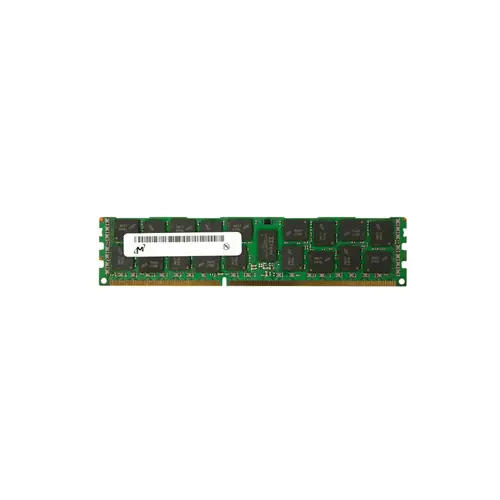
This DDR3-1866 RDIMM with ECC and a registered signal type is engineered for legacy server platforms, ensuring data integrity in memory-intensive workloads like virtualization or in-memory databases. Its single-rank x8 configuration and CL13 latency deliver a balance of low electrical loading and fast column access, optimizing performance and stability in multi-slot server deployments.
1. ECC protection corrects single-bit memory errors on the fly, ensuring data integrity for financial transactions and preventing silent corruption that could bring down critical server applications.
2. Registered signal buffering stabilizes the command and address lines, enabling fully populated server motherboards to run dense memory configurations without signal degradation or boot failures.
3. High clock speed elevates memory bandwidth, smoothing simultaneous virtual machine operations and accelerating in-memory database queries during peak enterprise workloads.
4. Single Rank x8 organization reduces electrical loading on the memory channel, improving thermal efficiency and sustaining reliable high-speed operation inside power-constrained rack servers.
5. The modest capacity serves as a dependable building block for lightweight server roles such as dedicated management controllers or network appliances where absolute reliability matters more than raw size.
As a registered ECC memory module, the MT9JSF51272PZ-1G9E2HE directly addresses the pain points of data center operators. Its ECC engine neutralizes single-bit upsets silently, so a virtualized environment hosting hundreds of machines won’t suffer undetected data corruption that could cascade into application failures or compliance violations. The registered clock driver buffers signals to maintain signal integrity across fully loaded 24-DIMM servers—this permits building the massive memory pools that in-memory databases like SAP HANA demand for real-time analytics. The 1866 MHz clock and CAS-13 latency minimize access delay, so transactional Redis caches and financial trading systems respond faster. Additionally, the single-rank x8 configuration limits electrical load and reduces rank-to-rank access latency; when multiple vCPUs contend for memory, your workloads achieve more predictable throughput instead of stuttering. For dense virtualization clusters and memory-intensive analytics, these traits unlock higher consolidation ratios, longer uptime, and absolute data integrity.
The 4 GB DDR3-1866 ECC Registered RDIMM (PC3-14900, CL13) is a server memory module. Leverage its reliability and registered architecture as follows.
General Virtualization
For a host running 10–15 VMs, install 16 modules (8 per CPU) to achieve 64 GB. This fills all memory channels, delivering balanced interleaving and minimising latency. Such a symmetric configuration also provides overhead for memory overcommitment. Avoid mixing capacities or ranks.
In-Memory Database
Populate every DIMM slot on a dual-socket board: 24 of these 4 GB modules yield 96 GB. That capacity caches entire databases in RAM for microsecond response. Use identical sticks to maintain ECC consistency. If 96 GB becomes limiting, plan a migration to 8 GB or 16 GB RDIMMs.
High-Performance Computing (HPC)
Prioritise bandwidth by installing one DIMM per channel at 1866 MT/s. Start with 8 modules (4 per socket) in a 16-slot node for 32 GB and high per-socket throughput; then scale to 16 modules for 64 GB, engaging all channels simultaneously and maximising aggregate data transfer.
Rigorously tested, compatible with Dell PowerEdge R720, HP DL380p Gen8, and similar DDR3 Registered servers.
Q: Can I mix this MT9JSF51272PZ-1G9E2HE with other memory modules of different brands or speeds?
A: Mixing Registered ECC modules of different brands or speeds is strongly discouraged. Differing timings or ranks can lead to system instability, POST failures, or memory errors on server platforms. Use identical modules for guaranteed compatibility.
Q: Is this memory compatible with my system?
A: This is a DDR3-1866 Registered ECC RDIMM. It requires a server motherboard with 240-pin DDR3 slots, 1.5V support, and ECC Registered capability, such as Intel Xeon 5500/5600 or AMD Opteron 6300 series platforms. Check your system’s qualified memory list.
Q: What is the recommended DIMM population order for optimal performance?
A: Follow your server manual. Typically, populate identical DIMMs per channel, starting with the farthest slot from the CPU. Install one single-rank x8 RDIMM per channel to enable balanced interleaving and maximize memory bandwidth.
Q: Does this module support overclocking or XMP profiles?
A: No. As a server-grade Registered ECC module, it strictly follows JEDEC DDR3-1866 standards. It does not support overclocking or Intel XMP profiles, running fixed at 1866MHz with CL13 timings and 1.5V for reliable 24/7 operation.
Q: What warranty and typical failure rate can I expect?
A: This module includes a 1-year warranty. Built under RoHS standards and rigorous server validation, it typically exhibits an annualized failure rate below 0.5%, ensuring dependable performance in critical environments.