











 Secure payments
Standard refund policy
Trade Assurance
Secure payments
Standard refund policy
Trade Assurance
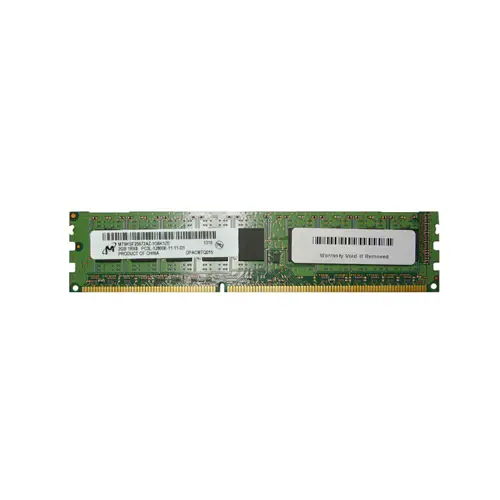
| Model | MT9KSF25672AZ-1G6K1ZE |
|---|---|
| Product Type | Memory Module |
| Compliance Standards | RoHS |
| Memory Capacity | 2 GB |
| Memory Technology | DDR3 |
| Product Voltage | 1.35V |
| RAM Speed | 1600MHz |
| RAM Standard | DDR3-1600/PC3-12800 |
| Error Identifying | ECC |
| Signal Type | Unbuffered |
| Column Access Strobe (CAS) | CL11 |
| Rank | Single Rank x8 |
| Quantity of Pins | 240-pin |
| RAM Genre | UDIMM |
This 2GB DDR3-1600 UDIMM with ECC and a low 1.35V operating voltage is optimized for entry-level servers and small-office NAS appliances where data integrity is critical but full RDIMM infrastructure is unnecessary. Its single-rank x8 configuration and CL11 latency ensure stable, efficient memory access for light virtualization or ZFS-based storage workloads that benefit from error correction without the added power draw of registered modules.
1. ECC integrity verifies data at every access, shielding critical financial transactions and long-running compute tasks from silent bit corruption.
2. Unbuffered signaling eliminates register delays, delivering the low command latency required by high-frequency trading and caching appliances.
3. Low-voltage operation slashes thermal dissipation per module, enabling denser server packing without exceeding cooling budgets.
4. Elevated transfer rates keep peak bandwidth aligned with multi-tenant web hosting demands, preventing throughput bottlenecks during traffic bursts.
5. Compact capacity intentionally targets single-role embedded controllers and edge gateways, where minimal power draw and reliable boot images matter more than raw scale.
Based on its 240-pin Unbuffered ECC UDIMM DDR3L design, the MT9KSF25672AZ-1G6K1ZE is clearly an entry-level server memory module built for small business servers, NAS units, and industrial edge devices. Its Error Correcting Code (ECC) is the first vital feature: it instantly corrects single-bit errors caused by background radiation, preventing silent data corruption. In a POS system recording thousands of transactions daily, this ensures financial logs remain accurate and compliant. Second, the 1.35V low voltage cuts power use and heat significantly against 1.5V. This is crucial for a sealed digital signage player in a retail window where active cooling is impossible. Third, the 1600MHz speed and PC3-12800 bandwidth deliver smooth multitasking for a lightweight virtualized print server or data cache. Finally, the single-rank x8 configuration guarantees stable compatibility across various micro-server chipsets by reducing electrical loading, simplifying any upgrade path. These features collectively translate into years of zero-touch reliability, assuring data integrity and operational continuity in mission-critical environments.
General Virtualization
This 2GB DDR3L ECC UDIMM suits lightweight or nested virtualization labs where modest memory density is acceptable. To sustain multiple VMs reliably, install four or six identical modules in the available DIMM slots, enabling dual- or triple-channel mode for improved throughput while ECC guards against in-memory errors. For production workloads demanding more than 8–12GB total, plan a platform migration to higher‑capacity Registered DIMMs.
In-Memory Database
In‑memory databases thrive on capacity and data integrity, both served by this module’s ECC feature. However, its 2GB density limits deployments to very small datasets or development instances. Maximize capacity by populating every channel equally—for example, six modules (12GB) on a triple‑channel server board—ensuring the dataset fits entirely in RAM. For production in‑memory stores, supplement with larger DIMMs as soon as the working set grows.
High Performance Computing (HPC)
HPC codes often benefit from balanced memory bandwidth more than sheer capacity. Populate all memory channels identically with these low‑voltage 1600MT/s UDIMMs (e.g., four modules for quad‑channel or six for triple‑channel) to maximize aggregate bandwidth per node. The 1.35V operation also helps reduce power and cooling overhead in dense cluster environments, though capacity‑hungry simulations will quickly outrun the 2GB per DIMM limit; reserve this module for compute‑bound, memory‑lean workloads.
Rigorously tested, compatible with Dell R210 II, HP MicroServer Gen8, Lenovo TS140.
Q: Can I mix this MT9KSF25672AZ-1G6K1ZE with other memory modules of different brands or speeds?
A: Mixing is not recommended. Inconsistent timings, voltages, or ECC schemes may cause instability or uncorrectable errors. For server environments, use identical modules to ensure validated reliability and data integrity.
Q: Is this memory compatible with my system?
A: It fits platforms supporting DDR3 ECC Unbuffered DIMMs, such as Intel Xeon E3-1200 series with C202/C204/C206 chipsets or AMD AM3+ boards with ECC support. Verify your server board's qualified vendor list (QVL).
Q: What is the recommended DIMM population order for optimal performance?
A: Install this single-rank module in the first slot of a channel according to your server board manual. For multi-channel configurations, populate identical DIMMs symmetrically across channels to enable full ECC and memory bandwidth.
Q: Does this module support overclocking or XMP profiles?
A: No. This is JEDEC-compliant server memory operating at fixed DDR3-1600 CL11 1.35V. Overclocking and XMP are not supported, as server stability and error-free operation are prioritized over speed flexibility.
Q: What warranty and typical failure rate can I expect?
A: It includes a one-year warranty. The MTBF is exceptionally high—typically over 1 million hours—thanks to strict screening and ECC-grade qualification. Field failure rates are far below standard desktop memory.