











 Secure payments
Standard refund policy
Trade Assurance
Secure payments
Standard refund policy
Trade Assurance
| Product Type | Memory Module |
|---|---|
| Compliance Standards | RoHS,CE,WEEE |
| Memory Capacity | 16 GB |
| Memory Technology | DDR4 |
| Product Voltage | 1.2V |
| RAM Speed | 3200MHz |
| RAM Standard | DDR4-3200/PC4-25600 |
| Error Identifying | ECC |
| Signal Type | Registered |
| Column Access Strobe (CAS) | CL22 |
| Rank | Dual Rank |
| Quantity of Pins | 288-pin |
| RAM Genre | RDIMM |
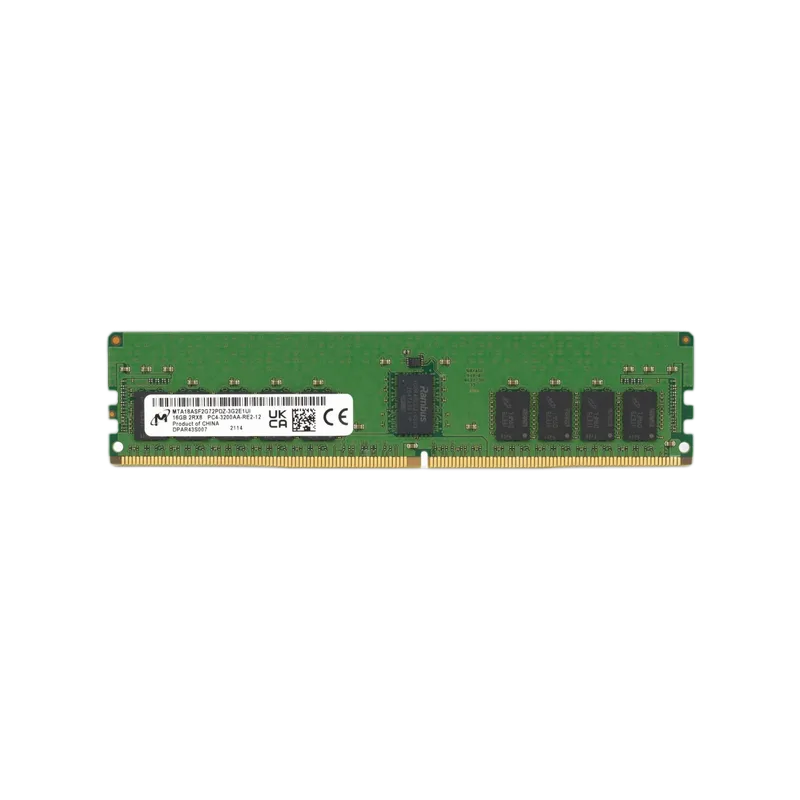
This DDR4-3200 Registered ECC memory module is specifically engineered for server platforms running mission-critical workloads such as virtualization and in-memory databases. The dual-rank configuration combined with registered signal buffering and ECC error correction ensures maximum data integrity, stable operation under heavy loads, and improved bandwidth efficiency in multi-DIMM configurations.
1. This capacity supports dense virtualization and large in-memory databases, maximizing consolidation ratios and reducing total cost of ownership per virtual machine.
2. The high transfer rate supplies the bandwidth demanded by real-time analytics and caching layers, preventing memory bottlenecks that slow data-driven decisions.
3. ECC protection continuously detects and corrects single-bit errors, safeguarding transactional integrity for financial processing and long-running scientific computations.
4. Registered signaling stabilizes command and address control, allowing fully populated memory channels across multi-socket servers without signal degradation or downtime risk.
5. Dual rank interleaving sustains peak throughput under concurrent access patterns, delivering consistent performance for multi-tenant and heavily virtualized workloads.
Identified as server memory by its RDIMM form factor and ECC Registered architecture, Micron’s MTA18ASF2G72PDZ-3G2E1UI solves the critical pain points that keep data center architects awake at night. In dense virtualization clusters running dozens of VMs per node, ECC is non-negotiable—it catches and corrects single-bit flips caused by background radiation, preventing silent data corruption that could cascade into VM crashes or inaccurate financial transactions. The Registered signal buffer becomes your lifeline as you scale: it stabilizes command and address lines when populating all channels with high-capacity DIMMs, allowing a single host to reliably operate huge memory pools without signal degradation—vital for in-memory databases like SAP HANA where gigabytes of hot data must remain instantly accessible. Dual Rank organization further amplifies throughput by enabling the memory controller to interleave accesses across two internal ranks, so concurrent database queries and analytics workloads experience measurably lower latency during peak OLTP sessions. Operating at a low 1.2V with a rapid 3200MT/s speed, it also trims the power budget and thermal load inside constrained rack environments, directly translating into reduced cooling costs and higher sustained reliability—because every watt saved inside a server farm compounds across thousands of nodes.
General Virtualization
For general virtualization hosts running multiple VMs, this 16GB RDIMM provides a balanced building block. Deploy modules in multiples of 8 (e.g., 128GB with 8 sticks) to populate all memory channels on typical dual-socket servers, maximizing bandwidth while maintaining room for future scaling. A configuration of 256GB to 512GB total is common for mid‑density VM farms, leaving headroom for memory overcommitment avoidance.
In-Memory Database
In‑memory databases like Redis or SAP HANA demand low latency and high capacity. Use the highest supported DIMM-per‑channel count without sacrificing speed—often 2 DPC (DIMMs per channel) with dual‑rank 16GB RDIMMs to reach 256GB–1TB on modern platforms while sustaining 3200 MT/s. Deploy in fully balanced configurations across all CPU sockets to guarantee symmetric memory access and maximize throughput under heavy query loads.
High-Performance Computing (HPC)
HPC clusters benefit from this memory’s 3200 MHz speed and ECC reliability during sustained compute. Configure nodes with 12 or 16 identical 16GB RDIMMs (192GB–256GB) to saturate eight memory channels on platforms like AMD EPYC or Intel Xeon Scalable, delivering the bandwidth demanded by MPI‑based simulations. Maintain uniform dual‑rank population per channel to avoid performance penalties, and reserve empty slots for scale‑out rather than mixing capacities.
Rigorously tested to work with servers like Dell PowerEdge R760, HPE ProLiant DL380 Gen11, and Lenovo ThinkSystem SR650 V3.
Q: Can I mix this MTA18ASF2G72PDZ-3G2E1UI with other memory modules of different brands or speeds?
A: Mixing RDIMMs from different brands or speeds is not recommended. It may force the system to default to the slowest speed and can introduce signal integrity issues, compromising server stability.
Q: Is this memory compatible with my server platform?
A: This module is compatible with Intel Xeon Scalable and AMD EPYC platforms that support DDR4-3200 Registered ECC memory. Always verify your server's qualified vendor list for specific support.
Q: What is the recommended DIMM population order for optimal performance?
A: For dual-socket servers, populate identical DIMMs per channel, starting with the DIMM slot farthest from the CPU. Follow your motherboard's population guide to balance memory channels and enable optimal interleaving.
Q: Does this module support overclocking or XMP profiles?
A: No. This is a JEDEC-compliant Registered DIMM running at PC4-25600 with fixed CL22 timings. It does not support XMP or overclocking; reliability and data integrity are prioritized over frequency tuning.
Q: What warranty and typical failure rate can I expect?
A: This module includes a one-year warranty. It is built to stringent enterprise standards with a typical annualized failure rate well below 0.5%, ensuring high reliability for mission-critical workloads.