











 Secure payments
Standard refund policy
Trade Assurance
Secure payments
Standard refund policy
Trade Assurance
| Product Type | Memory Module |
|---|---|
| Memory Capacity | 16 GB |
| Memory Technology | DDR4 |
| Product Voltage | 1.2V |
| RAM Speed | 2666MHz |
| RAM Standard | DDR4-2666/PC4-21300 |
| Error Identifying | ECC |
| Signal Type | Registered |
| Column Access Strobe (CAS) | CL19 |
| Rank | Single Rank x4 |
| Quantity of Pins | 288-pin |
| RAM Genre | NVDIMM |
This RDIMM-class NVDIMM, with its registered signal type and ECC, is ideally suited for memory-intensive server workloads such as in-memory databases and virtualization where data integrity and persistent storage are critical. The module leverages a single-rank x4 design with a CAS latency of 19 for balanced electrical loading and reliable command/address stability, while its non-volatile architecture preserves data across power cycles, making it a strong fit for storage acceleration and 24/7 enterprise environments.
1. NVDIMM persistence empowers mission-critical workloads with instant data preservation during unexpected power failures, drastically reducing recovery time and in-memory data loss risks.
2. ECC memory actively corrects single-bit errors and detects multi-bit faults, safeguarding the integrity of financial transactions and large-scale database operations.
3. Registered signal buffering stabilizes high-capacity memory channels, allowing servers to scale up reliably for demanding hypervisor and in-memory analytics roles.
4. Generous module capacity supports dense virtualization stacks, enabling more virtual machines per node without sacrificing per-VM memory allocation headroom.
5. Elevated memory bandwidth accelerates simultaneous data streams across multiple cores, boosting throughput for containerized microservices and real-time processing pipelines.
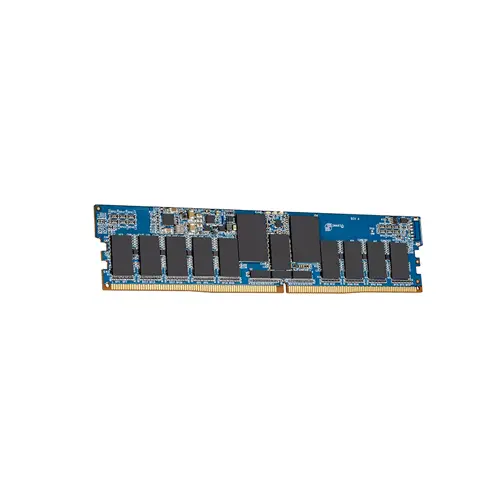
In server environments, the Micron MTA18ASF2G72XF1Z 16GB DDR4-2666 NVDIMM combines four critical attributes to eliminate downtime and data loss. ECC memory corrects single-bit errors on the fly, shielding your virtualization cluster from random bit flips that would otherwise corrupt hypervisor memory and bring down dozens of VMs. The Registered buffer stabilizes signal loads when you fully populate channels, letting you scale to 1TB+ without sacrificing the 2666MT/s bandwidth required for memory-hungry analytics. Its Single Rank x4 architecture leverages narrower x4 DRAM devices with more banks, increasing concurrency and delivering compelling IOPS for in-memory databases like Redis. Most transformative is the NVDIMM persistence: onboard capacitors and NAND flash automatically back up DRAM during a power outage. For a trading platform or medical imaging cache, your dataset survives a crash and restarts instantly, avoiding lengthy SSD reloads. These capabilities ensure your workloads stay resilient, performant, and always on.
General Virtualization
For mainstream dual‑socket servers, populate all memory channels per CPU with matching 16 GB registered DDR4‑2666 modules. A balanced 8‑DIMM‑per‑socket configuration delivers 128 GB of ECC‑protected capacity and full memory interleaving, comfortably supporting 30+ virtual machines. Scale further by installing identical DIMMs in the remaining slots while maintaining symmetric channel population.
In‑Memory Database
Exploit the NVDIMM capability to create a persistent memory tier. Install groups of these single‑rank 16 GB modules across each processor’s channels to reach a robust 192 GB pool in a 12‑slot system. The registered ECC design ensures data integrity, and the non‑volatile nature drastically reduces recovery time. Add standard DDR4 RDIMMs if a larger warm cache is required.
High Performance Computing (HPC)
Maximize bandwidth by fitting one 16 GB registered DIMM per channel—eight modules per node—keeping the 2666 MHz speed consistent. The single‑rank x4 organization lowers latency and avoids rank‑switching penalties, which benefits memory‑bound simulations like CFD or molecular dynamics. This configuration supplies a large per‑core bandwidth budget by balancing channel count with compute density.
Rigorously tested, compatible with Dell PowerEdge R760, R750, HPE ProLiant DL380 Gen10, Lenovo ThinkSystem SR650.
Q: Can I mix this MTA18ASF2G72XF1Z-2G6V21ABSGE with other memory modules of different brands or speeds?
A: Mixing is not recommended. Registered ECC NVDIMMs require identical specifications (rank, CAS, voltage) to ensure signal integrity and reliable data persistence. Mismatched modules may cause POST failures or NVDIMM backup errors.
Q: Is this memory compatible with my server? Which Intel or AMD platforms support it?
A: It is compatible with select Intel Xeon Scalable and AMD EPYC platforms that support DDR4 NVDIMM-N. Please verify your server's QVL and ensure BIOS recognizes persistent memory modules on the memory channel.
Q: What is the recommended DIMM population order for optimal performance with this NVDIMM?
A: Follow the server manufacturer's guidelines. Typically, populate identical NVDIMMs evenly across memory channels, starting with the furthest slot from the CPU, and consult the platform's memory population rules for persistent memory.
Q: Does this module support overclocking or XMP profiles?
A: No. This is a JEDEC-compliant DDR4-2666 Registered ECC NVDIMM. It does not support overclocking or XMP profiles. All timings and voltages are fixed to ensure data integrity and NVDIMM backup stability.
Q: What warranty and typical failure rate can I expect?
A: This module includes a one-year warranty. As an enterprise-grade NVDIMM, it delivers an annualized failure rate (AFR) typically below 0.5% under specified operating conditions, ensuring high reliability for critical workloads.