











 Secure payments
Standard refund policy
Trade Assurance
Secure payments
Standard refund policy
Trade Assurance
| Product Type | Memory Module |
|---|---|
| Memory Capacity | 8 GB |
| Memory Technology | DDR4 |
| Product Voltage | 1.2V |
| RAM Speed | 2666MHz |
| RAM Standard | DDR4-2666/PC4-21300 |
| Error Identifying | ECC |
| Signal Type | Registered |
| Column Access Strobe (CAS) | CL19 |
| Rank | Single Rank x8 |
| Quantity of Pins | 288-pin |
| RAM Genre | RDIMM |
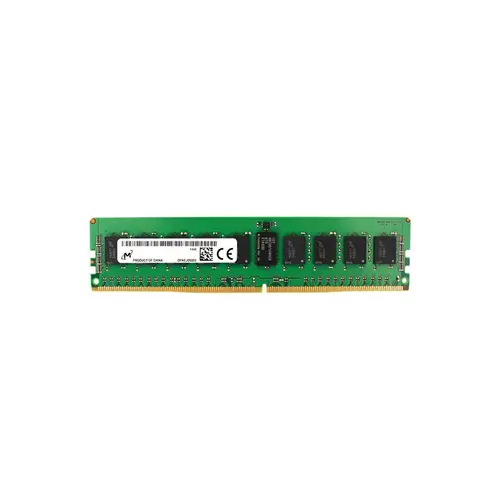
This 8GB DDR4-2666 RDIMM with ECC and registered signaling is engineered for server platforms running virtualization, in-memory databases, and mission-critical workloads where data integrity is paramount. Its single-rank x8 configuration with CL19 latency ensures stable signal integrity and efficient memory controller loading, while ECC protection detects and corrects single-bit errors to prevent silent data corruption in 24/7 operating environments.
1. End-to-end error correction prevents single-bit data corruption, ensuring transactional integrity in mission-critical database and financial workloads.
2. Registered signal buffering stabilizes high-capacity memory buses, enabling seamless scaling across densely populated server racks without signal degradation.
3. DDR4 memory technology delivers higher bandwidth per watt, reducing overall power draw in hyperscale data centers while improving compute throughput.
4. The twenty-six hundred megahertz frequency accelerates in-memory analytics and virtualized environments, minimizing data access latency under concurrent user loads.
5. Single Rank x8 architecture optimizes command-to-data timing on each channel, preserving consistent low-latency access when populating all DIMM slots in large-memory servers.
In server environments where reliability and performance are non-negotiable, the Micron MTA9ASF1G72PZ-2G6D1Q 8GB DDR4-2666 RDIMM combines four essential features. ECC error correction actively prevents silent data corruption. In a virtualization cluster, a single-bit error could corrupt a hypervisor and disrupt dozens of VMs; ECC detects and fixes faults on the fly to keep workloads running. The registered buffer stabilizes command and address signals when multiple DIMMs are installed—a daily reality in dense database servers—preventing signal degradation and ensuring dependable scaling. Its single-rank x8 design balances bandwidth and latency, giving in-memory databases like Redis consistent sub-microsecond response during high concurrency. Meanwhile, 1.2V low-voltage operation trims power consumption per module, which collectively reduces cooling and energy costs in a rack-scale deployment. For data centers running virtualized environments or real-time analytics, these capabilities mean higher uptime, predictable performance, and a leaner operational footprint.
The module specified is an 8GB DDR4-2666 ECC Registered DIMM (RDIMM), suited for server platforms.
General Virtualization
Populate each memory channel with one 8GB module (e.g., six modules per six‑channel CPU) to deliver 48GB per socket; this balances cost and performance for moderate VM densities. When higher consolidation is required, install two DIMMs per channel (96GB per socket) while keeping memory speed near 2666MT/s.
In-Memory Database
For large in-memory datasets, use two 8GB RDIMMs per channel (12 modules per CPU) to achieve 96GB per socket with manageable latency. If capacity demands exceed this, populate three slots per channel (144GB per socket), but expect a slight speed downgrade due to increased electrical loading.
High Performance Computing
Maximum bandwidth is critical; install exactly one 8GB module per memory channel (e.g., six per CPU, 48GB) to run at full 2666MT/s with lowest latency. Never fill more than one DIMM per channel, preserving the single‑rank loading and ensuring sustained high throughput for parallel HPC jobs.
Server-grade DDR4 RDIMM, rigorously tested, compatible with Dell PowerEdge R760, HPE ProLiant DL380 Gen10, Lenovo ThinkSystem SR650.
Q: Can I mix this MTA9ASF1G72PZ-2G6D1Q with other memory modules of different brands or speeds?
A: Mixing is not recommended for RDIMM servers. Different brands or speeds may cause signal integrity issues and system instability. Always use identical Micron modules with the same MPN and speed for validated server configurations.
Q: Is this memory compatible with my system?
A: It is compatible with Intel Xeon Scalable and AMD EPYC platforms that support DDR4-2666 ECC Registered DIMMs. Verify your server board’s Qualified Vendor List (QVL) for this specific Micron MPN before purchase.
Q: What is the recommended DIMM population order for optimal performance?
A: Follow your server motherboard manual. Generally, populate identical DIMMs per channel starting from slot 0, balancing all memory channels evenly to maximize interleaving and avoid performance penalties in multi-CPU systems.
Q: Does this module support overclocking or XMP profiles?
A: No. This is an enterprise server RDIMM operating at standard JEDEC timing of DDR4-2666 CL19. It does not support overclocking or XMP profiles, ensuring maximum stability and data integrity for mission-critical workloads.
Q: What warranty and typical failure rate can I expect?
A: This module includes a 1-year warranty. As a Micron enterprise-grade product, the annualized failure rate (AFR) is typically below 0.2%, delivering exceptional reliability for 24/7 server environments.