











 Secure payments
Standard refund policy
Trade Assurance
Secure payments
Standard refund policy
Trade Assurance
| Product Type | Memory Module |
|---|---|
| Memory Capacity | 4 GB |
| Memory Technology | DDR4 |
| Product Voltage | 1.2V |
| RAM Speed | 2400MHz |
| RAM Standard | DDR4-2400/PC4-19200 |
| Error Identifying | ECC |
| Signal Type | Unbuffered |
| Column Access Strobe (CAS) | CL17 |
| Rank | Single Rank x8 |
| Quantity of Pins | 288-pin |
| RAM Genre | UDIMM |
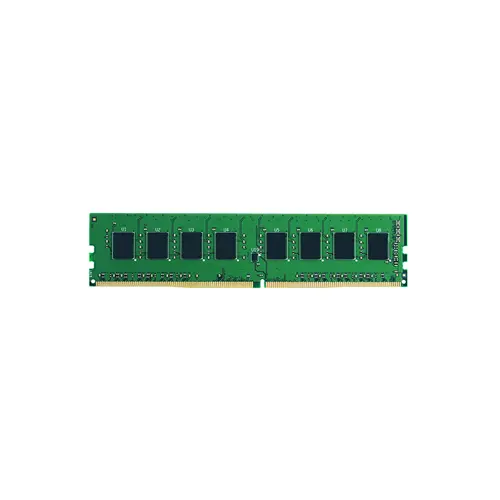
This 4GB DDR4-2400 ECC Unbuffered DIMM is ideally suited for entry-level workstations and small-scale servers running memory-sensitive applications such as NAS or light virtualization, where data integrity is critical and Unbuffered ECC ensures single-bit error correction without the cost of registered memory. Its single-rank x8 organization and a CL17 latency deliver a clean signal and responsive access profile on platforms with limited DIMM slots, optimizing both stability and bandwidth efficiency.
1. ECC error correction detects and corrects single-bit errors in real time, preserving data integrity for always-on services where even a flipped bit could crash a hypervisor or corrupt a database transaction.
2. Unbuffered signal topology trims command-to-data latency and power draw, benefiting entry-level servers that rely on fast, predictable response for lightweight container orchestration.
3. DDR4 technology boosts per-watt throughput, helping colocation and branch-office servers stay within strict thermal envelopes while supporting more simultaneous users.
4. The 2400MHz clock rate delivers consistent memory bandwidth, ensuring smooth live migration and stable performance when consolidating multiple virtual machines onto a single host.
5. Single Rank x8 organization minimizes electrical loading on the memory bus, enabling reliable operation across a wide range of server boards and simplifying fleet-wide deployment.
The MTA9ASF51272AZ-2G3B1ZI is a DDR4 ECC UDIMM built for reliability-driven server and workstation environments. Its four defining features—ECC error correction, unbuffered architecture, 1.2V low voltage, and 2400MT/s speed with CL17 latency—directly address critical pain points. Imagine a small business file server: ECC corrects single-bit upsets instantly, preventing invisible corruption of financial databases or virtual machine states that could cause costly downtime. The unbuffered design eliminates the registering clock driver, delivering lower access latency that accelerates small-file transfers and improves the responsiveness of containerized applications or a NAS. Meanwhile, the 1.2V operating voltage trims energy consumption by up to 20% compared to legacy DDR3, minimizing thermal stress in compact edge servers or 24/7 industrial enclosures. A second scenario—an industrial automation workstation processing real-time sensor data—benefits from the module’s single-rank x8 construction at 2400MHz, which ensures rock-solid signal integrity across mainstream server boards, while the CL17 timing guarantees predictable latency under sustained throughput. This combination keeps your data accurate, your systems responsive, and your power bills lower, making the module a perfect fit for SMB servers, network appliances, and dedicated workstations.
General Virtualization
Install matching 4 GB ECC UDIMMs in identical pairs to enable dual-channel interleaving. For a hypervisor hosting lightweight VMs, a 16 GB configuration (four modules) balances capacity and bandwidth on a typical dual-channel server board. ECC ensures data integrity under sustained multi-tenant operation.
In-Memory Database
Maximize capacity by populating all available memory slots with these 4 GB modules—reaching 32 GB on an eight-slot board is a pragmatic scaling target for small in-memory datasets. Maintain symmetrical channel population to preserve bandwidth, and rely on ECC to reduce corruption risks during constant read/write cycles. For larger working sets, supplement nodes rather than exceeding board limits.
High-Performance Computing
Place one module per memory channel to fully utilize the platform’s aggregate bandwidth; a quad-channel server sees optimal throughput with four 4 GB sticks. The unbuffered, single-rank design keeps access latency low for compute-bound workloads, and ECC protects against bit-flips during extended parallel runs. If per-node capacity is modest, cluster multiple nodes equipped with this configuration.
Rigorously tested for compatibility with Dell PowerEdge T40, HPE ProLiant DL20 Gen10, Lenovo ThinkSystem ST50.
Q: Can I mix this MTA9ASF51272AZ-2G3B1ZI with other memory modules of different brands or speeds?
A: Mixing modules is not recommended in server environments. Different brands or speeds can cause instability and compromise ECC functionality. For guaranteed reliability, always populate with identical Micron ECC UDIMMs.
Q: Is this memory compatible with my system?
A: This DDR4-2400 ECC Unbuffered UDIMM is designed for servers and workstations using Intel Xeon E3/E-2100/2200 series or AMD Ryzen Pro AM4 platforms that explicitly support ECC. Always verify your motherboard QVL.
Q: What is the recommended DIMM population order for optimal performance?
A: Please consult your server motherboard manual. Typically, populate the first slot of each memory channel (often blue slots) to balance interleaving and ensure proper ECC operation, maximizing bandwidth and fault tolerance.
Q: Does this module support overclocking or XMP profiles?
A: No. This is a JEDEC-compliant, server-grade ECC UDIMM. It does not support overclocking or XMP profiles. It operates strictly at the fixed 2400MHz CL17 specification to maintain data integrity and platform stability.
Q: What warranty and typical failure rate can I expect?
A: This Micron enterprise module comes with a 1-year warranty. Typical annualized failure rates (AFR) are very low, as it is built for 24/7 mission-critical operation with stringent quality validation for server reliability.