











 Secure payments
Standard refund policy
Trade Assurance
Secure payments
Standard refund policy
Trade Assurance
| Product Type | Memory Module |
|---|---|
| Memory Capacity | 128 GB |
| Memory Technology | DDR4 |
| Product Voltage | 1.2V |
| RAM Speed | 2933MHz |
| RAM Standard | DDR4-2933/PC4-23400 |
| Error Identifying | ECC |
| Signal Type | Registered |
| Column Access Strobe (CAS) | CL21 |
| Rank | Quad Rank x4 |
| Quantity of Pins | 288-pin |
| RAM Genre | RDIMM |
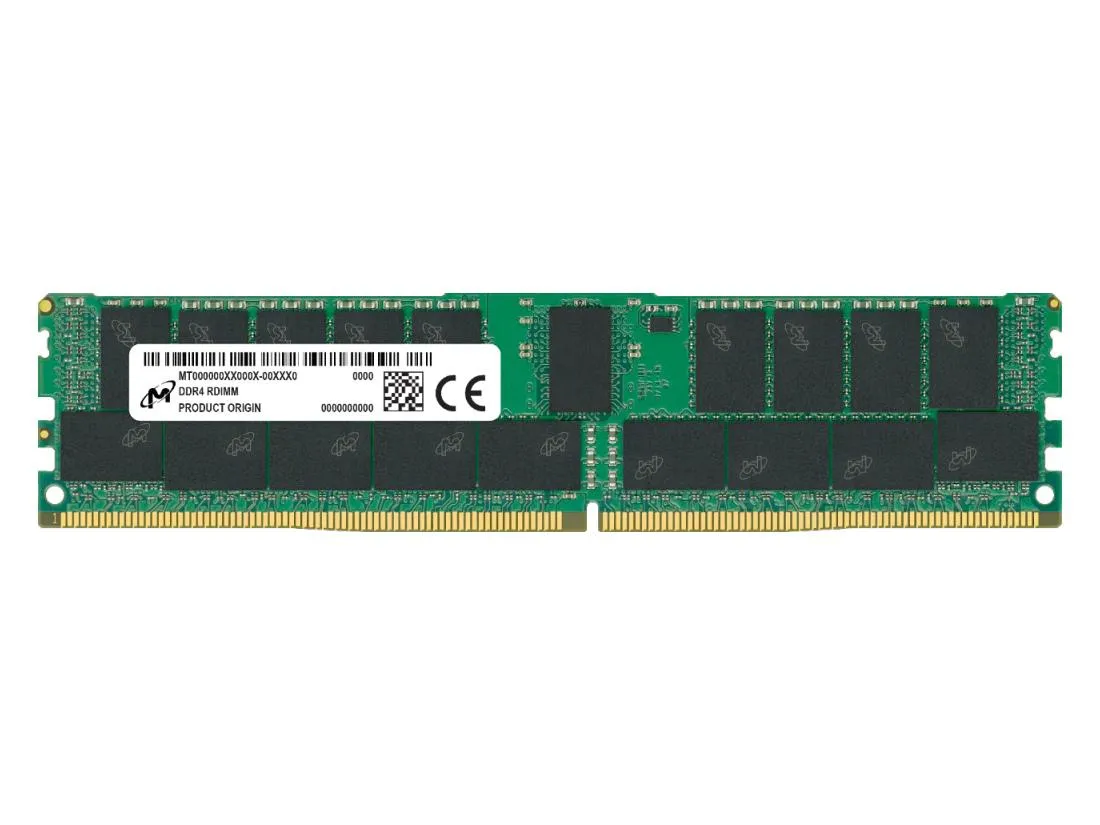
This 128GB DDR4-2933 Registered ECC RDIMM, with its quad-rank x4 organization, provides exceptional signal integrity and high-density scalability for enterprise servers. It is ideally suited for memory-intensive workloads such as virtualization and in-memory databases where the ECC functionality ensures strong data integrity under sustained heavy loads.
1. ECC protection silently corrects single-bit errors in real time, preserving data integrity for financial transactions and virtualized databases that cannot tolerate silent corruption.
2. The massive memory capacity per module allows dense server consolidation, keeping hundreds of active VMs fully resident in memory without swapping to slower storage.
3. Registered signal buffering maintains electrical stability across heavily loaded memory channels, enabling scalable configurations with reliable operation under 24/7 uptime demands.
4. Quad Rank x4 organization maximizes total installed memory per server node, giving scale-up analytics and big-data in-memory platforms the headroom they need without replacing existing DIMMs.
5. High-throughput 2933 MHz speed ensures bandwidth-heavy workloads like real-time inference and streaming data pipelines stay responsive even when multiple tenants compete for memory access.
Let’s be clear: the MTA72ASS16G72LZ-2G9B3R is built for the data center. This 128GB DDR4-2933 Registered DIMM is engineered for servers where compromise is not an option, and its four defining characteristics directly answer the real pain points you face every day.
The ECC error correction is your silent guardian against silent data corruption. In a financial transaction database, a single bit flip in memory can cascade into a corrupted record or a failed trade. ECC detects and corrects single-bit errors on the fly, meaning you are not just protecting data; you are preserving revenue and trust. Next, the registered signal buffer tackles signal integrity as you scale. When you pack a 4-socket server with massive memory for a dense virtualization cluster, electrical loading becomes the enemy. The register on this RDIMM stabilizes command and address signals, letting you fill every channel with confidence and avoid boot-time surprises or intermittent crashes. With 128GB on a single stick, you maximize capacity in limited slots, so you can provision more VMs per host without sacrificing performance headroom. Finally, the quad-rank x4 organization paired with 2933MHz bandwidth shines in memory-analytics workloads. An in-memory database like SAP HANA or Redis thrives on sustained throughput; the four internal ranks interleave requests efficiently, feeding the CPU a non-stop stream of data for real-time reporting. This isn’t just a module—it’s the foundation for always-on, high-availability operations where every millisecond and every byte counts.
General Virtualization
For general virtualization hosts, populate all memory channels symmetrically to maximize bandwidth. Use one 128 GB RDIMM per channel in a balanced configuration—e.g., 8 modules across 8 channels for a total of 1 TB—to avoid NUMA imbalance and provide ample capacity for dozens of VMs without oversubscription.
In-Memory Database
In-memory databases demand massive capacity and low latency. Deploy multiple 128 GB quad-rank RDIMMs to reach 1.5–3 TB per socket while keeping all channels populated identically. Configure ranks to stay within the platform’s supported limits (typically 8 ranks per channel) to maintain 2933 MT/s speed, and prefer 1 DIMM per channel to avoid clock speed drops.
High-Performance Computing
HPC workloads need high throughput and reliable data integrity. Install one 128 GB registered ECC module per memory channel, matching the CPU’s maximum channel count (e.g., 8 or 12 modules) to achieve full interleaved bandwidth. This configuration supplies large per-core memory reserves for simulation checkpoints and data-parallel jobs while the ECC and registered signaling ensure result accuracy under sustained heavy load.
Rigorously tested server RDIMM, compatible with Dell PowerEdge R760, HPE ProLiant DL380 Gen10, Lenovo ThinkSystem SR650.
Q: Can I mix this MTA72ASS16G72LZ-2G9B3R with other memory modules of different brands or speeds?
A: Mixing RDIMMs of unlike brands or speeds often causes instability in servers. For guaranteed ECC integrity and signal timing, use identical Micron modules or follow the server vendor’s memory population guidelines.
Q: Is this memory compatible with my server system?
A: It fits modern Intel and AMD platforms supporting DDR4 Registered ECC memory. Verify your board accepts 288-pin RDIMMs with 128GB Quad Rank x4 at 2933 MHz. Consult the manufacturer's memory QVL for specific server generation compatibility.
Q: What is the recommended DIMM population order for optimal performance?
A: Follow your server’s manual for balanced memory channels. Typically populate white or blue slots first, spreading identical Quad Rank DIMMs across all memory channels to maximize bandwidth and maintain ECC efficiency. Avoid mixing ranks in one channel.
Q: Does this module support overclocking or XMP profiles?
A: No. This is an enterprise RDIMM designed for stability and data integrity at JEDEC-standard speeds. Overclocking or XMP is not supported, as it would compromise ECC functionality and platform reliability in server environments.
Q: What warranty and typical failure rate can I expect?
A: This Micron module includes a one-year warranty. Enterprise-grade DDR4 ECC RDIMMs typically demonstrate an annualized failure rate (AFR) below 1% under specified operating conditions, ensuring high reliability for critical server workloads.