











 Secure payments
Standard refund policy
Trade Assurance
Secure payments
Standard refund policy
Trade Assurance
| Product Type | Memory Module |
|---|---|
| Memory Capacity | 128 GB |
| Memory Technology | DDR4 |
| Product Voltage | 1.2V |
| RAM Speed | 2933MHz |
| RAM Standard | DDR4-2933/PC4-23400 |
| Error Identifying | ECC |
| Signal Type | Registered |
| Column Access Strobe (CAS) | CL21 |
| Rank | Quad Rank x4 |
| Quantity of Pins | 288-pin |
| RAM Genre | RDIMM |
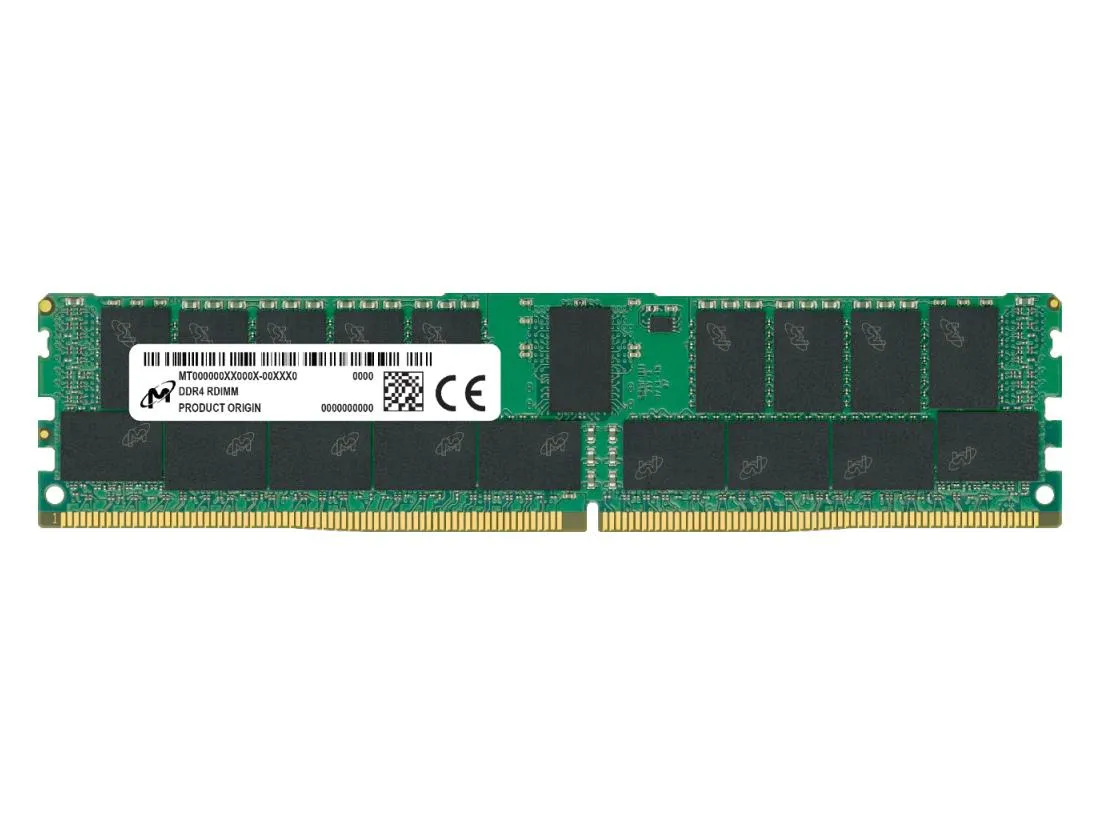
Designed for enterprise server environments, this 128GB DDR4-2933 Registered ECC RDIMM delivers exceptional data integrity and reliability for memory-intensive workloads such as virtualization, in-memory databases, and large-scale data analytics. Its Quad Rank x4 configuration maximizes capacity per channel while the registered signal type ensures stable operation in fully populated 288-pin server boards, and ECC protection corrects single-bit errors to prevent silent data corruption.
1. A massive 128 GB capacity per module allows dense memory configurations in a single server, enabling heavy virtualization workloads and large in-memory databases without resorting to slower storage tiering.
2. ECC protection continuously detects and corrects single-bit errors, preserving data integrity in financial transactions and mission-critical analytics where even silent corruption is unacceptable.
3. Registered signal buffering decouples the memory bus from the CPU, maintaining rock-solid electrical stability across fully populated multi-slot servers essential for scale-up enterprise platforms.
4. Quad Rank x4 organization packs more DRAM devices per channel, maximizing capacity while requiring careful motherboard compatibility—ideal for maximizing VM density in virtualization hosts.
5. A 2933 MHz clock rate balances high throughput with broad platform compatibility, delivering ample memory bandwidth for concurrent data streams in database and HPC applications.
When planning a virtualization cluster or an in-memory database deployment, stability and data integrity are non-negotiable. The Micron MTA72ASS16G72LZ-2G9, a server-grade DDR4 RDIMM, directly addresses these demands by integrating 128GB capacity, ECC error correction, a registered architecture, and a quad-rank x4 design. In a VMWare environment hosting dozens of virtual machines, the immense 128GB density lets you maximize VM consolidation per server, slashing hardware sprawl and licensing overhead. Registered logic buffers the command and address signals, preserving crisp signal integrity across the quad-rank load even when multiple DIMMs populate the channel—erasing the instability you would face with unbuffered modules at such scale. Simultaneously, ECC silently hunts and corrects single-bit memory errors. For a financial trading database or an SAP HANA instance holding live transactions, a cosmic-ray-induced bit flip uncorrected would mean silent data corruption, bringing costly auditing nightmares or client-facing inaccuracies. The quad-rank organization further unlocks interleaving gains, overlapping data fetches across ranks to feed 2933MT/s bandwidth with consistently low latency. For your data center, this combination means that tier-1 workloads operate with absolute integrity, denser virtualization, and the responsive throughput required for real-time analytics.
General Virtualization
For dense virtualized environments, deploy at least two 128 GB RDIMMs per server to enable dual‑channel interleaving and provide headroom for memory overcommitment. A typical configuration starts with 256 GB (2 modules) for moderate VM density, scaling to 512 GB or 1 TB (4 or 8 modules) as more memory‑intensive workloads are consolidated. Balance population across CPU memory controllers to maintain NUMA locality and consistent latency.
In‑Memory Database
In‑memory platforms like SAP HANA or Redis demand entire datasets reside in DRAM, making reliability and capacity critical. Begin with a minimum of 256 GB using two 128 GB modules (one per socket) to ensure basic mirroring or redundancy capabilities. For production nodes, populate all available channels—four or eight RDIMMs yielding 512 GB or 1 TB—to maximize bandwidth under heavy query loads while preserving registered ECC integrity.
High‑Performance Computing (HPC)
HPC applications are extremely sensitive to memory bandwidth, so populate every memory channel the platform offers. On an eight‑channel server, install eight 128 GB RDIMMs for 1 TB total capacity and peak throughput. For smaller clusters or throughput‑oriented nodes, a balanced 256 GB (two modules) or 512 GB (four modules) setup can suffice, but always favor uniform channel population over minimal DIMM count to avoid bandwidth bottlenecks on large‑scale simulations.
Rigorously tested server RAM: compatible with Dell PowerEdge R740, HPE ProLiant DL380 Gen10, Lenovo ThinkSystem SR650, and more.
Q: Can I mix this MTA72ASS16G72LZ-2G9 with other memory modules of different brands or speeds?
A: Mixing modules is not recommended, especially in server environments. Registered ECC memory requires matched ranks, timings, and speeds to maintain signal integrity. Mismatched DIMMs may cause instability or force the system to downclock to the lowest common speed.
Q: Is this memory compatible with my Intel or AMD server platform?
A: This 128 GB DDR4-2933 RDIMM is compatible with Intel Xeon Scalable (2nd Gen and later) and AMD EPYC 7002/7003 series platforms that support registered ECC memory. Please verify your server board’s QVL for 128 GB Quad Rank x4 modules.
Q: What is the recommended DIMM population order for optimal performance?
A: Refer to your server motherboard manual. Generally, populate one DIMM per channel first to maximize bandwidth, then fill remaining slots. For Quad Rank modules, balance ranks across memory channels to avoid performance degradation in multi-socket configurations.
Q: Does this module support overclocking or XMP profiles?
A: No. This is a JEDEC-compliant DDR4-2933 ECC RDIMM designed for server reliability. Overclocking and XMP profiles are not supported, as enterprise platforms prioritize data integrity and stability over adjustable memory speeds.
Q: What warranty and typical failure rate can I expect?
A: This module comes with a 1-year warranty. As enterprise-grade Micron RDIMM, it carries an extremely low annualized failure rate, typically under 0.5%, backed by rigorous testing and component screening for 24/7 data center operation.