











 Secure payments
Standard refund policy
Trade Assurance
Secure payments
Standard refund policy
Trade Assurance
| Product Type | Memory Module |
|---|---|
| Memory Capacity | 128 GB |
| Memory Technology | DDR4 |
| Product Voltage | 1.2V |
| RAM Standard | DDR4-3200/PC4-25600 |
| Column Access Strobe (CAS) | CL22 |
| RAM Genre | RDIMM |
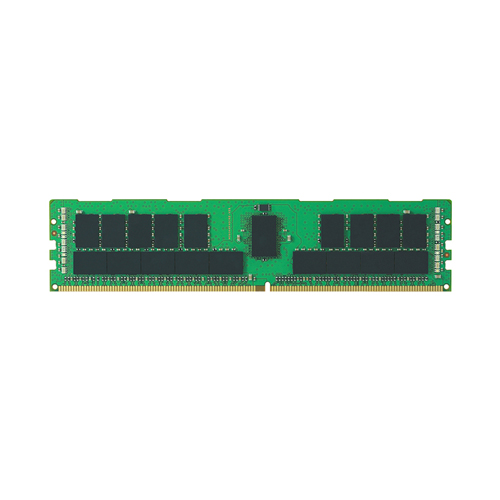
This 128 GB DDR4-3200 RDIMM is engineered for server platforms handling memory-intensive workloads such as virtualization and in-memory databases, where its registered design and CL22 latency ensure reliable signal integrity and data accuracy at high capacities. With a standard 1.2V operating voltage, it delivers optimal energy efficiency and seamless compatibility in dual-socket or multi-DIMM configurations demanding robust error correction.
1. A 128 GB RDIMM capacity dramatically increases VM density per server, allowing datacenters to consolidate more workloads without sacrificing performance headroom.
2. The DDR4-3200 speed grade delivers up to 25.6 GB/s of bandwidth per module, keeping data-intensive analytics and in-memory databases fed with minimal stalls.
3. Registered DIMM architecture uses on-module buffers to stabilize signal paths, which directly translates into fewer bit errors and higher uptime in fully populated server platforms.
4. A CAS latency of 22 at this speed provides a predictable access timing profile that safeguards response consistency under sustained enterprise transaction loads.
5. Operating at just 1.2 V significantly lowers the thermal footprint per DIMM, helping hyperscale environments meet dense deployment power budgets and reduce cooling overhead.
Behind every virtualized cluster and in-memory database lies a relentless demand for uncompromised data integrity and capacity—exactly where the Micron MTA72ASS16G72LZ proves essential. This 128GB DDR4-3200 RDIMM is engineered specifically for servers, and its four core attributes directly solve the pain points of enterprise IT. The registered design buffers command and address signals, enabling a single server to populate massive 128GB sticks without sacrificing signal stability. In a dense VMware or Hyper‑V cluster, that means you can double VM density per host, reducing licensing cost and rack space while keeping workloads isolated. The 128GB capacity itself allows an entire Redis or SAP HANA dataset to reside in memory, cutting query latency from milliseconds to sub‑microsecond levels for real‑time analytics. Operating at a low 1.2V, this module lowers thermal output and power draw across a fleet of servers, which adds up to significant OpEx savings in a 24/7 data center. And while ECC is inherent to the platform, pairing it with DDR4-3200 bandwidth at CL22 ensures that sustained throughput keeps pace with CPU cores during heavy extract‑transform‑load jobs. All of this translates into fewer application timeouts, higher transactional integrity, and a more predictable infrastructure when revenue depends on uptime.
General Virtualization
For dense server virtualization, 128 GB RDIMMs let you pack more VMs per host without sacrificing memory bandwidth. Deploy modules in multiples balanced across all memory channels—typically six or eight identical DIMMs per socket—to keep latency low and throughput predictable under mixed workloads.
In-Memory Database
Large in-memory databases demand both capacity and data integrity. Populate all channels symmetrically with 128 GB RDIMMs to reach terabyte-scale footprints, enabling full dataset caching in RAM. Registered ECC support guards against single-bit errors during high-speed transactional processing.
High-Performance Computing
HPC clusters benefit from high capacity per node while maintaining channel balance. Install one 128 GB RDIMM per channel (e.g., eight modules on an eight-channel platform) to maximize bandwidth for memory-bound simulations. This configuration reduces socket-level DIMM count compared to lower-density sticks, simplifying thermal management in dense compute sleds.
Rigorously tested and verified compatible with Dell PowerEdge R750, HPE ProLiant DL380 Gen10, Lenovo ThinkSystem SR650 V2, and similar servers.
Q: Can I mix this MTA72ASS16G72LZ with other memory modules of different brands or speeds?
A: Mixing RDIMM brands or speeds is not recommended for production servers. All modules should ideally match in rank, speed, and revision to ensure signal integrity and prevent unexpected system instability.
Q: Is this memory compatible with my Intel Xeon Scalable or AMD EPYC server platform?
A: This DDR4-3200 RDIMM is widely compatible with Intel Xeon Scalable (2nd/3rd Gen) and AMD EPYC 7002/7003 series. Please verify your board's QVL and ensure it supports 128GB RDIMMs at 1.2V.
Q: What is the recommended DIMM population order for optimal performance?
A: For dual-socket platforms, balance memory across both CPUs symmetrically. Populate 1 DIMM per channel first, using the farthest slot from the CPU, then fill remaining slots to maintain balanced memory channels.
Q: Does this module support overclocking or XMP profiles?
A: No. This is a server-class RDIMM adhering to strict JEDEC DDR4-3200 standards. It does not support XMP or overclocking; it is designed for maximum reliability and data integrity under sustained enterprise workloads.
Q: What warranty and typical failure rate can I expect?
A: This module includes a one-year warranty. Enterprise RDIMMs exhibit extremely low failure rates, typically under 0.5% AFR, due to rigorous testing and integrated ECC for error detection and correction.