











 Secure payments
Standard refund policy
Trade Assurance
Secure payments
Standard refund policy
Trade Assurance
| Model | MT9LSDT1672G-133E1 |
|---|---|
| Product Type | Memory Module |
| Compliance Standards | RoHS |
| Memory Capacity | 128 MB |
| Product Voltage | 3.3V |
| RAM Speed | 133MHz |
| Error Identifying | ECC |
| Signal Type | Registered |
| Column Access Strobe (CAS) | CL3 |
| Rank | Single Rank |
| Quantity of Pins | 168-pin |
| RAM Genre | DIMM |
This 128MB Registered DIMM with ECC and CL3 latency is a legacy server memory module specifically engineered for vintage systems running light virtualization or embedded data-logging applications. Its single-rank configuration minimizes bus loading and enhances signal integrity on older 168-pin platforms, while the registered signal type ensures stable operation at 133MHz even in fully populated systems.
1. ECC memory protects against single-bit errors silently corrupting financial transactions or database records, ensuring data integrity in mission-critical server workloads.
2. Registered signal type buffers command and address signals, enabling stable population of multiple DIMMs per channel without signal degradation—key for dense virtualization hosts.
3. Standard memory capacity allows dedicated allocation to lightweight embedded hypervisors or legacy network appliances, keeping isolated services running reliably without overcommitment.
4. The memory speed delivers balanced throughput for synchronous DRAM cycles, matching CPU front-side bus requirements of early-generation rack servers without introducing timing bottlenecks.
5. CAS latency of three clocks reduces initial access delay, improving response times for cache-miss sensitive applications like directory services or authentication daemons on always-on servers.
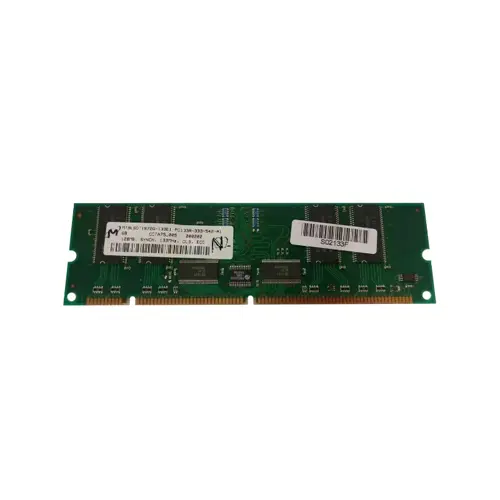
The Micron MT9LSDT1672G-133E1 is a 168-pin registered SDRAM DIMM engineered for legacy server platforms where reliability is non-negotiable. For IT teams maintaining virtualized clusters, the module’s ECC capability is a frontline defense against silent data corruption. In a hypervisor running a dozen virtual machines on aging hardware, a single-bit error flipping a memory value can crash an entire guest or, worse, corrupt a virtual disk file undetected. ECC detects and corrects these errors in real time, preserving workload continuity without costly downtime. Registered signal buffering tackles another pain point: as you populate multiple DIMM slots to maximize capacity, the electrical load on the memory controller escalates, often causing instability. The on-module register isolates this load, enabling stable operation even when the server board is fully populated—crucial for dense virtualization. In an in-memory database like Redis or a legacy SAP instance, the 133MHz clock with CL3 latency translates to predictable, low-latency access that keeps query response times tight, preventing transaction timeouts during peak loads. The single-rank configuration further reduces electrical strain and timing conflicts, assuring compatibility with older dual-processor boards where mixed ranks often trigger boot failures. This memory turns a vintage server into a reliable workhorse for niche industrial control or low-footprint database roles.
This module is a server-oriented Registered ECC SDRAM DIMM. Its 128 MB capacity and 133 MHz speed restrict modern use; planning requires combining many sticks, but physical limits make it impractical for heavy loads.
General Virtualization
A hypervisor needs large memory pools. Achieving just 4 GB would require 32 DIMMs, likely exceeding available slots. Fill all channels evenly for interleaving; even then, 4 GB is marginal and higher-density registered DIMMs are strongly recommended.
In-Memory Database
These workloads need the entire dataset in RAM. A tiny 8 GB store demands 64 modules, impossible on standard servers. This RAM is unfit for production; at most, fully populate slots to create a <1 GB lab setup, then migrate to modern DDR4/DDR5 RDIMMs.
High-Performance Computing
HPC relies on bandwidth and capacity. Reaching 2 GB requires 16 DIMMs, installed in matched pairs for interleaving. The low 133 MHz clock and tiny capacity bottleneck performance drastically. These DIMMs are only viable for retro computing teaching clusters, not real HPC.
Rigorously tested registered ECC server memory compatible with Dell PowerEdge 1650, HP ProLiant DL360 G2, IBM xSeries 330, and more.
Q: Can I mix this MT9LSDT1672G-133E1 with other memory modules of different brands or speeds?
A: Mixing registered ECC server memory of different brands or speeds is strongly discouraged. Mismatched specifications can compromise signal integrity and cause system instability or data corruption in mission-critical environments.
Q: Is this memory compatible with my server system? Which Intel or AMD platforms are supported?
A: This 168-pin PC133 Registered ECC SDRAM DIMM is designed for legacy server boards using chipsets like Intel 440BX/GX or AMD-760MP. Always verify your motherboard requires 3.3V registered ECC memory before purchase.
Q: What is the recommended DIMM population order for optimal server performance?
A: Install modules starting with the bank labeled DIMM 0 or 1 per your server board manual. For this single-rank module, populating slots in ascending order ensures correct ECC and registered signal termination.
Q: Does this module support overclocking or XMP profiles?
A: No. This is a JEDEC-compliant server-grade module strictly operating at 133 MHz (CL3). Overclocking and XMP profiles are not supported, as they would jeopardize the error-correcting reliability required for server workloads.
Q: What warranty and typical failure rate can I expect with this Micron module?
A: The module includes a 1-year warranty. Micron's stringent testing ensures an annualized failure rate well below industry average, typically under 0.5%, delivering lasting reliability for legacy server platforms.