











 Secure payments
Standard refund policy
Trade Assurance
Secure payments
Standard refund policy
Trade Assurance
| Product Type | Memory Module |
|---|---|
| Compliance Standards | RoHS |
| Memory Capacity | 16 GB |
| Memory Technology | DDR3 |
| Product Voltage | 1.35V |
| RAM Speed | 1333MHz |
| RAM Standard | DDR3-1333/PC3-10600 |
| Error Identifying | ECC |
| Signal Type | Registered |
| Column Access Strobe (CAS) | CL9 |
| Rank | Dual Rank x4 |
| Quantity of Pins | 240-pin |
| RAM Genre | RDIMM |
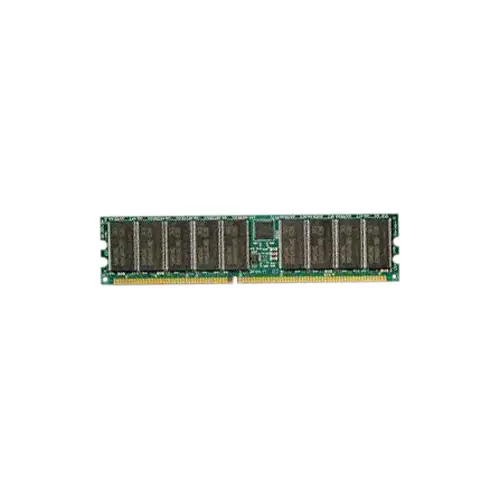
This registered DDR3-1333 RDIMM with ECC and a low 1.35V operating voltage is purpose-built for legacy server platforms, delivering the data integrity and reliability demanded by virtualization hosts and memory-intensive database applications. Its dual-rank x4 organization paired with registered signal buffering enhances electrical stability under fully populated configurations, allowing dense memory scaling without sacrificing signal quality.
1. Sixteen-gigabyte capacity allows a single server node to host more virtual machines, maximizing consolidation density without sacrificing memory headroom for critical applications.
2. ECC protection silently corrects single-bit errors in the background, preserving long-term data integrity essential for financial transactions and database accuracy.
3. Registered signal buffering stabilizes the command and address bus, enabling the deployment of high-capacity memory configurations across multiple DIMMs per channel without signal degradation.
4. Dual rank x4 construction interleaves memory accesses to keep the data bus saturated, substantially lifting sustained throughput for memory-intensive workloads like in-memory analytics.
5. Low 1.35-volt operation cuts power consumption and heat output per module, directly lowering cooling costs and improving energy efficiency across dense rack deployments.
When you are responsible for a virtualization cluster or an in-memory database that handles millions of transactions, memory is not just a component—it is the foundation of trust and performance. The Micron MT36KSF2G72PZ-1G4E1F is a DDR3-1333 Registered DIMM designed precisely for these enterprise server environments, and four characteristics directly determine what that means for your uptime and efficiency.
First, ECC error correction actively detects and corrects single-bit memory errors before they can silently corrupt critical database records or cause a hypervisor to crash an entire host. In a virtualized cluster running dozens of VMs, one uncorrected bit flip can cascade into hours of troubleshooting and lost revenue. Second, the Registered signal buffer gives you the electrical stability to populate all 24 DIMM slots per server without sacrificing signal integrity, turning a 16 GB module into a reliable building block for 384 GB or larger memory pools that in-memory databases like SAP HANA demand. Third, the dual-rank x4 organization interleaves access across internal banks, delivering measurably higher sustained bandwidth during heavy write operations and large table scans, so your Redis or Memcached instances respond faster under load. Finally, the 1.35V low-voltage operation directly reduces power draw and cooling demands across a fleet of servers—when you deploy hundreds of modules, the cumulative energy saving becomes a decisive factor in total cost of ownership. Together, these four attributes transform a simple memory stick into a safeguard for data integrity, a capacity enabler for virtual machines, and an efficiency multiplier for the datacenter floor.
General Virtualization
For a mid‑density virtualization host, deploy six to eight of these 16 GB RDIMMs (96–128 GB total) in a balanced multi‑channel configuration. This capacity comfortably supports 20–30 typical virtual machines while maintaining memory bandwidth and leaving room for hypervisor overhead.
In‑Memory Database
Maximize capacity with a fully populated configuration—twelve or more modules per socket, yielding 192 GB and beyond. The combination of ECC and registered signalling ensures data integrity under heavy write loads, while the 1.35 V operation reduces thermal stress in dense, round‑the‑clock deployments.
High‑Performance Computing (HPC)
Populate all memory channels identically to sustain peak bandwidth per core. For dual‑socket nodes, install eight or sixteen modules (128–256 GB) as matched sets, leveraging the dual‑rank x4 organization for improved bank‑level parallelism on DDR3‑1333. This balanced approach keeps large simulation datasets in memory with minimal latency.
Validated DDR3 server memory. Works flawlessly with Dell PowerEdge R720/R620, HP DL380p Gen8, Lenovo ThinkServer RD430, and more.
Q: Can I mix this MT36KSF2G72PZ-1G4E1F with other memory modules of different brands or speeds?
A: Mixing this RDIMM with different brands or speeds is not advised. It can cause instability and incompatibility. For reliable server operation, always use identical modules from a validated kit.
Q: Is this memory compatible with my Intel or AMD server platform?
A: This DDR3L-1333 ECC Registered DIMM suits Intel Xeon E5-2400/2600 v1 & v2, or AMD equivalents. Consult your server motherboard’s qualified vendor list (QVL) to confirm full compatibility.
Q: What is the recommended DIMM population order for optimal performance?
A: Follow your server manual. Generally, populate identical DIMMs in the first slot of each memory channel (e.g., A1, B1, C1) to enable balanced interleaving and maximum ECC bandwidth.
Q: Does this module support overclocking or XMP profiles?
A: No. This enterprise-grade RDIMM strictly adheres to JEDEC DDR3-1333/PC3-10600 standards. It does not support overclocking or XMP, ensuring data integrity and long-term reliability.
Q: What warranty and typical failure rate can I expect?
A: It includes a one-year limited warranty. Enterprise memory like this typically exhibits a very low annualized failure rate (AFR) of about 0.15% under specified operating conditions.