











 Secure payments
Standard refund policy
Trade Assurance
Secure payments
Standard refund policy
Trade Assurance
| Product Type | Memory Module |
|---|---|
| Memory Capacity | 16 GB |
| Memory Technology | DDR4 |
| Product Voltage | 1.2V |
| RAM Speed | 2400MHz |
| RAM Standard | DDR4-2400/PC4-19200 |
| Error Identifying | ECC |
| Signal Type | Registered |
| Column Access Strobe (CAS) | CL17 |
| Rank | Dual Rank x4 |
| Quantity of Pins | 288-pin |
| RAM Genre | RDIMM |
This RDIMM is engineered for enterprise servers and high-reliability computing platforms, excelling in virtualized environments, in-memory databases, and workloads demanding uncompromising data integrity. Its registered signal design and ECC error correction stabilize signal timing across densely populated memory channels, while the dual-rank x4 configuration enhances bank-level parallelism to sustain throughput under heavy concurrent access.
1. A 16 GB capacity per DIMM supports dense memory configurations, allowing virtualization-heavy servers to host more VMs and memory-resident databases without immediate need for scaling out.
2. End-to-end ECC correction continuously scrubs data errors, preserving financial and scientific data integrity in long-running computational tasks.
3. Registered clock and command signals stabilize multi-DIMM server architectures, enabling maximum installed memory without compromising signal integrity for 24/7 operations.
4. Dual Rank x4 organization interleaves memory banks to keep the data bus fully utilized, boosting throughput consistency for consolidated workloads and real-time analytics.
5. DDR4-2400 speed delivers strong per-channel bandwidth, accelerating transactions in in-memory caches and reducing latency spikes under concurrent user loads.
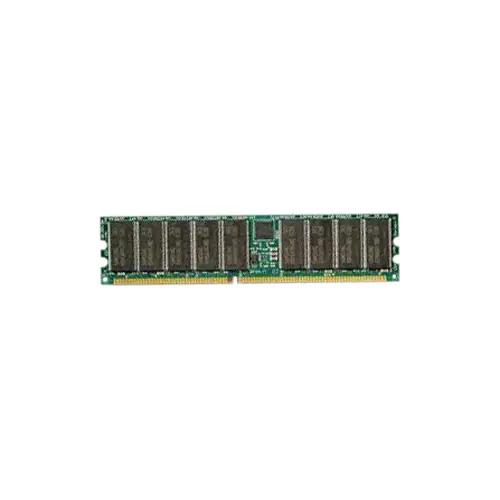
The Micron MTA36ASF2G72PZ-2G3B1QG is a server-grade DDR4 RDIMM, purpose-built for enterprise workloads where downtime is not an option. Its four defining characteristics directly answer the real-world challenges faced in virtualized clusters and in-memory databases.
First, ECC error correction actively detects and corrects single-bit memory errors caused by cosmic radiation or electrical noise, preventing silent data corruption that would otherwise ripple into financial miscalculations or a corrupted hypervisor state. When you are running dozens of virtual machines on a single host, that integrity safeguard means the difference between seamless uptime and a mysterious 3 a.m. crash. Second, the registered signal buffer stabilizes the command and address buses as you scale capacity; it allows you to fully populate all 24 DIMM slots with 16GB modules without signal degradation, giving your VMware or Hyper-V farm the headroom to grow. Third, the dual-rank x4 organization interleaves two internal memory banks per module, increasing effective bandwidth under heavy concurrent access. For an in-memory database like Redis or SAP HANA, this rank interleaving translates directly into faster query response times because the memory controller can overlap read commands across ranks. Finally, operating at 1.2V with a responsive CL17 latency at 2400MHz, the module delivers the throughput modern Xeon processors demand while keeping datacenter power and cooling costs in check. This is memory engineered not just to store data, but to protect your infrastructure and accelerate the decisions that depend on it.
This 16GB DDR4-2400 ECC Registered RDIMM (dual‑rank x4) is engineered for server platforms. The tailored capacity-planning suggestions below address typical data‑center workloads.
General Virtualization
Equip a dual‑socket server with six or eight modules (96–128 GB) distributed evenly across memory channels. This configuration preserves the full 2400MT/s speed, while registered ECC prevents data corruption under dense VM consolidation. For cost‑conscious deployments, 16GB RDIMMs remain the ideal capacity sweet spot; leave spare slots for future growth.
In‑Memory Database
Build a 192–384 GB pool by installing 12 to 24 modules, fully populating channels symmetrically to maximize rank interleaving. The dual‑rank x4 design delivers the low‑latency caching essential for Redis, SAP HANA, and similar stores. Operate at 1.2V to manage thermals in dense chassis; consider dedicating a spare module for advanced SDDC/ECC failover.
High‑Performance Computing
Populate each memory channel with one 16GB RDIMM to achieve 128–256 GB per node without down‑clocking. This balanced, one‑DIMM‑per‑channel layout provides the consistent bandwidth critical for parallel simulation and modeling. Deploy identical modules across the cluster to simplify tuning and maintain uniform performance.
Rigorously tested server memory, compatible with Dell PowerEdge R740, HPE ProLiant DL380 Gen10, Lenovo ThinkSystem SR650.
Q: Can I mix this MTA36ASF2G72PZ-2G3B1QG with other memory modules of different brands or speeds?
A: Mixing is not recommended for registered ECC memory. Different brands, speeds, or ranks can cause instability and uncorrected errors. Always populate identical Micron-certified modules to ensure signal integrity in server environments.
Q: Is this memory compatible with my system? Which Intel or AMD server platforms support it?
A: This DDR4-2400 ECC RDIMM is compatible with Intel Xeon E5-2600 v4, Scalable Gen1/2, and AMD EPYC 7001/7002 series platforms using C612/C621 or equivalent chipsets. Please verify your motherboard’s qualified vendor list.
Q: What is the recommended DIMM population order for optimal performance?
A: Populate identical DIMMs per channel, following your server board’s memory slot numbering. For dual-processor systems, balance capacity equally across CPUs. Start with slot 1 in each channel, using the same rank and configuration.
Q: Does this module support overclocking or XMP profiles?
A: No. This is a JEDEC-compliant, registered server DIMM operating at 2400MHz with CL17. Server memory does not support overclocking or XMP. It runs at the standard speed determined by the system BIOS and processor memory controller.
Q: What warranty and typical failure rate can I expect?
A: This Micron module includes a 1-year warranty. Enterprise DRAM offers an annualized failure rate (AFR) well below 0.5%, ensuring high reliability in 24/7 operation when operated within temperature and voltage specifications.