











 Secure payments
Standard refund policy
Trade Assurance
Secure payments
Standard refund policy
Trade Assurance
| Product Type | Memory Module |
|---|---|
| Memory Capacity | 16 GB |
| Memory Technology | DDR4 |
| Product Voltage | 1.2V |
| RAM Speed | 3200MHz |
| RAM Standard | DDR4-3200/PC4-25600 |
| Error Identifying | ECC |
| Signal Type | Registered |
| Column Access Strobe (CAS) | CL22 |
| Rank | Dual Rank x8 |
| Quantity of Pins | 288-pin |
| RAM Genre | RDIMM |
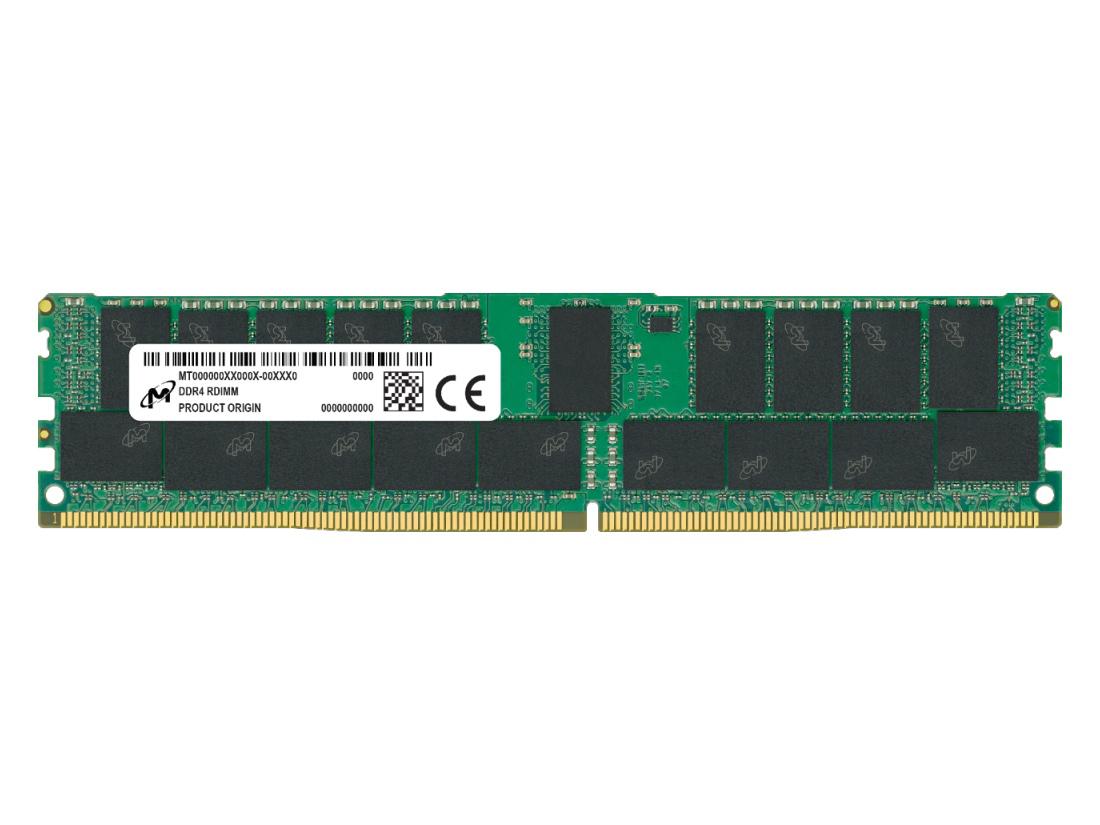
This is a server-grade 16GB DDR4-3200 RDIMM with ECC and registered signaling, purpose-built for virtualization, in-memory databases, and enterprise workloads that demand uncompromising data integrity. Its dual-rank x8 configuration boosts memory bandwidth through rank interleaving, while the registered architecture stabilizes command/address signals under high-capacity load, ensuring 24/7 operational reliability.
1. ECC memory detects and corrects single-bit errors in real time, preventing silent data corruption that could jeopardize financial transactions or database integrity in always-on server environments.
2. Registered signal buffering stabilizes command and address lines under heavy DIMM population, allowing dense multi-slot servers to scale capacity without sacrificing signal quality.
3. Dual Rank x8 organization leverages rank interleaving to keep the memory pipeline saturated, reducing latency spikes during concurrent virtual machine and container workloads.
4. Sixteen-gigabyte capacity per module balances density and cost, enabling a single 1U server to host a larger number of memory-hungry applications without exhausting all DIMM slots.
5. DDR4-3200 speed supplies the bandwidth headroom necessary for in-memory caching and real-time analytics, ensuring consistently low response times even as user concurrency scales.
Micron’s MTA18ASF2G72PDZ-3G2E1VI is a server-class DDR4-3200 RDIMM built to solve the real reliability and performance challenges that define modern data centers. In a virtualization cluster hosting dozens of mixed-workload VMs, the registered signal buffer is non-negotiable: it isolates the command and address lines so you can populate every DIMM slot without signal degradation, maintaining absolute stability as you scale memory to 512 GB or beyond per server. The integrated ECC then operates as a silent guardian, correcting single-bit upsets caused by background radiation before they can corrupt a financial transaction or a citizen database record. When your workloads move to an in-memory database like Redis or a real-time analytics platform, the dual-rank x8 organization and 3200 MT/s speed directly impact revenue. Dual‑rank interleaving allows the memory controller to prepare one rank while accessing the other, slashing latency and boosting random read IOPS under query storms. That 25.6 GB/s bandwidth translates into faster dashboard refreshes and shorter batch processing windows. Choosing this module means you eliminate the anxiety of unexplained server crashes and deliver predictable, low-latency performance where uptime is tied to business outcomes.
General Virtualization
Populate all memory channels on each CPU with one 16 GB RDIMM to maximize bandwidth while maintaining balanced capacity. In a typical dual‑socket server with eight channels per CPU, install sixteen modules for a total of 256 GB — a sweet spot for moderate VM density. Leave half the slots free to scale later without sacrificing performance.
In-Memory Database
Favor capacity and data redundancy by using two 16 GB dual‑rank RDIMMs per channel (2DPC). A dual‑socket platform populated with 32 such modules delivers 512 GB of robust ECC‑protected memory, essential for large in‑memory datasets. Expect a slight speed reduction to DDR4‑2933, but the trade‑off is acceptable for persistent storage caching and real‑time analytics.
High-Performance Computing (HPC)
Optimize for peak bandwidth and latency by installing exactly one 16 GB RDIMM per channel — avoiding the frequency drop of 2DPC configurations. A dual‑processor node filled across all 16 channels provides 256 GB at the full DDR4‑3200 speed. This balanced, fully‑populated arrangement ensures uniform access times and maximizes throughput for tightly‑coupled parallel workloads.
Rigorously tested server DDR4 RDIMM, compatible with Dell PowerEdge R750, HPE ProLiant DL380 Gen10 Plus, Lenovo ThinkSystem SR650 V2.
Q: Can I mix this MTA18ASF2G72PDZ-3G2E1VI with other memory modules of different brands or speeds?
A: Mixing different brands or speeds is not recommended. Mismatched registered ECC modules can cause signal integrity issues, system instability, and silent data corruption. For reliable server operation, use identical modules.
Q: Is this memory compatible with my system?
A: This RDIMM is designed for servers with Intel Xeon Scalable or AMD EPYC platforms that support DDR4-3200 ECC registered memory. Verify your motherboard’s memory QVL and ensure it accepts RDIMMs.
Q: What is the recommended DIMM population order for optimal performance?
A: Follow your server manual, generally populating identical modules symmetrically across all memory channels. Start with the primary slots per channel to enable balanced channel interleaving and maximum bandwidth.
Q: Does this module support overclocking or XMP profiles?
A: No. This JEDEC-standard RDIMM runs strictly at DDR4-3200 with CL22 timings. Overclocking and XMP are not supported, as registered server memory prioritizes operational stability and data integrity.
Q: What warranty and typical failure rate can I expect?
A: This module carries a 1-year warranty. Enterprise-grade Micron memory exhibits very low failure rates under normal conditions, built for 24/7 mission-critical server environments.