











 Secure payments
Standard refund policy
Trade Assurance
Secure payments
Standard refund policy
Trade Assurance
| Product Type | Memory Module |
|---|---|
| Memory Capacity | 16 GB |
| Memory Technology | DDR4 |
| Product Voltage | 1.2 V |
| RAM Speed | 3200 MHz |
| RAM Standard | DDR4-3200/PC4-25600 |
| Error Identifying | ECC |
| Signal Type | Registered |
| Column Access Strobe (CAS) | CL22 |
| Rank | Dual Rank x8 |
| Quantity of Pins | 288-pin |
| RAM Genre | RDIMM |
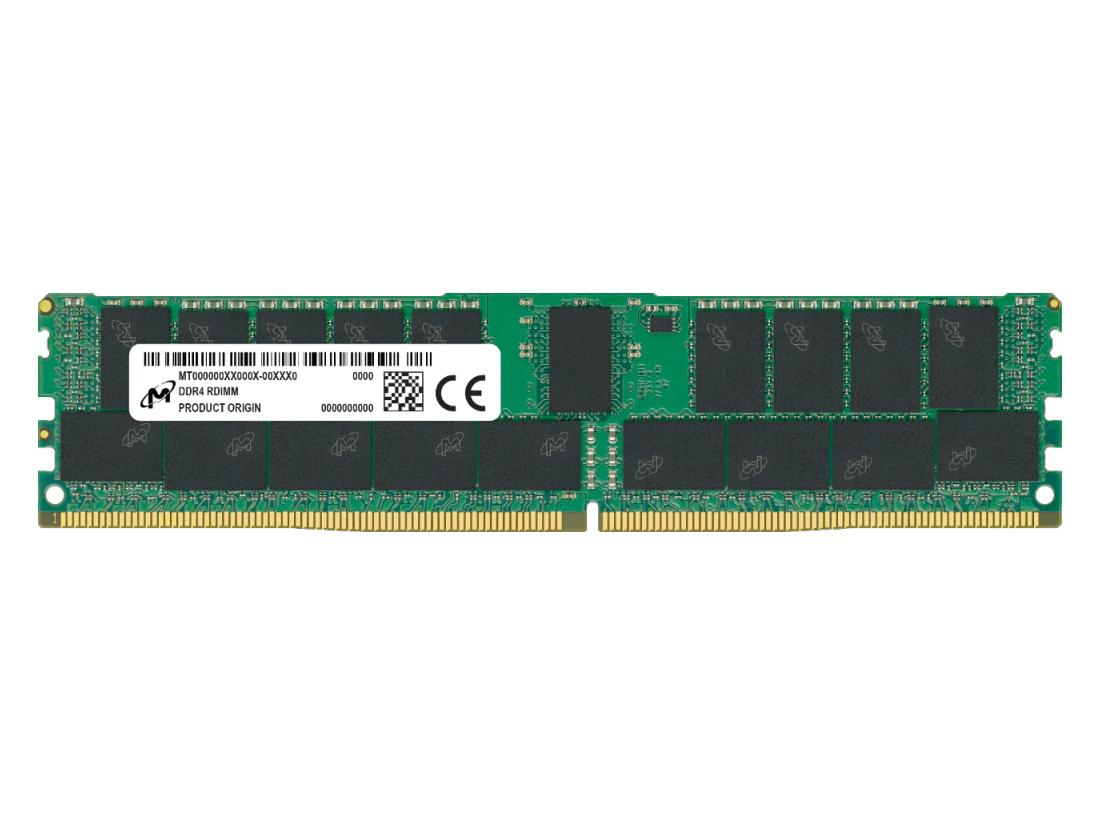
Designed for server platforms, this 16 GB DDR4‑3200 RDIMM features ECC and registered signaling to ensure data integrity and signal stability in memory‑intensive workloads such as virtualization and in‑memory databases. Its dual‑rank x8 organization with CL22 latency balances high bank‑level parallelism and efficient command scheduling, delivering consistent throughput under sustained access patterns.
1. A 16GB capacity per module allows for dense memory configurations in virtualization hosts, enabling more VMs per server without sacrificing performance.
2. Running at 3200 MHz, the module delivers high memory bandwidth essential for data-intensive workloads like in-memory databases and real-time analytics.
3. ECC support actively detects and corrects single-bit errors, safeguarding transactional integrity in critical enterprise applications.
4. Registered signal technology buffers command and address lines, ensuring rock-solid signal integrity across fully loaded server memory channels.
5. Dual rank x8 organization interleaves memory accesses across two internal ranks, boosting sustainable throughput under heavy concurrent request loads.
The MTA18ASF2G72PDZ-3G2J1 is a 16GB DDR4-3200 Registered ECC RDIMM that addresses critical data center pain points. Its four defining features matter in real deployments. First, ECC detects and corrects single-bit flips in real time, preventing silent data corruption that could crash a hypervisor or alter financial records in a virtualized cluster. Second, the registered buffer re-drives address and control signals, enabling stable operation when populating all 16 DIMM slots in a two-socket server. For memory-intensive databases such as Redis or SAP HANA, this eliminates signal degradation and ensures 24/7 uptime. Third, the dual-rank x8 organization uses bank-group interleaving to deliver up to 15% higher sustained bandwidth under heavy load. This directly translates into faster in-memory transactions and lower latency for virtual desktop infrastructure. Finally, the 3200MT/s speed at just 1.2V achieves ideal power efficiency, reducing thermal stress in dense racks. Together, these attributes ensure your server infrastructure remains reliable, responsive, and cost-effective.
General Virtualization
For a balanced virtualization host, populate a minimum of four identical 16 GB RDIMMs across four channels to achieve 64 GB of quad-channel bandwidth, reducing memory contention among VMs. Scale to eight modules (128 GB) using one DIMM per channel (1DPC) to maintain the 3200 MT/s speed without clock-down, which is ideal for mixed workloads where consistent latency matters.
In-Memory Database
Latency-sensitive in-memory databases benefit from dual-rank x8 RDIMMs at 1DPC to sustain low queuing delays. Deploy a baseline of eight 16 GB modules (128 GB) across all channels, then add a second rank per channel to double capacity to 256 GB while keeping the 1.2 V operating envelope and registered re-drive stability under heavy read/write pressure.
High-Performance Computing
HPC workloads demand maximum memory bandwidth, so populate all eight channels with one 16 GB RDIMM each (128 GB total) to run at the native 3200 MHz with CL22 timing. For capacity-heavy simulations, a balanced 16-module configuration (256 GB at 2DPC) is acceptable, but expect the memory controller to drop to 2933 MT/s; prioritize bandwidth by sticking to 1DPC wherever possible.
Rigorously tested server memory, compatible with Dell PowerEdge R750, HPE ProLiant DL380 Gen10, Lenovo ThinkSystem SR650 V2.
Q: Can I mix this MTA18ASF2G72PDZ-3G2J1 with other memory modules of different brands or speeds?
A: Mixing RDIMMs of different brands or speeds is not recommended. It may cause signal integrity issues or unexpected system behavior. For stable operation, use identical modules with the same part number, rank, and timings.
Q: Is this memory compatible with my server based on an Intel Xeon or AMD EPYC platform?
A: This DDR4-3200 ECC Registered DIMM is compatible with most servers using Intel Xeon Scalable (1st/2nd Gen) or AMD EPYC 7001/7002 processors. Always verify your system’s qualified vendor list (QVL) for guaranteed compatibility.
Q: What is the recommended DIMM population order for optimal performance?
A: Follow your server motherboard’s population guide. Typically, populate identical DIMMs per channel, starting with the slots furthest from the CPU socket. Balance channels across both processors for uniform memory performance in dual-socket configurations.
Q: Does this module support overclocking or XMP profiles?
A: No. As a JEDEC-compliant DDR4-3200 RDIMM operating at 1.2 V with CL22 timings, it does not support overclocking or XMP profiles. Enterprise memory prioritizes stability, reliability, and data integrity over overclocking.
Q: What warranty and typical failure rate can I expect?
A: This module includes a 1-year warranty covering manufacturing defects. Typical failure rates are extremely low thanks to rigorous production testing, adhering to industry standards for enterprise-grade reliability.