











 Secure payments
Standard refund policy
Trade Assurance
Secure payments
Standard refund policy
Trade Assurance
| Product Type | Memory Module |
|---|---|
| Memory Capacity | 16 GB |
| Memory Technology | DDR3 |
| Product Voltage | 1.5V |
| RAM Speed | 1066MHz |
| RAM Standard | DDR3-1066/PC3-8500 |
| Error Identifying | ECC |
| Signal Type | Registered |
| Column Access Strobe (CAS) | CL7 |
| Rank | Quad Rank x4 |
| Quantity of Pins | 240-pin |
| RAM Genre | RDIMM |
This 16 GB DDR3-1066 Registered ECC RDIMM is a server-class memory module purpose-built for virtualization clusters, memory-resident databases, and mission-critical enterprise workloads that demand uncompromising data integrity. The quad-rank x4 organization and registered signal path stabilize high-capacity multi-DIMM configurations, while ECC and a low CL7 latency guarantee reliable, responsive operation under continuous load.
1. ECC detection and correction eliminates silent data errors, preserving transactional integrity for mission-critical database and financial processing workloads.
2. Registered buffering stabilizes signal paths across fully populated memory channels, enabling reliable scaling in dense multi-socket server deployments.
3. Quad Rank x4 organization maximizes per-DIMM capacity, serving memory-hungry virtualization hosts with optimal interleaving for sustained throughput under heavy consolidation.
4. CL7 low latency shortens data retrieval cycles, delivering faster response in latency-sensitive enterprise applications like in-memory analytics.
5. 16 GB per module raises the memory ceiling per server node, directly increasing virtual machine density without sacrificing guaranteed quality of service.
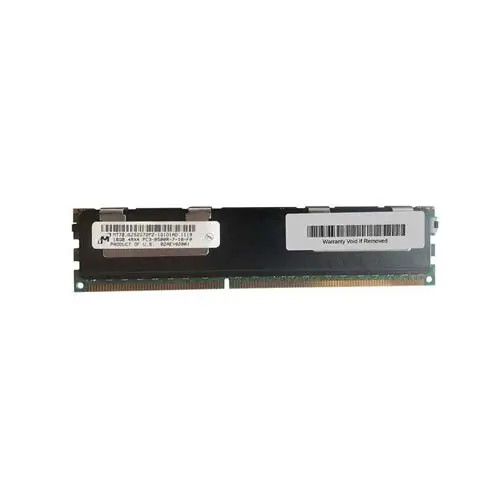
The MT72JSZS2G72PZ-1G1D1AD is a server DDR3 RDIMM. Its four defining traits—ECC, registered buffer, 16GB capacity, and quad-rank x4 design—are critical for enterprise workloads. In a virtualized cluster, a single uncorrected memory bit flip can silently corrupt a hypervisor or guest database, causing multi-tenant outages. ECC detects and corrects such errors on the fly, preserving data integrity and uptime. Registered buffering reduces electrical load on the memory controller, enabling servers to support dense configurations without signal degradation. This directly benefits in-memory databases like SAP HANA, where every bit must be precise and large datasets demand hundreds of gigabytes of reliable memory. The 16GB quad-rank module maximizes capacity per channel; the register ensures clean commands reach all four ranks, so you can scale up memory for real-time analytics while maintaining stability. Ultimately, these features deliver the unshakeable reliability and consistent performance required for consolidated, mission-critical operations.
Server Memory Identification:
This 16GB DDR3-1066 Registered ECC RDIMM (Quad Rank x4, CL7, 1.5V) is strictly server-grade memory designed for stability in multi-socket platforms.
General Virtualization
Deploy six to eight of these modules across dual-socket servers to achieve 96–128 GB total capacity. A balanced population of three or four DIMMs per processor maintains dual-channel or triple-channel symmetry, ensuring ample memory for moderate VM density while ECC and registered buffering safeguard multi-tenant workloads. Use identical part numbers in each memory channel to avoid training failures.
In-Memory Database
Maximize capacity by fully populating all 12 or 16 DIMM slots on a typical two-socket server, yielding 192–256 GB. Although 1066 MHz is modest, the sheer capacity keeps entire datasets resident. Enable memory mirroring or sparing if the platform supports it, as registered ECC alone is critical but not sufficient for the high-availability demands of in-memory analytics.
High-Performance Computing (HPC)
Focus on population rules: on triple-channel systems, install three DIMMs per CPU for peak bandwidth; on quad-channel systems, use four. Avoid mixing quad-rank DIMMs beyond two per channel to prevent speed downgrades. For 16 GB DIMMs, this yields 48–64 GB per node—sufficient for memory-bound MPI tasks, where error correction and signal integrity from registered RDIMMs prevent silent data corruption during weeks-long simulations.
Rigorously tested and verified compatible with Dell PowerEdge R710, HP ProLiant DL380 G7, and IBM System x3650 M3.
Q: Can I mix this MT72JSZS2G72PZ-1G1D1AD with other memory modules of different brands or speeds?
A: Mixing different brands or speeds is not recommended for registered ECC server memory. It can cause system instability and compatibility issues. All installed modules should be identical for guaranteed reliability.
Q: Is this memory compatible with my server? Which Intel or AMD platforms support it?
A: This DDR3-1066 registered ECC DIMM is compatible with servers using Intel Xeon 5500/5600 series or AMD Opteron 6100/6200 platforms. Always verify your server's qualified vendor list for precise compatibility.
Q: What is the recommended DIMM population order for optimal performance with this quad-rank module?
A: Always follow your server manufacturer's population guidelines. Typically, populate memory channels starting with the first slot per channel to balance load. Quad-rank modules may require specific order due to higher electrical demand.
Q: Does this module support overclocking or XMP profiles?
A: No. As an enterprise-grade registered ECC DIMM, it operates at standard JEDEC specifications only. Overclocking or XMP is not supported to ensure data integrity and 24/7 stability.
Q: What warranty and typical failure rate can I expect?
A: This module includes a one-year warranty. Its typical failure rate is extremely low, aligning with enterprise-class reliability standards. We ensure rigorous testing for sustained mission-critical operations.