











 Secure payments
Standard refund policy
Trade Assurance
Secure payments
Standard refund policy
Trade Assurance
| Product Type | Memory Module |
|---|---|
| Memory Capacity | 16 GB |
| Memory Technology | DDR3 |
| Product Voltage | 1.5V |
| RAM Speed | 1066MHz |
| RAM Standard | DDR3-1066/PC3-8500 |
| Error Identifying | ECC |
| Signal Type | Registered |
| Column Access Strobe (CAS) | CL7 |
| Rank | Quad Rank x4 |
| Quantity of Pins | 240-pin |
| RAM Genre | RDIMM |
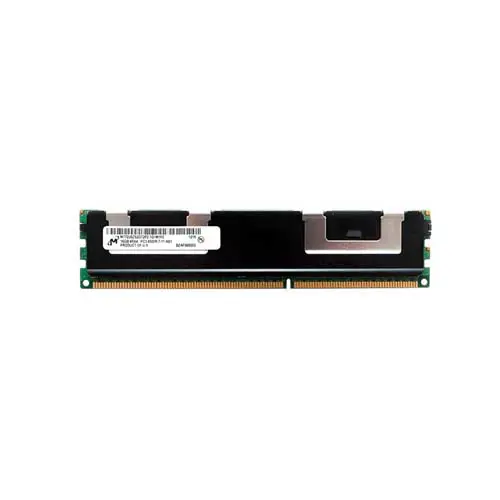
This registered DDR3-1066 RDIMM with ECC and a low CAS latency of CL7 is ideally suited for virtualization hosts and in-memory databases, where its quad-rank x4 configuration maximizes memory density per channel while advanced error correction ensures data integrity under continuous operation. The registered signal type enhances electrical stability in multi-DIMM configurations, making it a reliable choice for legacy enterprise servers requiring consistent, low-latency access to large datasets.
1. ECC error correction safeguards transactional databases and virtualized workloads from silent data corruption, ensuring uninterrupted uptime in enterprise server environments.
2. The registered buffer re-drives address and command signals, maintaining signal integrity across fully populated memory channels for rock-solid multi-DIMM server configurations.
3. 16 GB capacity per module enables higher virtual machine density, allowing one physical server to consolidate more isolated workloads without exhausting memory resources.
4. Quad Rank x4 organization doubles the number of DRAM banks per DIMM, maximizing memory capacity in limited server slots to keep large in-memory datasets close to the CPU.
5. CL7 low latency accelerates memory response cycles, delivering predictable and snappy data retrieval for latency-sensitive operations like financial trading and real-time analytics.
When you deploy the Micron MT72JSZS2G72PZ-1G1M1FE in your server, you immediately address four critical reliability and performance challenges. ECC technology actively corrects single-bit errors caused by cosmic radiation or electrical noise, preventing silent data corruption that could destabilize a virtualized cluster or cause a financial database to return incorrect results—for you, that means uninterrupted service and data accuracy in mission-critical operations. Registered signal buffering then stabilizes the high electrical loads of this quad-rank module, allowing you to fully populate memory channels for large virtualization hosts without signal degradation; your dozens of guest VMs run smoothly even under extreme memory pressure. The quad-rank x4 organization interleaves access across four internal ranks, hiding refresh latency and boosting effective bandwidth for in-memory databases like SAP HANA, which accelerates real-time queries. Lastly, the generous 16GB per DIMM expands total memory in space-confined 1U servers, supporting dense, cost-effective infrastructure for your growing server farm.
General Virtualization
For a dual-socket server with triple-channel DDR3 architecture, install six of these 16GB Registered DIMMs (one per channel per CPU) to achieve 96GB of balanced capacity. This configuration maximizes memory bandwidth for multiple VMs while leaving room for future expansion. Avoid mixing quad-rank modules on the same channel without verifying the platform’s rank limitations to prevent downclocking.
In-Memory Database
Maximize total capacity by populating all available slots—up to 12 modules per host (288GB) on a typical two-CPU board—as in-memory datasets demand large, contiguous RAM. Because these 16GB quad-rank RDIMMs operate at 1066MHz, ensure the memory controller can handle four ranks per channel without throttling; if speed drops below 800MHz, consider balancing with smaller rank counts. Pair identical modules to maintain ECC scrubbing efficiency and data integrity.
High-Performance Computing
Fill every memory channel with one 16GB RDIMM first (e.g., six modules for a dual-socket Xeon 5600 series) to deliver peak sustained bandwidth for memory-bound MPI workloads. For capacity-hungry HPC jobs, add a second identical module to each channel, creating 192GB uniform configurations, but expect a reduction to 800MHz due to quad-rank loading. Always populate channels symmetrically to avoid NUMA imbalances and performance degradation.
Rigorously tested server memory. Compatible with Dell PowerEdge R710, R610, HP DL380 G7, and more.
Q: Can I mix this MT72JSZS2G72PZ-1G1M1FE with other memory modules of different brands or speeds?
A: Mixing this registered ECC RDIMM with different brands or speeds is not recommended. It can cause instability, boot failures, or uncorrected errors. For reliable server operation, use identical modules in each memory channel.
Q: Is this memory compatible with my system?
A: This 16GB DDR3-1066 ECC Registered RDIMM targets servers with Intel Xeon 5500/5600 or AMD Opteron 6100/6200 platforms. Check your motherboard’s QVL for RDIMM support, quad-rank population rules, and C32/G34 socket compatibility.
Q: What is the recommended DIMM population order for optimal performance?
A: Populate identical quad-rank RDIMMs across channels per server manual. Install one DIMM per channel first, then fill second slots to balance loads and sustain 1066MHz, avoiding speed downclocking. This ensures optimal interleaving and signal integrity.
Q: Does this module support overclocking or XMP profiles?
A: No, this server-class ECC registered memory operates at JEDEC standard timings (CL7) and does not support overclocking or XMP. Data integrity and 24/7 stability are prioritized over speed adjustments.
Q: What warranty and typical failure rate can I expect?
A: This module includes a 1-year warranty covering manufacturing defects. Enterprise server memory typically shows an annualized failure rate well below 0.5%, thanks to rigorous ECC testing and high-quality chip screening for continuous operation.