











 Secure payments
Standard refund policy
Trade Assurance
Secure payments
Standard refund policy
Trade Assurance
| Product Type | Memory Module |
|---|---|
| Compliance Standards | RoHS |
| Memory Capacity | 16 GB |
| Memory Technology | DDR3 |
| Product Voltage | 1.35V |
| RAM Speed | 1333MHz |
| RAM Standard | DDR3-1333/PC3-10600 |
| Error Identifying | ECC |
| Signal Type | Registered |
| Column Access Strobe (CAS) | CL9 |
| Rank | Dual Rank x4 |
| Quantity of Pins | 240-pin |
| RAM Genre | RDIMM |
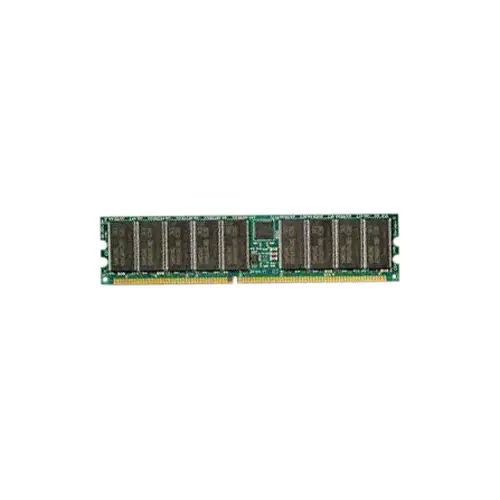
Designed for server platforms, this 16GB DDR3-1333 RDIMM with ECC and registered signaling ensures data integrity in virtualized environments and memory-intensive database workloads. Its dual-rank x4 configuration and low 1.35V voltage enhance signal stability and power efficiency while maintaining CL9 latency for reliable performance in 24/7 data center operations.
1. The sixteen-gigabyte capacity per module supports high-density memory configurations, enabling more virtual machines per physical host and reducing data center footprint.
2. ECC protection actively corrects single-bit errors in real time, preventing silent data corruption in transactional databases and financial processing.
3. Registered buffering stabilizes signal integrity across fully populated memory channels, allowing large-scale deployments to maintain 24/7 operational reliability.
4. Low 1.35-volt operation cuts energy consumption and thermal load in dense server racks, lowering cooling costs and improving overall power usage effectiveness.
5. Dual rank x4 organization interleaves memory bank accesses to keep data channels fully utilized, boosting throughput for virtualization and in-memory analytics.
The MT36KSF2G72PZ-1G4E1LF is a server DDR3 RDIMM engineered to solve critical infrastructure challenges. Its ECC technology eliminates risks of silent data corruption, ensuring your virtualization cluster or in-memory database like Redis maintains rock-solid data integrity through every single transaction. The registered buffer enables stable, high-capacity configurations—when you deploy multiple DIMMs per channel to support dozens of VMs, it prevents the signal degradation that directly causes unpredictable crashes. The dual-rank x4 design employs interleaving to accelerate memory access, directly improving query response times and live migration throughput under heavy load. Moreover, operating at a mere 1.35V, this module dramatically reduces power draw and cooling costs in dense data centers, extending hardware lifespan. For a Hyper-V farm or an SAP HANA environment, that translates to uncompromising uptime, faster data retrieval, and a measurably lower total cost of ownership.
Server Memory Identified
This is a DDR3-1333 Registered ECC DIMM (RDIMM) with 16 GB capacity, 1.35V low voltage, and dual-rank x4 organization—typical for enterprise servers and workstations requiring data integrity and large memory footprints.
General Virtualization
Populate all memory channels evenly with identical 16 GB RDIMMs to maximize available capacity while maintaining balanced NUMA access. For a dual-socket server with 12 DIMM slots per CPU, install 12 modules per processor (192 GB total) to support 30–40 moderate VMs, leaving headroom for memory overcommitment and vMotion operations.
In-Memory Database
Deploy the maximum supported configuration by fully populating every DIMM slot with these 16 GB modules—e.g., 24 modules across two sockets for 384 GB—to hold entire datasets in RAM. Ensure 1 DIMM per channel initially to maintain peak bandwidth, then expand to 2 DIMMs per channel only if capacity demands outweigh the slight frequency drop to 1066 MT/s.
High-Performance Computing
Configure a balanced memory layout using one 16 GB RDIMM per memory channel (8 or 12 modules per node) to deliver both high capacity and consistent 1333 MT/s speed. Stick to identical dual-rank x4 modules to preserve symmetric interleaving and minimize memory latency in tightly coupled MPI workloads; scale to 256 GB per node for memory-bandwidth-bound CFD or genomic simulations.
Rigorously tested server memory for Dell PowerEdge R720, HP ProLiant DL380p Gen8, IBM System x3650 M4.
Q: Can I mix this MT36KSF2G72PZ-1G4E1LF with other memory modules of different brands or speeds?
A: Mixing RDIMMs of different brands or speeds is not recommended. It may cause signal integrity issues, force all modules to the lowest common speed, or lead to system instability in server environments.
Q: Is this memory compatible with my system? (Intel/AMD server platform)
A: This module requires a platform supporting DDR3 Registered ECC memory at 1.35V. Verify your server motherboard or CPU (e.g., Intel Xeon E5-2400 series) explicitly lists DDR3-1333 RDIMM compatibility on its qualified vendor list.
Q: What is the recommended DIMM population order for optimal performance?
A: Follow your server manual’s population guide. Generally, populate identical dual-rank RDIMMs identically per channel, starting with the first slot of each memory channel to enable balanced interleaving and full ECC protection.
Q: Does this module support overclocking or XMP profiles?
A: No. This is a server-grade Registered ECC DIMM designed for strict JEDEC compliance and maximum reliability. It does not support overclocking, XMP, or any profile beyond the standard DDR3-1333 timing set.
Q: What warranty and typical failure rate can I expect?
A: It includes a one-year warranty. As enterprise-class RDIMM memory built with error correction and high-quality components, the typical annualized failure rate (AFR) is very low, commonly below 0.5% under specified conditions.