











 Secure payments
Standard refund policy
Trade Assurance
Secure payments
Standard refund policy
Trade Assurance
| Product Type | Memory Module |
|---|---|
| Compliance Standards | RoHS |
| Memory Capacity | 16 GB |
| Memory Technology | DDR3 |
| Product Voltage | 1.35V |
| RAM Speed | 1333MHz |
| RAM Standard | DDR3-1333/PC3-10600 |
| Error Identifying | ECC |
| Signal Type | Registered |
| Column Access Strobe (CAS) | CL9 |
| Rank | Dual Rank x4 |
| Quantity of Pins | 240-pin |
| RAM Genre | RDIMM |
This RDIMM module’s DDR3-1333 specification with registered signaling and ECC ensures stable, error-resilient operation for server platforms hosting memory-intensive workloads such as virtualization clusters or in-memory databases. Its dual-rank x4 organization at 1.35V delivers robust memory density and enhanced signal integrity while reducing power consumption, making it an optimal upgrade for enterprise servers demanding data integrity and 24/7 reliability.
1. ECC error correction actively detects and corrects single-bit memory faults, ensuring data integrity for financial transactions and database operations that cannot tolerate silent corruption.
2. Registered signal type buffers address and command lines, enabling stable operation across fully populated servers and allowing IT to scale memory capacity without compromising reliability.
3. 1.35V low-voltage operation trims power consumption per DIMM, which directly reduces cooling costs and improves energy efficiency across large-scale cloud deployments.
4. 16 GB capacity per module raises memory density in each server node, allowing more virtual machines to run concurrently on the same physical host before requiring additional hardware.
5. Dual Rank x4 organization interleaves memory accesses at the rank level, sustaining higher command throughput and improving overall memory bandwidth for heavy analytics workloads.
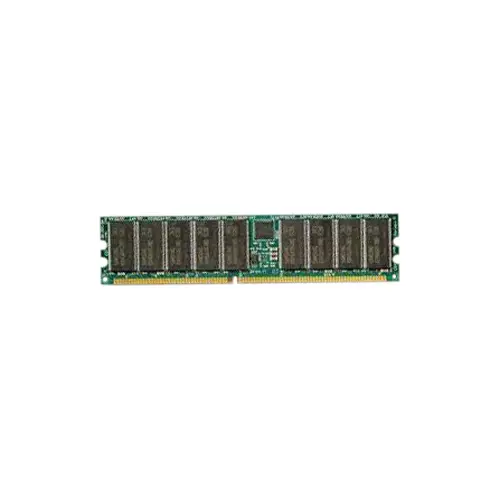
Designed for enterprise servers, the Micron MT36KSF2G72PZ-1G4E1G is a 16GB DDR3-1333 RDIMM that transforms how your data center handles critical workloads, not through a checklist of specifications, but through four capabilities that directly prevent costly failures. Its ECC engine continuously corrects single-bit memory errors caused by background radiation, a silent threat that, without protection, silently flips a bit in a financial database or a virtualization hypervisor, corrupting transactions or crashing an entire virtual machine cluster instantly. The registered signal buffer is what lets you populate all 24 DIMM slots of a 2U server with confidence; it isolates the command bus from the memory ranks, so a massive in-memory database like Redis or SAP HANA can scale to terabytes without signal degradation, keeping query latencies predictable under full load. The dual-rank x4 organization interleaves access across two internal ranks, giving the memory controller twice the page-hits per cycle and measurably higher bandwidth for consolidated VMware hosts where dozens of VMs compete for data. And at 1.35V, this module cuts power consumption by roughly 20% versus standard 1.5V DDR3, which across a rack of servers reduces cooling costs and thermal stress, extending service life in always-on analytics clusters where every watt of saved energy becomes a margin advantage.
Based on the specifications—16 GB capacity, DDR3-1333, ECC, Registered, 240-pin—this is a server-class memory module. Capacity planning for this low-voltage (1.35 V) RDIMM follows.
General Virtualization
Start with two 16 GB modules (32 GB total) to enable dual-channel interleaving for a modest virtual machine host. For higher consolidation ratios, install four or eight identical RDIMMs (64–128 GB); the registered ECC preserves stability under sustained multi-tenant workloads and helps avoid swapping.
In-Memory Database
Populate all available memory channels with these 16 GB RDIMMs, typically achieving 256 GB or more on a dual-socket server. This keeps entire datasets (e.g., Redis, SAP HANA) in DRAM, eliminates disk I/O bottlenecks, and delivers the sub-millisecond response times required for real-time analytics.
High-Performance Computing (HPC)
Distribute modules evenly across channels—for example, eight 16 GB dual‑rank RDIMMs in a two‑CPU, quad‑channel system—to maximize aggregate memory bandwidth. The uniform registered configuration feeds data‑intensive parallel workloads such as computational fluid dynamics or molecular dynamics without introducing latency inconsistencies.
Rigorously tested DDR3 RDIMM; compatible with Dell PowerEdge R720, HP DL380p Gen8, Lenovo RD430.
Q: Can I mix this MT36KSF2G72PZ-1G4E1G with other memory modules of different brands or speeds?
A: Mixing different brands or speeds of registered ECC memory is not recommended. It may cause instability, POST failures, or reduced reliability in server environments. Use identical part numbers for guaranteed compatibility.
Q: Is this memory compatible with my system?
A: This RDIMM is designed for dual-processor Intel or AMD server platforms supporting DDR3-1333 registered ECC memory. Please verify your motherboard's qualified vendor list and chipset support for 1.35V low-voltage modules.
Q: What is the recommended DIMM population order for optimal performance?
A: Populate identical DIMMs per channel, starting with the slot farthest from the CPU. For dual-rank x4 modules, balance across memory channels and follow the motherboard's specific slot numbering to enable interleaving and maximize bandwidth.
Q: Does this module support overclocking or XMP profiles?
A: No. This is a JEDEC-compliant registered server DIMM operating at fixed DDR3-1333 CL9 timings. Overclocking and XMP are not supported, as enterprise memory prioritizes data integrity and maximum uptime over tunable performance.
Q: What warranty and typical failure rate can I expect?
A: This module includes a one-year warranty. Designed for 24/7 server workloads, it achieves a typical annualized failure rate well below 0.5%, reflecting rigorous screening and high-reliability standards for registered ECC components.