











 Secure payments
Standard refund policy
Trade Assurance
Secure payments
Standard refund policy
Trade Assurance
| Product Type | Memory Module |
|---|---|
| Compliance Standards | RoHS |
| Memory Capacity | 16 GB |
| Memory Technology | DDR3 |
| Product Voltage | 1.35V |
| RAM Speed | 1333MHz |
| RAM Standard | DDR3-1333/PC3-10600 |
| Error Identifying | ECC |
| Signal Type | Registered |
| Column Access Strobe (CAS) | CL9 |
| Rank | Dual Rank x4 |
| Quantity of Pins | 240-pin |
| RAM Genre | RDIMM |
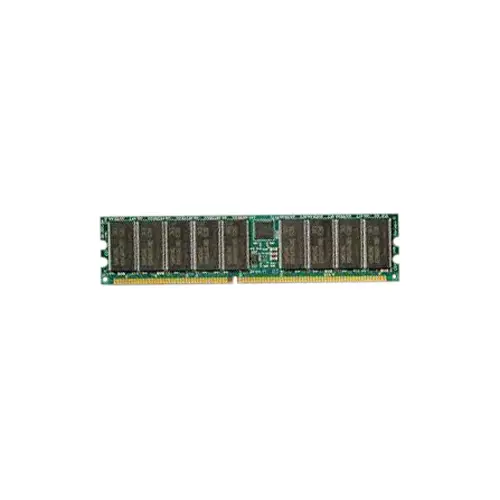
This 16GB DDR3-1333 registered ECC module (PC3-10600, 1.35V) with dual-rank x4 organization and CL9 latency is purpose-built for virtualization clusters, in-memory databases, and data-integrity-critical workloads where registered signal buffering ensures stability in dense memory configurations. Its 1.35V low-power design combined with ECC guards against silent data corruption, while the dual-rank interleaving optimizes throughput under heavy concurrent access.
1. Registered signal type buffers the command and address lines, allowing a single server to support large memory populations without signal degradation as DIMM counts scale up.
2. ECC protection detects and corrects single-bit memory errors in real time, preventing silent data corruption in financial transactions or long-running analytics workloads.
3. 16 GB capacity per module strikes a dense balance for virtualization hosts, enabling more active VMs per socket without immediately exhausting all DIMM slots.
4. Dual Rank x4 organization leverages four independent 4-bit banks to interleave accesses, sustaining high throughput under the continuous random reads typical of database servers.
5. 1.35V low-voltage operation reduces the overall thermal footprint inside 1U and blade enclosures, cutting cooling costs while preserving error correction reliability.
Understanding the MPN MT36KSF2G72PZ-1G4D1FE begins with its classification as a Registered DDR3 RDIMM with ECC, purpose-built for server environments. For IT architects managing virtualization clusters, the Error Correcting Code (ECC) capability is a silent guardian. A single-bit flip in a dense VMware or Hyper-V host, caused by cosmic radiation or electrical noise, can corrupt a virtual machine’s state or crash an entire node. ECC detects and corrects these errors in real time, preserving uptime and data fidelity without administrative intervention. Equally critical is the Registered signal buffer. In a 16-DIMM slot server running multiple VMs, unbuffered memory would strain the memory controller to the point of instability. The register redrives address and command signals, enabling reliable population of high-capacity configurations so you can scale your virtualized workloads confidently.
The 1.35V low-voltage design directly attacks operational cost. In a rack of 50 servers, each with eight such DIMMs, the reduction from standard 1.5V DDR3 translates into megawatt-hours of annual savings and lower cooling loads, letting you reinvest that budget into innovation. Meanwhile, the dual-rank x4 organization on a single module is a deliberate performance choice for in-memory databases like Redis or SAP HANA. It allows interleaved access across two internal rank banks, boosting effective bandwidth during the simultaneous read/write storms typical of real-time analytics. This isn’t just a specification sheet—it’s a guarantee of deterministic latency under load, ensuring your critical transactions complete without the jitter that annoys end users and violates service level agreements.
General Virtualization
For moderate-density VM hosts, populate at least six of these 16 GB RDIMMs per socket to reach 96 GB of balanced capacity. Use identical dual-rank DIMMs across all populated channels to maintain uniform memory access and avoid performance penalties from mixed-rank configurations. Plan for a 1 DIMM-per-channel (1DPC) fill on triple-channel platforms to stay at 1333 MT/s without speed degradation.
In-Memory Database
Capacity is paramount—install 12 or more modules per dual-socket node to achieve 192 GB or higher, allowing entire datasets to reside in RAM. Because the 1.35 V low-voltage RDIMMs reduce thermal load even at full population, higher density is sustainable without excessive cooling. Validate that the memory interleaving aligns with the database engine’s NUMA settings to minimize remote-memory latency.
High-Performance Computing (HPC)
Optimize for bandwidth by populating all memory channels symmetrically—three or four of these dual-rank DIMMs per socket, depending on the platform. The Registered ECC signaling ensures reliability across long-running parallel jobs, while the 1333 MHz clock and CL9 latency provide deterministic performance for tightly coupled workloads. Avoid any channel imbalance that could stall memory-bound MPI processes.
Rigorously tested server memory. Compatible with Dell PowerEdge R720/R620, HP ProLiant DL380p Gen8, and Lenovo ThinkServer RD430.
Q: Can I mix this MT36KSF2G72PZ-1G4D1FE with other memory modules of different brands or speeds?
A: Mixing RDIMMs of different brands or speeds is not recommended. The memory controller will clock all modules to the slowest common speed, potentially causing instability or POST failures in server environments.
Q: Is this memory compatible with my server? Which Intel or AMD platforms are supported?
A: This 16GB DDR3-1333 ECC Registered DIMM is compatible with servers using Intel Xeon E5-2400/2600 v1/v2 or AMD Opteron 6300 series platforms. Verify your board supports 1.35V dual-rank x4 RDIMMs.
Q: What is the recommended DIMM population order for optimal performance with this module?
A: Populate identical DIMMs per memory channel, starting with the farthest slot from the CPU. Match rank and capacity across channels to maintain balanced interleaving and maximize memory bandwidth on your server board.
Q: Does this module support overclocking or XMP profiles?
A: No. This is an enterprise-grade ECC Registered DIMM adhering to JEDEC DDR3-1333 specifications. It does not support XMP or overclocking, prioritizing data integrity and 24/7 stability over tunable performance.
Q: What warranty and typical failure rate can I expect for this server memory?
A: This module comes with a one-year warranty. As a Micron-built ECC RDIMM with a mature DDR3 process, it delivers an annualized failure rate well below 0.5% under normal server operating conditions.