











 Secure payments
Standard refund policy
Trade Assurance
Secure payments
Standard refund policy
Trade Assurance
| Product Type | Memory Module |
|---|---|
| Compliance Standards | RoHS |
| Memory Capacity | 16 GB |
| Memory Technology | DDR3 |
| Product Voltage | 1.35V |
| RAM Speed | 1333MHz |
| RAM Standard | DDR3-1333/PC3-10600 |
| Error Identifying | ECC |
| Signal Type | Registered |
| Column Access Strobe (CAS) | CL9 |
| Rank | Dual Rank x4 |
| Quantity of Pins | 240-pin |
| RAM Genre | RDIMM |
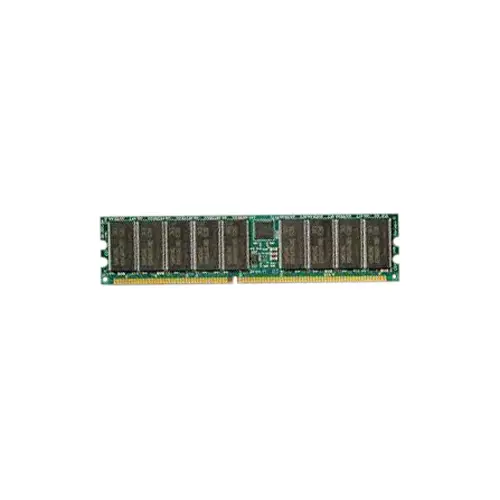
This 16GB DDR3-1333 RDIMM, operating at a low 1.35V with ECC and registered signal technology, is engineered for server platforms handling virtualization, memory-intensive databases, and other mission-critical workloads where data integrity is paramount. Its dual-rank x4 configuration enhances memory bandwidth utilization and signal stability in dense, multi-DIMM server deployments, while CL9 latency ensures efficient access times under sustained load.
1. ECC protection silently corrects single-bit memory errors, ensuring financial transactions and database records remain uncorrupted in always-on server environments.
2. Registered signal type stabilizes command and address lines across fully loaded memory channels, enabling seamless scaling to hundreds of gigabytes without compromising signal integrity.
3. The 16 GB module capacity packs enough headroom to host numerous virtual machines per server node, boosting consolidation ratios in dense private cloud deployments.
4. Dual Rank x4 organization interleaves accesses across multiple internal banks, elevating sustained throughput under the heavy parallel I/O typical of enterprise analytics workloads.
5. Low 1.35V operation trims power consumption per DIMM, directly lowering cooling costs and improving energy efficiency across large-scale server farms.
When you're running a dense virtualization cluster or an in-memory database like Redis, a single undetected bit flip doesn't just mean a crashed application—it means revenue loss and corrupted transactions. The Micron MT36KSF2G72PZ-1G4E1HF, a 16GB DDR3-1333 RDIMM, is built precisely for that reality. Its ECC technology continuously corrects single-bit errors and detects multi-bit failures, so background radiation or aging silicon won't silently poison your data. Coupled with a Registered buffer, the module enables your server to support three times more DIMMs per channel without signal degradation, directly translating to the massive memory footprint that virtualized workloads demand. In a VMware farm with dozens of VMs, or under the relentless read/write pressure of an in-memory cache, that stability means you aren’t getting paged at 3 a.m. for unexplained node failures. The dual-rank x4 organization further optimizes bank-level parallelism, maintaining bandwidth when multiple processes pound the memory bus, while the low 1.35V operation reduces thermal load inside 1U rack servers, preserving component longevity across your fleet.
General Virtualization
Deploy these 16 GB Registered ECC DDR3 modules in a balanced population across all memory channels to maximize throughput. For a dual‑socket server with three channels per CPU, install six identical DIMMs (96 GB total) to avoid NUMA penalties and leave room for moderate VM density. This configuration provides reliable memory isolation and error correction essential for hosting mixed workloads.
In‑Memory Database
Populate all DIMM slots with these low‑voltage (1.35 V) dual‑rank RDIMMs to achieve maximum capacity and sustained bandwidth. A fully‑loaded 12‑DIMM platform delivers 192 GB, enabling large in‑memory datasets while the ECC and registered signaling safeguard data integrity under heavy write pressure. Pair with a fast storage tier to reduce checkpoint latency.
High‑Performance Computing (HPC)
Use an even number of these modules per socket to exploit dual‑rank parallelism and channel interleaving. For bandwidth‑sensitive HPC jobs, install two DIMMs per channel (e.g., 12×16 GB across six channels) to reach 192 GB while maintaining balanced memory bandwidth. The 1333 MT/s speed and CL9 latency suit cluster nodes where capacity and power efficiency outweigh raw frequency, especially in dense, power‑constrained environments.
Rigorously validated; works in Dell PowerEdge R720/R620, HP DL380p Gen8, IBM x3650 M4.
Q: Can I mix this MT36KSF2G72PZ-1G4E1HF with other memory modules of different brands or speeds?
A: Mixing different brands or speeds is not recommended for registered server memory. It may cause instability or prevent the system from booting. For reliable operation, use identical RDIMMs with matching capacity, rank, and CAS latency.
Q: Is this memory compatible with my system?
A: This DDR3-1333 ECC Registered RDIMM is designed for servers. It supports platforms such as Intel Xeon E5-2600 v2 series or AMD Opteron 6300 series that require 240-pin, 1.35V registered DIMMs. Verify your server motherboard’s qualified vendor list.
Q: What is the recommended DIMM population order for optimal performance?
A: Follow your server motherboard manual for the correct sequence. Generally, populate identical RDIMMs per channel, filling blue slots first. Use balanced configurations across memory channels to maintain maximum throughput and ECC effectiveness.
Q: Does this module support overclocking or XMP profiles?
A: No. As a server-grade registered DIMM, this module operates strictly at JEDEC standard DDR3-1333 with CL9 timing. Overclocking and XMP are not supported, as stability and data integrity are prioritized in server environments.
Q: What warranty and typical failure rate can I expect?
A: This module includes a one-year warranty. Server RDIMMs undergo rigorous testing and exhibit very low failure rates. Typical annualized failure rate (AFR) is well under 1% under normal operating conditions, ensuring long-term reliability for critical workloads.