











 Secure payments
Standard refund policy
Trade Assurance
Secure payments
Standard refund policy
Trade Assurance
| Product Type | Memory Module |
|---|---|
| Compliance Standards | RoHS |
| Memory Capacity | 16 GB |
| Memory Technology | DDR3 |
| Product Voltage | 1.35V |
| RAM Speed | 1333MHz |
| RAM Standard | DDR3-1333/PC3-10600 |
| Error Identifying | ECC |
| Signal Type | Registered |
| Column Access Strobe (CAS) | CL9 |
| Rank | Dual Rank x4 |
| Quantity of Pins | 240-pin |
| RAM Genre | VLP RDIMM |
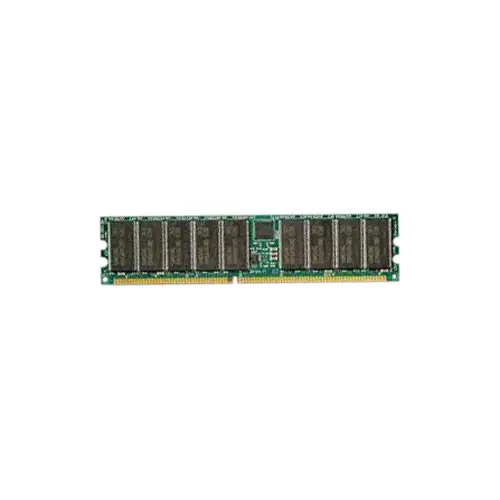
Built with a DDR3-1333 Registered ECC design and low 1.35V VLP form factor, this 16GB module is purpose-built for dense server environments where data integrity and power efficiency are critical, such as virtualization clusters and in-memory databases. Its dual-rank x4 organization and CL9 latency optimize memory bandwidth under heavy multi-DIMM loads while the registered signal type ensures stable command/address signaling across fully populated 240-pin platforms.
1. ECC error correction detects and corrects single-bit memory errors in real time, preventing silent data corruption in mission-critical database and virtualization workloads.
2. Registered signal type buffers command and address lines, enabling stable population of high-density DIMMs across all channels for maximum server memory scalability.
3. VLP RDIMM form factor reduces module height to fit into dense 1U and blade server chassis, improving airflow and cooling efficiency in tightly packed racks.
4. 16 GB capacity per module strikes a density sweet spot, allowing a dual-socket server to comfortably provision hundreds of lightweight containers or virtual machines without exhausting budget.
5. 1.35V low-voltage operation reduces overall power draw and thermal output in large server farms, helping data centers lower cooling costs and achieve better energy efficiency ratios.
When every transaction counts and downtime isn’t an option, this Micron 16GB DDR3-1333 VLP RDIMM (MT36KDZS2G72PZ-1G4D1) turns reliability from a specification into a business enabler. The registered signal buffer keeps command and address lines clean as you scale, so a virtualization host can confidently run dozens of VMs without signal degradation—meaning your multi-tenant cloud or on‑prem cluster won’t silently stumble under load. Integrated ECC continuously corrects single‑bit errors, which matters most in memory‑hungry in‑memory databases like Redis or SAP HANA, where a stray bit flip could corrupt a financial record or a user session. The dual‑rank x4 architecture interleaves access across banks, raising effective bandwidth for simultaneous read/write operations, so analytical queries return faster while concurrent workloads stay responsive. Operating at an energy‑efficient 1.35V in a very low‑profile form factor, it eases thermal stress inside dense 1U and blade servers, allowing sustained 24/7 operation without throttling. This isn’t just memory—it’s the foundation that keeps mission‑critical data accurate, available, and fast.
General Virtualization
For moderate VM density, install one 16 GB RDIMM per memory channel to sustain the full 1333 MT/s speed and balanced capacity. A dual-socket server with eight channels yields 128 GB, sufficient for 20–30 lightweight virtual machines. When running memory-hungry applications, scale to two modules per channel (256 GB total) while retaining registered ECC protection for multi-tenant stability.
In-Memory Database
Maximize capacity by populating every channel with two 16 GB modules if the platform supports two DIMMs per channel at 1333 MT/s. In an eight-channel dual-socket server, 16 modules provide 256 GB, ideal for sizeable in-memory datasets. The dual-rank x4 design and 1.35 V low-voltage operation help control power and cooling in dense configurations.
High Performance Computing
Prioritize memory bandwidth by using a single 16 GB RDIMM per channel to maintain 1333 MT/s with CL9 latency; eight channels deliver 128 GB. For capacity-heavy HPC jobs, a validated 2DPC setup with 256 GB is acceptable if minor frequency trade-offs are tolerable. The very-low-profile form factor enhances airflow in tightly packed nodes, and the registered buffer preserves signal integrity under load.
Rigorously tested for servers. Compatible with Dell PowerEdge R720/R620, HP DL380p Gen8, Lenovo RD530.
Q: Can I mix this MT36KDZS2G72PZ-1G4D1 with other memory modules of different brands or speeds?
A: Mixing different brands or speeds in server platforms is not recommended. For optimal stability and ECC functionality, use identical modules with the same part number, rank, and timing.
Q: Is this memory compatible with my server? Which Intel or AMD platforms are supported?
A: This DDR3-1333 Registered ECC VLP RDIMM works with Intel Xeon E5-2400/2600 v1/v2 and AMD Opteron 6300 series platforms supporting 1.35V registered memory. Verify your server's QVL.
Q: What is the recommended DIMM population order for optimal performance?
A: For optimal performance, populate memory channels symmetrically. Typically, install identical DIMMs starting with the first slot of each channel (e.g., A1, B1, C1) to balance interleaving and maximize bandwidth.
Q: Does this module support overclocking or XMP profiles?
A: No. This is a JEDEC-compliant server-grade Registered DIMM. It does not support overclocking or XMP profiles. It operates strictly at DDR3-1333 with CL9 at 1.35V for maximum reliability.
Q: What warranty and typical failure rate can I expect?
A: This module comes with a 1-year warranty. As an enterprise-class ECC RDIMM, it has a very low annualized failure rate (AFR) under 0.5% when operated within specified conditions.