











 Secure payments
Standard refund policy
Trade Assurance
Secure payments
Standard refund policy
Trade Assurance
| Product Type | Memory Module |
|---|---|
| Compliance Standards | RoHS |
| Memory Capacity | 16 GB |
| Memory Technology | DDR3 |
| Product Voltage | 1.35V |
| RAM Speed | 1333MHz |
| RAM Standard | DDR3-1333/PC3-10600 |
| Error Identifying | ECC |
| Signal Type | Registered |
| Column Access Strobe (CAS) | CL9 |
| Rank | Dual Rank x4 |
| Quantity of Pins | 240-pin |
| RAM Genre | RDIMM |
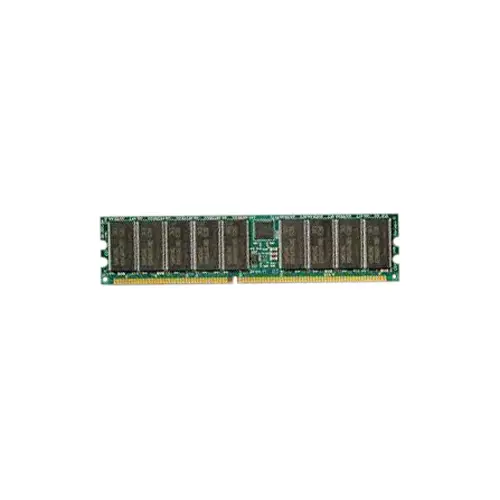
This 16GB DDR3-1333 RDIMM, operating at a low 1.35V with ECC and registered signal technology, is engineered for server platforms running memory-intensive workloads such as virtualization and in-memory databases. Its dual-rank x4 organization and CL9 latency deliver reliable data integrity and optimized rank interleaving, ensuring stable throughput in high-capacity, multi-DIMM configurations.
1. 16GB capacity per module allows dense memory configurations, enabling higher virtual machine counts per host without sacrificing responsiveness in clustered environments.
2. ECC protection detects and corrects single-bit errors in real time, preserving data integrity for financial transactions and long-running analytical workloads.
3. Registered signal buffering stabilizes electrical loads across large memory arrays, which is essential for maintaining uptime in multi-socket server deployments.
4. 1.35V low-voltage operation cuts overall power draw and thermal output, translating to measurable savings on energy and cooling in scale-out data centers.
5. Dual Rank x4 organization interleaves access cycles to keep memory bandwidth high under concurrent requests, preventing throughput dips during heavy database operations.
Engineered for mission-critical servers, the Micron MT36KSF2G72PZ-1G4E1HG is a 16GB DDR3-1333 Registered DIMM with ECC and a low 1.35V operating voltage. In your virtualized cluster, the Registered signal technology buffers address and command lines, enabling the system to support a far greater number of memory modules without signal degradation. This translates to higher virtual machine density and rock-steady stability under heavy consolidation workloads. Simultaneously, the dual-rank x4 organization activates rank interleaving, noticeably boosting memory bandwidth and reducing access latency for in-memory databases like SAP HANA or Redis. The integrated ECC continuously corrects single-bit errors caused by cosmic radiation or electrical noise, a non-negotiable safeguard that prevents silent data corruption in financial transaction logs or patient records. Operating at just 1.35V rather than the standard 1.5V, this module dramatically reduces power consumption and thermal output across your fleet, shrinking cooling costs and extending hardware longevity. For your data center, it means uncompromising integrity, measurable scalability, and a substantially lower total cost of ownership.
Server Memory Identified
This 16 GB DDR3-1333 ECC Registered RDIMM (1.35V, dual-rank x4) is designed for server platforms, where reliability and data integrity are paramount. Below is capacity planning guidance for common workloads.
General Virtualization
Virtualized environments demand balanced capacity and memory bandwidth across CPU sockets. Install pairs of these 16 GB RDIMMs to populate at least one DIMM per memory channel on each processor, ensuring even distribution. A typical dual-socket server with 8 channels per CPU would start with 16 modules (256 GB total), allowing comfortable overcommit for moderate VM densities while maintaining NUMA locality.
In-Memory Database
For in-memory databases (e.g., Redis, SAP HANA), capacity is king. Maximize the server’s DIMM slots with identical 16 GB modules, filling all channels equally to avoid unbalanced configurations that degrade performance. A fully loaded dual-socket server with 24 DIMM slots yields 384 GB, enabling large datasets to reside entirely in RAM. Ensure the platform supports 1.35V low-voltage DIMMs for reduced power and heat, critical in densely packed systems.
High Performance Computing (HPC)
HPC workloads are sensitive to memory bandwidth and latency. Use these dual-rank RDIMMs in a balanced configuration, placing one DIMM per channel initially to achieve maximum rated speed (1333 MT/s). Populating two DIMMs per channel may drop frequency to 1066 MT/s on many DDR3 platforms; reserve that only if capacity outstrips bandwidth needs. For dual-socket nodes, configure 8 or 16 identical modules to saturate all memory channels and enable efficient interleaving.
Rigorously tested server memory for Dell PowerEdge R720/R620, HP DL380p Gen8, Lenovo System x3650 M4.
Q: Can I mix this MT36KSF2G72PZ-1G4E1HG with other memory modules of different brands or speeds?
A: Mixing different brands or speeds is not recommended. It may cause instability and disable ECC functionality, which is critical for server environments. Use identical modules to ensure reliable operation.
Q: Is this memory compatible with my system?
A: This is a DDR3-1333 registered ECC RDIMM designed for server platforms. It requires a motherboard with a 240-pin slot and a chipset supporting registered memory, such as Intel Xeon E5-series or AMD Opteron systems.
Q: What is the recommended DIMM population order for optimal performance?
A: Refer to your server motherboard manual. Generally, populate identical DIMMs per channel starting with the first slot to balance memory channels and ensure full ECC and bandwidth utilization.
Q: Does this module support overclocking or XMP profiles?
A: No. Server-grade RDIMMs are designed for JEDEC standards and stability. They do not support overclocking or XMP profiles, as data integrity and error correction take priority over speed.
Q: What warranty and typical failure rate can I expect?
A: This module includes a one-year warranty. Enterprise-class registered memory has a very low annualized failure rate, typically well below that of consumer parts when operated within specifications.